

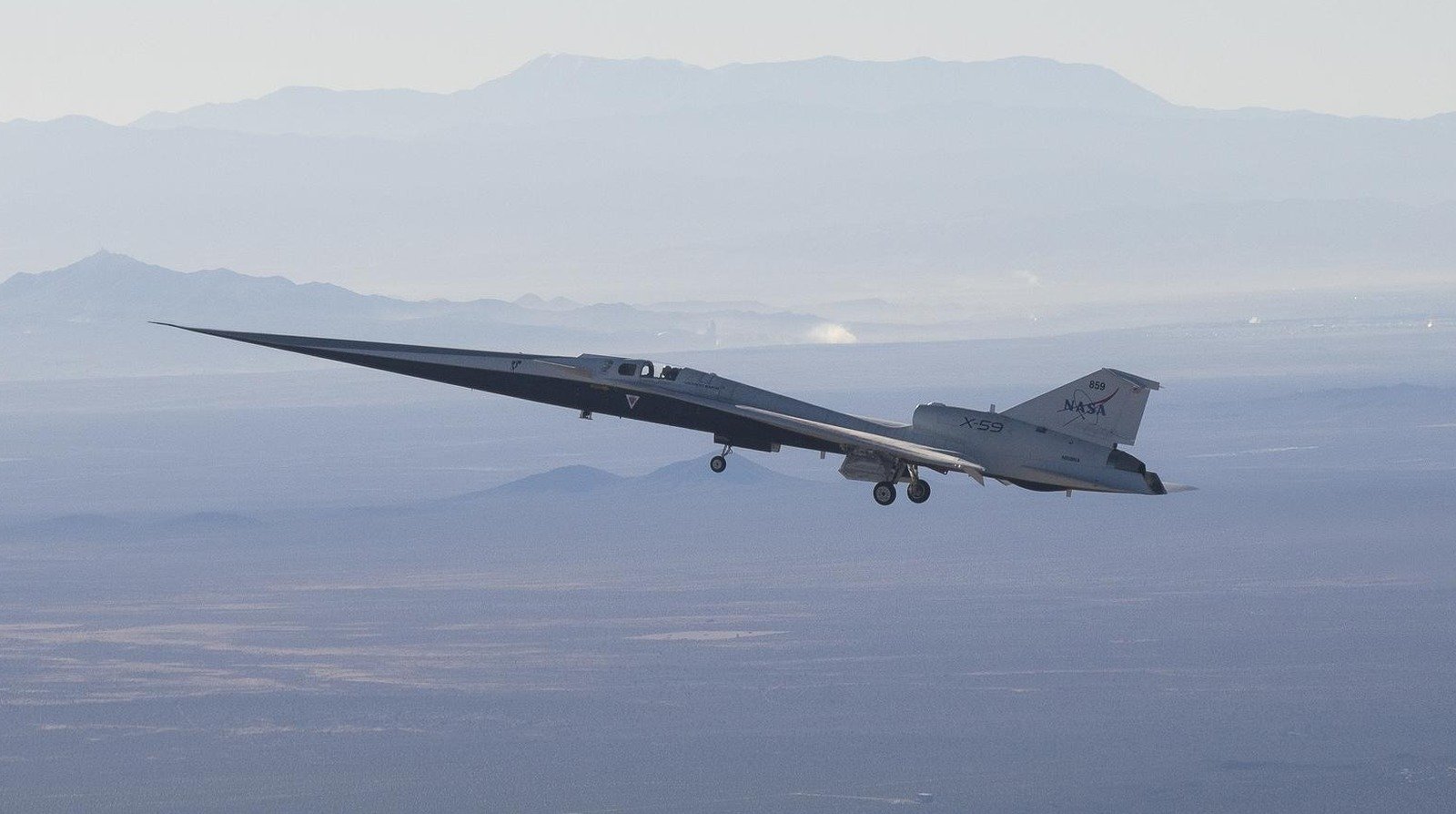
NASA’s Ultra-Quiet X-59 Aircraft Just Took To The Skies For The First Time
Humankind is always on a quest for speed: You can ride the fastest rollercoaster in the world, the Formula Rossa, at Ferrari World in Abu Dhabi, and the fastest land speed record was achieved in 1997 in Nevada when Andy Green hit 763 mph. But what about in the air? Humans first broke the sound barrier in 1947 when U.S. Air Force test pilot Chuck Yeager achieved supersonic flight in an experimental aircraft, the Bell X-1. This is an amazing feat considering that only 44 years prior, the Wright Flyer had a top speed of a mere 30 mph in the air. Now, a new generation of supersonic aircraft is under development, including Lockheed Martin’s X-59.
Supersonic flight reached the commercial sector decades ago with the Concorde, the first passenger plane that traveled at speeds faster than sound. The Concorde began ferrying passengers across the Atlantic Ocean in 1976 before being retired in 2003 for various reasons, including high costs. But the aircraft’s sonic boom was also an issue, leading to operational restrictions. The Concorde was only allowed to fly over the ocean because the sonic boom was so disruptive, able to rattle and sometimes even break windows. Several aeronautics companies are at work on modern supersonic aircraft that mitigate that boom, including Lockheed Martin in partnership with NASA. Its X-59, a next-generation supersonic aircraft, recently completed a successful test flight. This single-seat plane is endeavoring to change the future of supersonic passenger flight.
The X-59
Lockheed Martin’s research and development unit, the Skunk Works division, developed the X-59 in a partnership with NASA’s Quesst Mission. Quesst, by the way, stands for Quiet Supersonic Technology, and the mission is intended to prove that we can design technology that will “fly supersonic, or faster than the speed of sound, without generating loud sonic booms,” according to NASA. The goal is to prove to regulators that supersonic travel can be achieved more quietly in order to lift the ban on commercial supersonic travel over land.
The X-59 is a demonstrator prototype that has a wingspan of about 30 feet and is about 100 feet long. It’s an experimental plane that is designed to separate the shock waves that make that loud sonic boom. This is achieved by managing the flow of air so that it isn’t concentrated solely on the nose, but also flows over the hull and wings. This helps to direct the air wave up, resulting in a sonic boom that is more like the sound of a car door closing, at least to those of us on the ground. The first flight proved the X-59’s flightworthiness and did not reach supersonic speeds, but Lockheed Martin reports that the aircraft is capable of speeds up to 925 mph. Testing will continue in collaboration with NASA, including eventual supersonic flights over populated areas.
Other supersonic aircraft under development
With the success of the X-59, NASA hopes to encourage efforts to develop supersonic commercial aviation capable of overland flights, and Lockheed Martin and NASA are not the only ones at work on new, supersonic technology for commercial flight. Spike Aerospace is developing the Spike S-512 Diplomat, a supersonic jet intended for the business market. The company promises flights from New York City to London in under four hours. The aircraft is designed with the same goal as the X-59 — to reduce the sonic boom to a quiet thump through advanced engineering principles. The Spike S-512 Supersonic Diplomat is designed to hold up to 18 passengers. The company conducted test flights on a smaller prototype in 2017 but has yet to get the S-512 Supersonic Diplomat in the air. The company stated in 2025 that it is at work on an “enhanced study to further refine the S-512 Diplomat’s aerodynamics, cabin configuration, and low-boom performance.”
Boom Supersonic is also developing a supersonic commercial plane and already has orders from several airlines, including United Airlines and American Airlines. Its demonstrator aircraft, the Boom XB-1, achieved a supersonic flight in early 2025, a first step in the development of the larger Boom Overture. These supersonic planes are designed with the “Boomless Cruise,” which means that supersonic boom doesn’t reach the ground. Ultimately, the Concorde is a closed chapter in aviation history, but Lockheed Martin and others continue to drive innovation in pursuit of commercial supersonic flight.
