

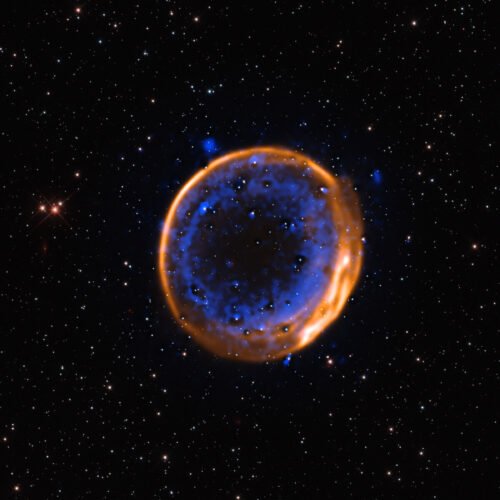
New evidence that some supernovae may be a “double detonation”
It may be possible to blow up a white dwarf before it reaches a critical mass.
Type Ia supernovae are critical tools in astronomy, since they all appear to explode with the same intensity, allowing us to use their brightness as a measure of distance. The distance measures they’ve given us have been critical to tracking the expansion of the Universe, which led to the recognition that there’s some sort of dark energy hastening the Universe’s expansion. Yet there are ongoing arguments over exactly how these events are triggered.
There’s widespread agreement that type Ia supernovae are the explosions of white dwarf stars. Normally, these stars are composed primarily of moderately heavy elements like carbon and oxygen, and lack the mass to trigger additional fusion. But if some additional material is added, the white dwarf can reach a critical mass and reignite a runaway fusion reaction, blowing the star apart. But the source of the additional mass has been somewhat controversial.
But there’s an additional hypothesis that doesn’t require as much mass: a relatively small explosion on a white dwarf’s surface can compress the interior enough to restart fusion in stars that haven’t yet reached a critical mass. Now, observations of the remains of a supernova provide some evidence of the existence of these so-called “double detonation” supernovae.
Deconstructing white dwarfs
White dwarfs are the remains of stars with a similar mass to our Sun. After having gone through periods during which hydrogen and helium were fused, these tend to end up as carbon and oxygen-rich embers: hot due to their history, but incapable of reaching the densities needed to fuse these elements. Left on their own, these stellar remnants will gradually cool.
But many stars are not left on their own; they exist in binary systems with a companion, or even larger systems. These companions can provide the material needed to boost white dwarfs to the masses that can restart fusion. There are two potential pathways for this to happen. Many stars go through periods where they are so large that their gravitational pull is barely enough to hold on to their outer layers. If the white dwarf orbits closely enough, it can pull in material from the other star, boosting its mass until it passes a critical threshold, at which point fusion can restart.
In other cases, another member of the system will go on to form a second white dwarf. If gravitational instabilities bring these two objects together, then their collision will create a single object with a much higher mass. This will also restart fusion, leading to an explosion.
We have found evidence for both of these events happening. However, there are some questions about whether they happen often enough to explain the frequency of type Ia supernovae that we see. Both mechanisms require stars of sufficient mass orbiting within a reasonably close distance for either mass transfer or a collision to occur. So, astronomers have been considering other ways of blowing up a white dwarf.
The most promising option appears to be a double detonation. This can also require the transfer of some helium-rich material from another companion, but it can also occur if the white dwarf ends up with some unfused helium left on its surface. Regardless of how it ends up there, the helium can start fusing if enough of it pools up, or simply if its movement causes a sufficiently high local density in one region. However it happens, once fusion starts, the entire surface of the white dwarf will quickly follow, creating detonation number one.
That in turn will create compression in the carbon-oxygen portion of the white dwarf, pushing it past the density needed for that to start fusing. Once again, the initiation of fusion heats and compresses nearby material, creating a chain reaction that triggers widespread fusion in the white dwarf, blowing it to pieces as part of detonation two.
A shell game
The key thing about this is that it allows the explosion of white dwarfs before they reach a mass sufficient enough to trigger the fusion of their carbon and oxygen. Instead, it can potentially happen any time enough helium gathers on their surface. A double-detonation event would also be very difficult to detect, as the explosions would happen in rapid succession, and the environment in the immediate surroundings of a type Ia supernova is going to be complex and difficult to resolve.
That said, the two detonations involve the fusion of different elements, and therefore are going to end up producing different materials. “The detonations in the carbon-oxygen core and the helium-rich shell result in qualitatively different yield products,” the researchers behind the new work write in a paper describing it. In the paper, they focus on calcium, which there are two ways of producing. One is from the outer shell of helium, via fusion before the detonation dilutes the material. A second batch of calcium is produced through the fusion of the core material as it’s ejected in the supernova, which prevents further fusion events from converting it to even heavier elements. (Material deeper in the core does end up getting fused into heavier material.)
Because it’s produced by both of the detonations, models predict that the expanding sphere of debris will contain two different shells of calcium, with some space in between them. To find evidence for these shells, the researchers checked an older supernova remnant, which allows enough time for the movement of material to separate the shells by enough distance that they can be resolved from Earth.
They focused their observations on a supernova remnant named SNR 0509-67.5, located in the nearby Large Magellanic Cloud. SNR 0509-67.5 is estimated to be a bit over 300 years old, meaning material has had enough time to move a significant distance away from the site of the explosion. Imaging using a spectrograph on the Very Large Telescope allowed them to resolve what, in effect, was a spherical sulfur sandwich, with the role of the bread played by calcium. In other words, if you were to travel away from the site of the explosion, you would first hit a layer of ionized calcium, followed by ionized sulfur, and then run into a second layer of ionized calcium.
This is exactly what computer models that simulate double detonations predict. So, the researchers suggest it is strong support for that hypothesis. The researchers say that the details suggest that SNR 0509-67.5 was a white dwarf with roughly the same mass as the Sun when it exploded, and that its explosion was likely triggered by the detonation of a helium shell with only three percent of the Sun’s mass.
While the physics of the process itself are interesting, the key question this raises is whether type Ia supernovae really are all equally bright. If they can detonate with substantially less mass than is needed for direct ignition of the core, then it’s possible that some of them could be considerably less bright. However, the research team notes that there are additional complications: If there’s a second white dwarf orbiting sufficiently close, then the debris from the supernova could also trigger a double detonation in that one, potentially with a timing and separation that would make the two impossible to distinguish. So, we likely need to do a fair bit of modeling to fully understand the consequences of these findings.
Nature Astronomy, 2025. DOI: 10.1038/s41550-025-02589-5 (About DOIs).
John is Ars Technica’s science editor. He has a Bachelor of Arts in Biochemistry from Columbia University, and a Ph.D. in Molecular and Cell Biology from the University of California, Berkeley. When physically separated from his keyboard, he tends to seek out a bicycle, or a scenic location for communing with his hiking boots.
