

Nubia RedMagic 10S Pro Smartphone Review: Top hardware for a fast-paced gamer – NotebookCheck.net Reviews
The RedMagic 10S Pro is a powerful smartphone for anyone on the lookout for fast hardware and enjoys gaming. With its responsive display and additional sensor buttons, it offers real added value in these areas.
There are no cutouts in the display for the selfie camera, which lends to an uninterrupted viewing experience; the rear cameras sit absolutely flush with the body as well — neither of which can be found on any other competitor in this price range.
The fast Snapdragon 8 Elite Leading Version nominally makes the Nubia RedMagic 10S Pro the fastest smartphone. However, it is often unable to exploit this advantage as the 10S Pro cannot always cope with the heat generated despite the fan being active. Moreover, the surface temperatures can rise quite high.
A few compromises also have to be made in everyday use, as the RedMagic 10S Pro does not support eSIM or wireless charging. Although the update cycle has been extended, it is still not optimal, and the cameras are only in the mid-range.
Pros
+ under-interference-free and responsive display
+ high performance
+ fast memory
+ additional sensor buttons
+ long battery life
Cons
– low IP certification
– neither eSIM support nor wireless charging
– irregular updates
– can get very hot
The tested variant of the Nubia RedMagic 10S Pro can be purchased for $799 directly from the manufacturer’s online store, which also stocks other color and memory variants.
Alternatively, the 10S Pro can also be had from Amazon DE and Amazon US.
REDMAGIC 10S Pro Smartphone 5G, 144Hz Gaming Phone, 6.85″ 1.5K AMOLED, Under Display Camera, Android Phone, 16+512GB, Dual-Sim, Unlocked Phone Silver
The RedMagic 10S Pro is an upgrade of the RedMagic 10 Pro and offers a faster SoC, RAM and internal memory as well as nominally more powerful camera sensors.
It starts at an RRP of 649 euros for the entry-level model with 12/256 GB and climbs up to 999 euros for the model with 24 GB RAM and 1 TB internal storage.
Display
6.85 inch 19.89:9, 2688 x 1216 pixel 431 PPI, Capacitive Touchscreen, AMOLED, Corning Gorilla Glass, glossy: yes, HDR, 144 Hz
Storage
512 GB UFS 4.1 Flash, 512 GB
, 472.21 GB free
Connections
1 USB 3.1 Gen2, USB-C Power Delivery (PD), 1 HDMI, 1 DisplayPort, 1 Infrared, Audio Connections: 3.5mm, 1 Fingerprint Reader, NFC, Brightness Sensor, Sensors: accelerometer, gyro, proximity, compass, G-Sensor, OTG, IR-Blaster
Networking
Wi-Fi 7 (a/b/g/n = Wi-Fi 4/ac = Wi-Fi 5/ax = Wi-Fi 6/ Wi-Fi 6E 6 GHz be = Wi-Fi 7), Bluetooth 5.4, 2G (850, 900, 1800, 1900 MHz), 3G (Band 1, 2, 4, 5, 6, 8, 19), LTE (Band 1, 2, 3, 4, 5, 7, 8, 12, 17, 18, 19, 20, 26, 28a, 28b, 34, 38, 39, 40, 41, 42, 66), 5G-Sub6 (Band 1, 2, 3, 5, 7, 8, 20, 26, 28, 38, 40, 41, 66, 71, 77, 78), Dual SIM, LTE, 5G, GPS
Size
height x width x depth (in mm): 8.9 x 163.42 x 76.14 ( = 0.35 x 6.43 x 3 in)
Battery
7050 mAh Lithium-Ion, Dual Cell, Battery life in cycles: 1200
Charging
fast charging / Quickcharge
Operating System
Android 15
Camera
Primary Camera: 50 MPix (f/1.88, 23 mm, OV50E40, 1/1.55″, OIS) + 50 MPix (f/2.0, 13 mm, OV50D40, 1/2.88″) + 2 MPix; Camera2-API-Level: Level 3
Secondary Camera: 16 MPix (f/2.0, OV16EQ, 1/2.77″)
Additional features
Speakers: Dual, Keyboard: OnScreen, 80W-Charger, USB-C-Cabel, SIM-Tool, RedMagicOS 10.5, 12 Months Warranty, Shoulder Trigger Buttons (520 Hz) | Bluetooth Audio Codecs: SBC, AAC, aptX, aptX HD, aptX Adaptive, aptX TWS+, LDAC, Opus, LC3, LHDC | GNSS: GPS (L1, L2, L5), Glonass (L1), BeiDou (B1l, B1C, B2a, B2b), Galileo (E1, E5a, E5b) | HDR: HLG, HDR10 | DRM Widevine L1 | IP54 | FAN up to 23000 RPM | max. charging speed: 80 W (wired)
Weight
229 g ( = 8.08 oz / 0.5 pounds) ( = 0 oz / 0 pounds)
Note: The manufacturer may use components from different suppliers including display panels, drives or memory sticks with similar specifications.
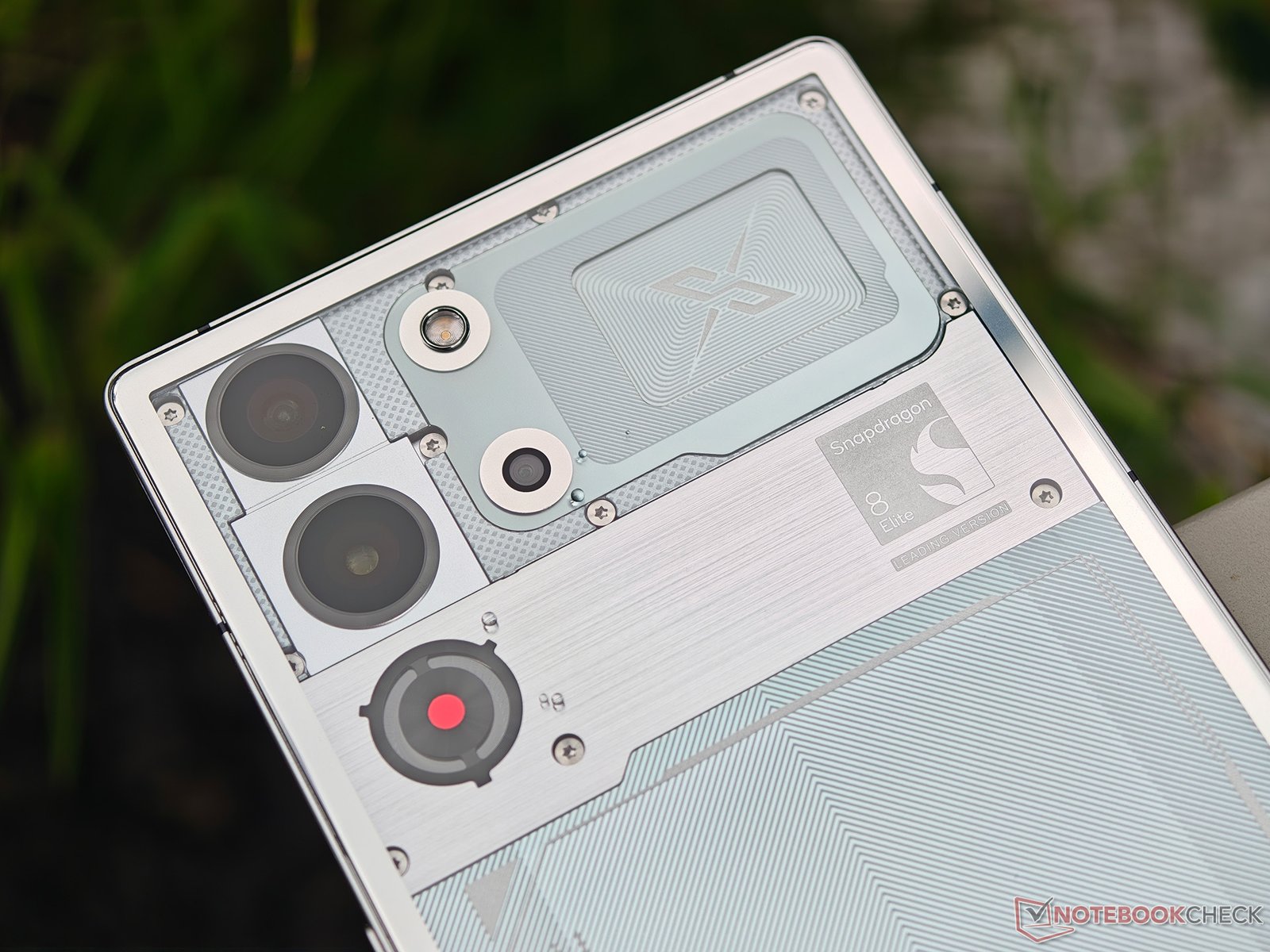
The RedMagic 10S Pro once again uses the bezel design of its predecessor and comes in three new color options: Nightfall, Dusk, and Moonlight. The workmanship is of a high quality, and the phone impresses with narrow display edges although it creaks slightly when twisted.
The cameras are located under the rear glass cover, so there is no camera bump. Unfortunately, the gaming phone is neither dustproof nor waterproof and only comes with an IP54 certification.
The onboard features are impressive. The RedMagic 10S Pro is powered by the Snapdragon 8 Elite Leading Version, with a higher peak clock rate for both the CPU and GPU than the standard variant.
In addition, there is state-of-the-art UFS 4.1 storage, LPDDR5T RAM, and USB 3.2 Gen2 connectivity — that’s as good as it gets in these areas at the moment. There are also two sensor buttons that can be used for control in games.
The integrated fan can be optionally activated, but it hardly makes any difference. With noise levels up to 44 dB(A), the fan can get quite loud.
The RedMagic 10S Pro offers good communication hardware that includes 5G and Wi-Fi 7, but the voice quality is only average and there is no eSIM support. The linear vibration motor provides crisp feedback, and an optical fingerprint sensor is available for biometric security.
The RedMagic 10S Pro comes with Google’s Android 15 and RedMagicOS 10.5. In the EU and the UK, the update period is extended to five years (three years, otherwise), which is still below the EU requirements. At the time of testing, the security updates were up to date as of May 1, 2025.
The outer packaging contains a lot of plastic and RedMagic does not provide any information on sustainability. In the EU energy label the battery is indicated as replaceable, but this cannot be done by the user as Nubia offers neither suitable spare parts nor instructions.
The front camera of the RedMagic 10S Pro is located under the display, allowing an uninterrupted view of the content. However, the quality is rather mediocre, with many details drowning in a coarse sea of pixels while the photos are highly saturated.
Although the rear lenses offer high resolutions for the most part, the image quality here is rather mediocre and at the level of a mid-range smartphone. Zoom shots are not good even at low magnification levels and a 10x zoom is already the end of the line.
Videos are recorded on the front camera in full HD 30 fps. The main camera on the back allows recordings in 8K 30 fps and 4k 60 fps among others.
8.8 ∆E
8.7 ∆E
5.7 ∆E
9.7 ∆E
7.9 ∆E
5.4 ∆E
9.6 ∆E
9.6 ∆E
11.9 ∆E
5.6 ∆E
5.7 ∆E
5.7 ∆E
8.5 ∆E
9.7 ∆E
13.2 ∆E
3.9 ∆E
11.6 ∆E
13.4 ∆E
6.4 ∆E
2.8 ∆E
7 ∆E
6.7 ∆E
2.2 ∆E
4.1 ∆E
The 6.85-inch AMOLED display of the RedMagic 10S Pro has a refresh rate of up to 144 Hz and a multi-touch sampling rate of up to 960 Hz. The resolution is high, ensuring an appealing pixel density. The factory color calibration is impressive as well.
The brightness of the panel is high but does not come close to the top values of the competition. The minimum luminosity is also slightly higher.
The display flickers at a basic frequency of 120 Hz, but also uses high-frequency PWM dimming, which flickers at 2,083 Hz at minimum display brightness and should therefore be comparatively easy on the eyes.
| 1414 cd/m² |
1436 cd/m² |
1516 cd/m² |
||
| 1412 cd/m² |
1442 cd/m² |
1539 cd/m² |
||
| 1403 cd/m² |
1421 cd/m² |
1497 cd/m² |
||
Distribution of brightness
tested with X-Rite i1Pro 3
Maximum: 1539 cd/m² (Nits) Average: 1453.3 cd/m² Minimum: 3.44 cd/m²
Brightness Distribution: 91 %
Center on Battery: 1442 cd/m²
Contrast: ∞:1 (Black: 0 cd/m²)
ΔE ColorChecker Calman: 2 | ∀{0.5-29.43 Ø4.82}
ΔE Greyscale Calman: 2.3 | ∀{0.09-98 Ø5.1}
98.6% sRGB (Calman 2D)
Gamma: 2.38
CCT: 6284 K
| Nubia RedMagic 10S Pro AMOLED, 2688×1216, 6.9″ |
Asus ROG Phone 9 Pro AMOLED, 2400×1080, 6.8″ |
Samsung Galaxy S25 AMOLED, 2340×1080, 6.2″ |
Xiaomi 15 OLED, 2670×1200, 6.4″ |
|
|---|---|---|---|---|
| Screen |
25% |
-17% |
0% |
|
| Brightness middle |
1442 |
1682 17% |
1301 -10% |
1021 -29% |
| Brightness |
1453 |
1685 16% |
1311 -10% |
1018 -30% |
| Brightness Distribution |
91 |
97 7% |
98 8% |
98 8% |
| Black Level * | ||||
| Colorchecker dE 2000 * |
2 |
1.1 45% |
3.1 -55% |
1.3 35% |
| Colorchecker dE 2000 max. * |
3.3 |
2.1 36% |
4.4 -33% |
2.9 12% |
| Greyscale dE 2000 * |
2.3 |
1.7 26% |
2.3 -0% |
2.2 4% |
| Gamma |
2.38 92% |
2.27 97% |
2.01 109% |
2.25 98% |
| CCT |
6284 103% |
6581 99% |
6454 101% |
6658 98% |
* … smaller is better
Screen Flickering / PWM (Pulse-Width Modulation)
ℹ
To dim the screen, some notebooks will simply cycle the backlight on and off in rapid succession – a method called Pulse Width Modulation (PWM) . This cycling frequency should ideally be undetectable to the human eye. If said frequency is too low, users with sensitive eyes may experience strain or headaches or even notice the flickering altogether.
| Screen flickering / PWM detected | 120 Hz Amplitude: 13.92 % Secondary Frequency: 2083 Hz |
||
|
The display backlight flickers at 120 Hz (worst case, e.g., utilizing PWM) . The frequency of 120 Hz is very low, so the flickering may cause eyestrain and headaches after extended use. In comparison: 53 % of all tested devices do not use PWM to dim the display. If PWM was detected, an average of 8301 (minimum: 5 – maximum: 343500) Hz was measured. |
|||
Display Response Times
ℹ
Display response times show how fast the screen is able to change from one color to the next. Slow response times can lead to afterimages and can cause moving objects to appear blurry (ghosting). Gamers of fast-paced 3D titles should pay special attention to fast response times.
| ↔ Response Time Black to White | ||
|---|---|---|
| 1 ms … rise ↗ and fall ↘ combined | ↗ 0.49 ms rise | |
| ↘ 0.5135 ms fall | ||
| The screen shows very fast response rates in our tests and should be very well suited for fast-paced gaming. In comparison, all tested devices range from 0.1 (minimum) to 240 (maximum) ms. » 3 % of all devices are better. This means that the measured response time is better than the average of all tested devices (20.4 ms). |
||
| ↔ Response Time 50% Grey to 80% Grey | ||
| 1.08 ms … rise ↗ and fall ↘ combined | ↗ 0.468 ms rise | |
| ↘ 0.609 ms fall | ||
| The screen shows very fast response rates in our tests and should be very well suited for fast-paced gaming. In comparison, all tested devices range from 0.165 (minimum) to 636 (maximum) ms. » 3 % of all devices are better. This means that the measured response time is better than the average of all tested devices (32 ms). |
||
| Networking | |
| Nubia RedMagic 10S Pro Wi-Fi 7 |
|
| iperf3 transmit AXE11000 6GHz |
|
| iperf3 receive AXE11000 6GHz |
|
| Asus ROG Phone 9 Pro Wi-Fi 7 |
|
| iperf3 transmit AXE11000 |
|
| iperf3 receive AXE11000 |
|
| iperf3 transmit AXE11000 6GHz |
|
| iperf3 receive AXE11000 6GHz |
|
| Samsung Galaxy S25 Wi-Fi 7 |
|
| iperf3 transmit AXE11000 |
|
| iperf3 receive AXE11000 |
|
| iperf3 transmit AXE11000 6GHz |
|
| iperf3 receive AXE11000 6GHz |
|
| Xiaomi 15 Wi-Fi 7 |
|
| iperf3 transmit AXE11000 |
|
| iperf3 receive AXE11000 |
|
| iperf3 transmit AXE11000 6GHz |
|
| iperf3 receive AXE11000 6GHz |
|
| Average Wi-Fi 7 |
|
| iperf3 transmit AXE11000 |
|
| iperf3 receive AXE11000 |
|
| iperf3 transmit AXE11000 6GHz |
|
| iperf3 receive AXE11000 6GHz |
|
| Average of class Smartphone |
|
| iperf3 transmit AXE11000 |
|
| iperf3 receive AXE11000 |
|
| iperf3 transmit AXE11000 6GHz |
|
| iperf3 receive AXE11000 6GHz |
|
| Geekbench 6.4 | |
| Single-Core | |
| Asus ROG Phone 9 Pro Qualcomm Snapdragon 8 Elite, Adreno 830, 24576 |
|
| Nubia RedMagic 10S Pro Qualcomm Snapdragon 8 Elite, Adreno 830, 16384 |
|
| Samsung Galaxy S25 Qualcomm Snapdragon 8 Elite for Galaxy, Adreno 830, 12288 |
|
| Average Qualcomm Snapdragon 8 Elite (2309 – 3228, n=24) |
|
| Xiaomi 15 Qualcomm Snapdragon 8 Elite, Adreno 830, 12288 |
|
| Average of class Smartphone (196 – 3479, n=204, last 2 years) |
|
| Multi-Core | |
| Asus ROG Phone 9 Pro Qualcomm Snapdragon 8 Elite, Adreno 830, 24576 |
|
| Samsung Galaxy S25 Qualcomm Snapdragon 8 Elite for Galaxy, Adreno 830, 12288 |
|
| Nubia RedMagic 10S Pro Qualcomm Snapdragon 8 Elite, Adreno 830, 16384 |
|
| Xiaomi 15 Qualcomm Snapdragon 8 Elite, Adreno 830, 12288 |
|
| Average Qualcomm Snapdragon 8 Elite (7656 – 10401, n=24) |
|
| Average of class Smartphone (830 – 10401, n=204, last 2 years) |
|
| 3DMark | |
| Wild Life Unlimited Score | |
| Nubia RedMagic 10S Pro Qualcomm Snapdragon 8 Elite, Adreno 830, 16384 |
|
| Samsung Galaxy S25 Qualcomm Snapdragon 8 Elite for Galaxy, Adreno 830, 12288 |
|
| Xiaomi 15 Qualcomm Snapdragon 8 Elite, Adreno 830, 12288 |
|
| Average Qualcomm Snapdragon 8 Elite (19436 – 28053, n=21) |
|
| Asus ROG Phone 9 Pro Qualcomm Snapdragon 8 Elite, Adreno 830, 24576 |
|
| Average of class Smartphone (271 – 28053, n=187, last 2 years) |
|
| Steel Nomad Light Score | |
| Nubia RedMagic 10S Pro Qualcomm Snapdragon 8 Elite, Adreno 830, 16384 |
|
| Average Qualcomm Snapdragon 8 Elite (1883 – 2849, n=23) |
|
| Xiaomi 15 Qualcomm Snapdragon 8 Elite, Adreno 830, 12288 |
|
| Asus ROG Phone 9 Pro Qualcomm Snapdragon 8 Elite, Adreno 830, 24576 |
|
| Average of class Smartphone (132 – 2849, n=108, last 2 years) |
|
| Samsung Galaxy S25 Qualcomm Snapdragon 8 Elite for Galaxy, Adreno 830, 12288 |
|
| Steel Nomad Light Unlimited Score | |
| Nubia RedMagic 10S Pro Qualcomm Snapdragon 8 Elite, Adreno 830, 16384 |
|
| Average Qualcomm Snapdragon 8 Elite (1697 – 2838, n=23) |
|
| Xiaomi 15 Qualcomm Snapdragon 8 Elite, Adreno 830, 12288 |
|
| Asus ROG Phone 9 Pro Qualcomm Snapdragon 8 Elite, Adreno 830, 24576 |
|
| Average of class Smartphone (132 – 2838, n=107, last 2 years) |
|
| GFXBench | |
| on screen Aztec Ruins Normal Tier Onscreen | |
| Asus ROG Phone 9 Pro Qualcomm Snapdragon 8 Elite, Adreno 830, 24576 |
|
| Xiaomi 15 Qualcomm Snapdragon 8 Elite, Adreno 830, 12288 |
|
| Samsung Galaxy S25 Qualcomm Snapdragon 8 Elite for Galaxy, Adreno 830, 12288 |
|
| Average Qualcomm Snapdragon 8 Elite (50 – 166, n=22) |
|
| Nubia RedMagic 10S Pro Qualcomm Snapdragon 8 Elite, Adreno 830, 16384 |
|
| Average of class Smartphone (6.2 – 166, n=201, last 2 years) |
|
| 1920×1080 Aztec Ruins Normal Tier Offscreen | |
| Samsung Galaxy S25 Qualcomm Snapdragon 8 Elite for Galaxy, Adreno 830, 12288 |
|
| Xiaomi 15 Qualcomm Snapdragon 8 Elite, Adreno 830, 12288 |
|
| Asus ROG Phone 9 Pro Qualcomm Snapdragon 8 Elite, Adreno 830, 24576 |
|
| Average Qualcomm Snapdragon 8 Elite (166 – 332, n=22) |
|
| Nubia RedMagic 10S Pro Qualcomm Snapdragon 8 Elite, Adreno 830, 16384 |
|
| Average of class Smartphone (3.4 – 332, n=201, last 2 years) |
|
| on screen Aztec Ruins High Tier Onscreen | |
| Asus ROG Phone 9 Pro Qualcomm Snapdragon 8 Elite, Adreno 830, 24576 |
|
| Samsung Galaxy S25 Qualcomm Snapdragon 8 Elite for Galaxy, Adreno 830, 12288 |
|
| Xiaomi 15 Qualcomm Snapdragon 8 Elite, Adreno 830, 12288 |
|
| Average Qualcomm Snapdragon 8 Elite (45 – 144, n=22) |
|
| Nubia RedMagic 10S Pro Qualcomm Snapdragon 8 Elite, Adreno 830, 16384 |
|
| Average of class Smartphone (0.85 – 144, n=202, last 2 years) |
|
| 2560×1440 Aztec Ruins High Tier Offscreen | |
| Samsung Galaxy S25 Qualcomm Snapdragon 8 Elite for Galaxy, Adreno 830, 12288 |
|
| Asus ROG Phone 9 Pro Qualcomm Snapdragon 8 Elite, Adreno 830, 24576 |
|
| Xiaomi 15 Qualcomm Snapdragon 8 Elite, Adreno 830, 12288 |
|
| Average Qualcomm Snapdragon 8 Elite (58 – 118, n=22) |
|
| Nubia RedMagic 10S Pro Qualcomm Snapdragon 8 Elite, Adreno 830, 16384 |
|
| Average of class Smartphone (1.2 – 129, n=201, last 2 years) |
|
| 3840×2160 4K Aztec Ruins High Tier Offscreen | |
| Samsung Galaxy S25 Qualcomm Snapdragon 8 Elite for Galaxy, Adreno 830, 12288 |
|
| Asus ROG Phone 9 Pro Qualcomm Snapdragon 8 Elite, Adreno 830, 24576 |
|
| Xiaomi 15 Qualcomm Snapdragon 8 Elite, Adreno 830, 12288 |
|
| Average Qualcomm Snapdragon 8 Elite (26 – 53, n=22) |
|
| Nubia RedMagic 10S Pro Qualcomm Snapdragon 8 Elite, Adreno 830, 16384 |
|
| Average of class Smartphone (0.54 – 53, n=202, last 2 years) |
|
| Octane V2 – Total Score | |
| Samsung Galaxy S25 Qualcomm Snapdragon 8 Elite for Galaxy, Adreno 830, 12288 |
|
| Xiaomi 15 Qualcomm Snapdragon 8 Elite, Adreno 830, 12288 |
|
| Asus ROG Phone 9 Pro Qualcomm Snapdragon 8 Elite, Adreno 830, 24576 |
|
| Average Qualcomm Snapdragon 8 Elite (25448 – 95506, n=21) |
|
| Average of class Smartphone (2228 – 100368, n=203, last 2 years) |
|
| Nubia RedMagic 10S Pro Qualcomm Snapdragon 8 Elite, Adreno 830, 16384 |
|
| Geekbench AI | |
| Single Precision NPU 1.4 | |
| Average of class Smartphone (231 – 1131, n=17, last 2 years) |
|
| Average Qualcomm Snapdragon 8 Elite (246 – 628, n=5) |
|
| Nubia RedMagic 10S Pro Qualcomm Snapdragon 8 Elite, Adreno 830, 16384 |
|
| Half Precision NPU 1.4 | |
| Average of class Smartphone (231 – 4555, n=17, last 2 years) |
|
| Average Qualcomm Snapdragon 8 Elite (249 – 633, n=5) |
|
| Nubia RedMagic 10S Pro Qualcomm Snapdragon 8 Elite, Adreno 830, 16384 |
|
| Quantized NPU 1.4 | |
| Average of class Smartphone (133 – 4549, n=17, last 2 years) |
|
| Average Qualcomm Snapdragon 8 Elite (508 – 1475, n=5) |
|
| Nubia RedMagic 10S Pro Qualcomm Snapdragon 8 Elite, Adreno 830, 16384 |
|
| CrossMark | |
| Overall | |
| Asus ROG Phone 9 Pro Qualcomm Snapdragon 8 Elite, Adreno 830, 24576 |
|
| Average Qualcomm Snapdragon 8 Elite (1064 – 2674, n=17) |
|
| Xiaomi 15 Qualcomm Snapdragon 8 Elite, Adreno 830, 12288 |
|
| Nubia RedMagic 10S Pro Qualcomm Snapdragon 8 Elite, Adreno 830, 16384 |
|
| Average of class Smartphone (187 – 2674, n=139, last 2 years) |
|
| Samsung Galaxy S25 Qualcomm Snapdragon 8 Elite for Galaxy, Adreno 830, 12288 |
|
| Productivity | |
| Asus ROG Phone 9 Pro Qualcomm Snapdragon 8 Elite, Adreno 830, 24576 |
|
| Average Qualcomm Snapdragon 8 Elite (774 – 2084, n=17) |
|
| Xiaomi 15 Qualcomm Snapdragon 8 Elite, Adreno 830, 12288 |
|
| Average of class Smartphone (198 – 2084, n=139, last 2 years) |
|
| Nubia RedMagic 10S Pro Qualcomm Snapdragon 8 Elite, Adreno 830, 16384 |
|
| Creativity | |
| Asus ROG Phone 9 Pro Qualcomm Snapdragon 8 Elite, Adreno 830, 24576 |
|
| Average Qualcomm Snapdragon 8 Elite (923 – 1756, n=17) |
|
| Xiaomi 15 Qualcomm Snapdragon 8 Elite, Adreno 830, 12288 |
|
| Nubia RedMagic 10S Pro Qualcomm Snapdragon 8 Elite, Adreno 830, 16384 |
|
| Average of class Smartphone (163 – 1962, n=139, last 2 years) |
|
| Responsiveness | |
| Asus ROG Phone 9 Pro Qualcomm Snapdragon 8 Elite, Adreno 830, 24576 |
|
| Average Qualcomm Snapdragon 8 Elite (3986 – 13042, n=17) |
|
| Xiaomi 15 Qualcomm Snapdragon 8 Elite, Adreno 830, 12288 |
|
| Nubia RedMagic 10S Pro Qualcomm Snapdragon 8 Elite, Adreno 830, 16384 |
|
| Average of class Smartphone (239 – 13042, n=139, last 2 years) |
|
| Nubia RedMagic 10S Pro | Asus ROG Phone 9 Pro | Samsung Galaxy S25 | Xiaomi 15 | Average 512 GB UFS 4.1 Flash | Average of class Smartphone | |
|---|---|---|---|---|---|---|
| AndroBench 3-5 |
2% |
-40% |
-17% |
-8% |
-44% |
|
| Sequential Read 256KB |
3948.03 |
4026.96 2% |
3982.43 1% |
3934.92 0% |
3973 3754 – 4110, n=12) 1% |
2181 270 – 4370, n=187, last 2 years) -45% |
| Sequential Write 256KB |
3499.89 |
3773.6 8% |
2256.71 -36% |
3889.06 11% |
3591 3095 – 4035, n=12) 3% |
1791 103.2 – 4035, n=187, last 2 years) -49% |
| Random Read 4KB |
450.84 |
441.13 -2% |
299.89 -33% |
296.95 -34% |
374 296 – 475, n=12) -17% |
295 47.6 – 504, n=187, last 2 years) -35% |
| Random Write 4KB |
634.2 |
637.2 0% |
51.76 -92% |
360.36 -43% |
506 309 – 678, n=12) -20% |
342 9.4 – 964, n=187, last 2 years) -46% |
|
|||||||||||||||||||||||||
| Maximum: 55 °C = 131 F Average: 53.5 °C = 128 F |
|||||||||||||||||||||||||
|
|||||||||||||||||||||||||
| Maximum: 53.4 °C = 128 F Average: 49.8 °C = 122 F |
|||||||||||||||||||||||||
Power Supply (max.) 32.7 °C = 91 F | Room Temperature 22 °C = 72 F | Fluke t3000FC (calibrated) & Voltcraft IR-260
(-) The average temperature for the upper side under maximal load is 53.5 °C / 128 F, compared to the average of 32.9 °C / 91 F for the devices in the class Smartphone.
(-) The maximum temperature on the upper side is 55 °C / 131 F, compared to the average of 35.2 °C / 95 F, ranging from 21.9 to 247 °C for the class Smartphone.
(-) The bottom heats up to a maximum of 53.4 °C / 128 F, compared to the average of 33.9 °C / 93 F
(+) In idle usage, the average temperature for the upper side is 30.6 °C / 87 F, compared to the device average of 32.9 °C / 91 F.
| 3DMark | |
| Wild Life Stress Test Stability | |
| Asus ROG Phone 9 Pro Adreno 830, SD 8 Elite, 1 TB UFS 4.0 Flash |
|
| Nubia RedMagic 10S Pro Adreno 830, SD 8 Elite, 512 GB UFS 4.1 Flash |
|
| Xiaomi 15 Adreno 830, SD 8 Elite, 512 GB UFS 4.0 Flash |
|
| Samsung Galaxy S25 Adreno 830, SD 8 Elite f. Galaxy, 256 GB UFS 4.0 Flash |
|
| Steel Nomad Light Stress Test Stability | |
| Asus ROG Phone 9 Pro Adreno 830, SD 8 Elite, 1 TB UFS 4.0 Flash |
|
| Asus ROG Phone 9 Pro Adreno 830, SD 8 Elite, 1 TB UFS 4.0 Flash |
|
| Nubia RedMagic 10S Pro Adreno 830, SD 8 Elite, 512 GB UFS 4.1 Flash |
|
| Xiaomi 15 Adreno 830, SD 8 Elite, 512 GB UFS 4.0 Flash |
|
Nubia RedMagic 10S Pro Adreno 830, SD 8 Elite, 512 GB UFS 4.1 Flash; Wild Life Stress Test Stability: Ø136.1 (123.3-153.4)
Asus ROG Phone 9 Pro Adreno 830, SD 8 Elite, 1 TB UFS 4.0 Flash; Wild Life Stress Test Stability: Ø118.2 (112.9-124.7)
Samsung Galaxy S25 Adreno 830, SD 8 Elite f. Galaxy, 256 GB UFS 4.0 Flash; Wild Life Stress Test Stability; 0.0.0.0: Ø92.8 (76.2-144.6)
Xiaomi 15 Adreno 830, SD 8 Elite, 512 GB UFS 4.0 Flash; Wild Life Stress Test Stability; 0.0.0.0: Ø101.2 (87.7-132.2)
Nubia RedMagic 10S Pro Adreno 830, SD 8 Elite, 512 GB UFS 4.1 Flash; Steel Nomad Light Stress Test Stability; 1.1.1.3: Ø18.5 (16.3-20.2)
Asus ROG Phone 9 Pro Adreno 830, SD 8 Elite, 1 TB UFS 4.0 Flash; Steel Nomad Light Stress Test Stability; 1.1.1.3, with Fan: Ø15.2 (15.2-15.3)
Asus ROG Phone 9 Pro Adreno 830, SD 8 Elite, 1 TB UFS 4.0 Flash; Steel Nomad Light Stress Test Stability; 1.1.1.3: Ø15 (13.7-15.3)
Xiaomi 15 Adreno 830, SD 8 Elite, 512 GB UFS 4.0 Flash; Steel Nomad Light Stress Test Stability; 1.1.1.3: Ø13.8 (12.2-17.6)
The Nubia RedMagic 10S Pro is heavily specialized in gaming and has a strong feature set for this. In everyday use, however, we miss a few functions such as a higher IP certification, eSIM support, and wireless charging. The update supply is also not optimal.
Nubia RedMagic 10S Pro
– 08/12/2025 v8
Daniel Schmidt
Connectivity
68 / 69 → 99%
Games Performance
47 / 55 → 86%
Application Performance
80 / 85 → 94%
Smartphone – Weighted Average
CO2 Emissions
No Data
Materials
25%
Packaging
0%
Power Use
82.3%
Repairability
40%
Software Updates
83.5%
Total Sustainability Score: 38.5%
|
Image |
Model / Review |
Price |
Weight |
Drive |
Display |
|---|---|---|---|---|---|
| Nubia RedMagic 10S Pro Qualcomm Snapdragon 8 Elite ⎘ Qualcomm Adreno 830 ⎘ 16 GB Memory, 512 GB |
Amazon: $949.00 List Price: 799€ |
229 g | 512 GB UFS 4.1 Flash | 6.85″ 2688×1216 431 PPI AMOLED |
|
| Asus ROG Phone 9 Pro Qualcomm Snapdragon 8 Elite ⎘ Qualcomm Adreno 830 ⎘ 24 GB Memory, 1024 GB |
Amazon: 1. $10.79 Ibywind Screen Protector for… 2. $11.99 Guizzcg 2 Pack Screen Protec… 3. $313.09 Lkfyyds for ASUS ROG Phone 9… List Price: 1499€ |
227 g | 1 TB UFS 4.0 Flash | 6.78″ 2400×1080 388 PPI AMOLED |
|
| Samsung Galaxy S25 Qualcomm Snapdragon 8 Elite for Galaxy ⎘ Qualcomm Adreno 830 ⎘ 12 GB Memory, 256 GB |
Amazon: 1. $7.58 firtstnow 3 Pack Glass Scree… 2. $7.58 firtstnow 3 Pack Glass Scree… 3. $14.99 Super Fast Charger Type C, 2… List Price: 899€ |
162 g | 256 GB UFS 4.0 Flash | 6.20″ 2340×1080 416 PPI AMOLED |
|
| Xiaomi 15 Qualcomm Snapdragon 8 Elite ⎘ Qualcomm Adreno 830 ⎘ 12 GB Memory, 512 GB |
Amazon: 1. $209.98 XIAOMI Watch S4 Smartwatch w… 2. $29.11 JOYFAR Portable-Charger-Powe… 3. $10.79 Ibywind Screen Protector For… List Price: 760€ |
191 g | 512 GB UFS 4.0 Flash | 6.36″ 2670×1200 460 PPI OLED |
Transparency
The selection of devices to be reviewed is made by our editorial team. The test sample was provided to the author as a loan by the manufacturer or retailer for the purpose of this review. The lender had no influence on this review, nor did the manufacturer receive a copy of this review before publication. There was no obligation to publish this review. We never accept compensation or payment in return for our reviews. As an independent media company, Notebookcheck is not subjected to the authority of manufacturers, retailers or publishers.
This is how Notebookcheck is testing
Every year, Notebookcheck independently reviews hundreds of laptops and smartphones using standardized procedures to ensure that all results are comparable. We have continuously developed our test methods for around 20 years and set industry standards in the process. In our test labs, high-quality measuring equipment is utilized by experienced technicians and editors. These tests involve a multi-stage validation process. Our complex rating system is based on hundreds of well-founded measurements and benchmarks, which maintains objectivity. Further information on our test methods can be found here.
Editor of the original article: Daniel Schmidt – Managing Editor Mobile – 682 articles published on Notebookcheck since 2013
As a child I was fascinated by my Commodore 16, and this sparked my enthusiasm for computers. Using my first modem, I surfed the BTX videotext system and later the World Wide Web. I have always been captivated by the latest technologies, and this is especially true for mobile devices such as smartphones and tablets. I’ve been part of the Notebookcheck team since 2013 and have also on occasion written for Notebookinfo.de, and I’m looking forward to testing new innovations for our readers. I like to spend my spare time indulging in photography and barbecues and being with my family.
Translator: Ninh Ngoc Duy – Editorial Assistant – 597207 articles published on Notebookcheck since 2008
My main responsibility as an editorial assistant is maintaining the Library section, which aggregates reviews from other publications and channels. In addition, my daily breakfast is Notebookcheck’s long list of new content, which I comb through to select the most interesting topics for translation from English to French, Italian, Spanish, Portuguese, and Dutch.”
Daniel Schmidt, 2025-08-18 (Update: 2025-08-18)


