

Outbreak turns 30
Ars chats with epidemiologist Tara Smith about the film’s scientific accuracy and impact over 3 decades.
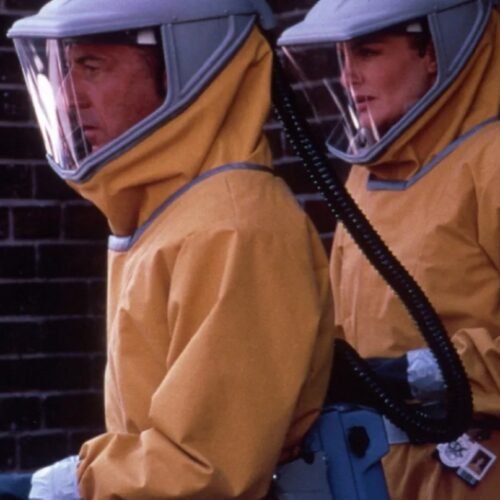
Dustin Hoffman and Renee Russo starred in this medical disaster thriller.
Credit:
Warner Bros.
Back in 2020, when the COVID pandemic was still new, everyone was “sheltering in place” and bingeing films and television. Pandemic-related fare proved especially popular, including the 1995 medical disaster-thriller Outbreak, starring Dustin Hoffman. Chalk it up to morbid curiosity, which some researchers have suggested is an evolved response mechanism for dealing with threats by learning from imagined experiences. Outbreak turned 30 this week, making this the perfect time to revisit the film.
(Spoilers for Outbreak abound below.)
Outbreak deals with the re-emergence of a deadly virus called Motaba, 28 years after it first appeared in an African jungle, infecting US soldiers and many others. The US military secretly destroyed the camp to conceal evidence of the virus, a project overseen by Major General Donald McClintock (Donald Sutherland) and Brigadier General William Ford (Morgan Freeman). When it re-emerges in Zaire decades later, a military doctor, Colonel Sam Daniels (Hoffman), takes a team to the afflicted village to investigate, only to find the entire town has died.
Daniels takes blood samples and realizes the villagers had been infected by a deadly new virus. But Ford shrugs off Daniels’ concerns about a potential global spread, not wanting the truth to come out about the bombing of the village nearly 30 years ago. Daniels alerts his estranged ex-wife, Dr. Roberta “Robby” Keough, who works for the Centers for Disease Control and Prevention, about the virus, and she, too, is initially unconcerned.
Meanwhile, a local monkey is captured and brought to the US as an exotic pet. A smuggler named Jimbo (Patrick Dempsey)—who works at an animal testing facility—tries to sell the monkey to a pet shop owner named Rudy (Daniel Chodos) in the fictional town of Cedar Creek, California. The monkey bites Rudy. Unable to sell the monkey, Jimbo lets it loose in the woods and flies home to Boston. Both Jimbo and his girlfriend (who greets him at Logan Airport and passionately kisses a feverish Jimbo right before he collapses) die from the virus.
Naturally Keough hears about the Boston cases and realizes Daniels was right—the new virus has found its way to American soil. Initially she thinks there aren’t any other cases, but then Rudy’s demise comes to light, along with the death of a hospital technician who became infected after accidentally breaking a vial of Rudy’s blood during testing. When the virus strikes down a cinema filled with moviegoers, Daniels and Keough realize the virus has mutated and become airborne.
This time Ford and a reluctant McClintock can’t afford not to act as the bodies keep piling up. The military declares martial law in the town as Daniels and his fellow scientists race to develop a cure, even as the nefarious McClintock schemes to bomb Cedar Creek to smithereens to contain the virus. The deaths of the residents strike him as a necessary cost to preserve his hopes of developing Motaba as a biological weapon; he dismisses them as “casualties of war.”
Outbreak ended up grossing nearly $190 million worldwide when it was released in March 1995, but critical reviews were mixed. Some loved the medical thriller aspects and quick pacing, while others dismissed it as shallow and improbable. Some of the biggest criticisms of the film came from scientists.
A mixed bag
“Honestly, the science, if you look at it broadly, is not awful,” Tara Smith, an epidemiologist at Kent State University in Ohio, told Ars. “They showed BSL-4 facilities and had a little description of the different levels that you work in. The protagonists respond to an outbreak, they take samples, they bring them back to the lab. They infect some cells, infect some animals, they do some microscopy, although it’s not clear that they’re actually doing electron microscopy, which would be needed to see the virus. But overall, the steps are right.”
Granted, there are plenty of things to nitpick. “There’s a lot of playfulness,” said Smith. “Kevin Spacey [who plays military doctor Lt. Col. Casey Schuler] takes out a fake virus tube and tosses it to Cuba Gooding Jr. [who plays another military doctor, Major Salt]. You don’t play in the BSL-4 laboratories. You just don’t. And a lab tech [who becomes infected] is spinning a centrifuge and doing other things at the same time. Then he opens up the centrifuge and just puts his hand in there and everything breaks. That’s how he gets exposed to the virus. I’ve used a centrifuge hundreds of times. You wait until everything is stopped to open it up. As a trained scientist, those are the things you are told over and over not to do. [The filmmakers] exploit those to drive the plot.”
One of the biggest scientific criticisms is the time compression: the virus multiplies in the body within an hour instead of days; Salt eventually synthesizes a cure in under a minute when this would normally take months; and Keough (who has been infected) recovers almost immediately after being injected with said cure. Smith also noted that scientists identify the two Motaba strains using electron micrographs rather than sequencing them, as would normally be required.
And that whole bit about the Motaba virus liquefying organs just isn’t a thing, according to Smith. “If you read The Hot Zone [Richard Preston’s bestselling 1994 nonfiction thriller], or watch Outbreak and take a shot every time you hear ‘liquefying,’ you would be dead by the end,” she said. “I don’t know how that trope got so established in the media, but you see it every time the Ebola comes up: people are bleeding from their eyes, they’re liquefying. That doesn’t happen. They’re horribly sick. It is an awful virus, but people don’t just melt.”
That said, “I think the biggest [scientific] issue with Outbreak was the whole airborne thing,” said Smith. “Realistically, viruses just don’t change transmission like that.”
Influencing public perceptions
According to Smith, Outbreak may have impacted public perceptions of the 2014–2016 Ebola outbreak—the largest yet seen—fueling widespread fear. “There were very serious people in The New York Times talking about Ebola potentially becoming airborne,” she said. “There was one study where scientists had aerosolized the virus on purpose and given it to pigs and the pigs got infected, which was treated as proof that Ebola could be airborne.”
“That idea that Ebola is super contagious and you can spread it by air—that really originates with Outbreak in 1995, because if you look at the science, it’s just not there,” Smith continued. “Ebola is not that easy to get unless you have close, personal, bodily-fluid-exchanging contact. But people certainly thought it was airborne in 2014–2015, and thought that Ebola was going to cause this huge outbreak in the United States. Of course, we just had a few select cases.”
Smith is currently working on a project that reviews various outbreak stories in popular media and their influence on public perception, particularly when it comes to the origins of those outbreaks. “Where does the virus, fungus, or bacteria come from?” said Smith. “So many films and TV series have used a lab leak origin, where something was made in the laboratory, it escapes, and causes a global pandemic. That’s an important narrative when we talk about the COVID pandemic, because so many people jumped on the lab leak bandwagon as an origin for that. In Outbreak it’s a natural virus, not a lab leak. I don’t think you’d see that if it were re-made today.”
Sam and Salt find the information they’re looking for.
Warner Bros.
Outbreak is often unfavorably compared to another pandemic movie, 2011’s Contagion, of which Smith is naturally a fan. “Contagion is the gold standard [of pandemic movies],” said Smith. “Contagion was done in very close collaboration with a lot of scientists. One of the scientists in the movie is even named for [Columbia University epidemiologist] Ian Lipkin. Scientific accuracy was more important from the start. And there’s a bigger timeframe. These things happen in months rather than days. Even in Contagion, the vaccine was developed quicker than in the COVID pandemic, but at least it was a little bit more realistically done, scarily so when you think about the Jude Law character who was the blogger peddling fake cures—very similar to Ivermectin during the COVID pandemic.”
One might quibble with the science, but as entertainment, after 30 years, the film holds up remarkably well, despite the obvious tropes of action films of the 1990s. (Sam and Salt defying orders and hijacking a military helicopter, then using it to face-off mid-air against a military aircraft deployed to bomb the town out of existence, is just one credibility-straining example.) The talented cast alone makes it worth a rewatch. And for Smith, it was nice to see a strong female epidemiologist as a leading character in Russo’s Bobby Keough. On the whole, “I honestly think Outbreak was fairly good,” she said.
Jennifer is a senior writer at Ars Technica with a particular focus on where science meets culture, covering everything from physics and related interdisciplinary topics to her favorite films and TV series. Jennifer lives in Baltimore with her spouse, physicist Sean M. Carroll, and their two cats, Ariel and Caliban.
