Close Menu

    Subscribe to Updates

    Get the latest creative news from FooBar about art, design and business.

    What's Hot

    Castlevania and Bloodstained developer Shutaro Īda has died aged 52

    Call of Duty: Warzone Mobile servers to shut down in April 2026

    Anchor Point Studios set to break from NetEase and go independent

    Facebook X (Twitter) Instagram
    • Artificial Intelligence
    • Business Technology
    • Cryptocurrency
    • Gadgets
    • Gaming
    • Health
    • Software and Apps
    • Technology
    Facebook X (Twitter) Instagram Pinterest Vimeo
    Tech AI Verse
    • Home
    • Artificial Intelligence

      Read the extended transcript: President Donald Trump interviewed by ‘NBC Nightly News’ anchor Tom Llamas

      February 6, 2026

      Stocks and bitcoin sink as investors dump software company shares

      February 4, 2026

      AI, crypto and Trump super PACs stash millions to spend on the midterms

      February 2, 2026

      To avoid accusations of AI cheating, college students are turning to AI

      January 29, 2026

      ChatGPT can embrace authoritarian ideas after just one prompt, researchers say

      January 24, 2026
    • Business

      The HDD brand that brought you the 1.8-inch, 2.5-inch, and 3.5-inch hard drives is now back with a $19 pocket-sized personal cloud for your smartphones

      February 12, 2026

      New VoidLink malware framework targets Linux cloud servers

      January 14, 2026

      Nvidia Rubin’s rack-scale encryption signals a turning point for enterprise AI security

      January 13, 2026

      How KPMG is redefining the future of SAP consulting on a global scale

      January 10, 2026

      Top 10 cloud computing stories of 2025

      December 22, 2025
    • Crypto

      Metaplanet Reports FY2025 Results as Bitcoin Unrealized Losses Top $1 Billion

      February 17, 2026

      Crypto’s AI Pivot: Hype, Infrastructure, and a Two-Year Countdown

      February 17, 2026

      The RWA War: Stablecoins, Speed, and Control

      February 17, 2026

      Jeffrey Epstein Emails Show Plans to Meet Gary Gensler To Talk Crypto

      February 17, 2026

      Bitcoin Bounce Fades, Q1 Losses Deepen, and New Price Risk Back in Focus

      February 17, 2026
    • Technology

      Noah Donohoe inquest reveals issues with police ControlWorks system

      February 17, 2026

      Pascal Brier, Capgemini: AI will prove its enterprise truth this year

      February 17, 2026

      Interview: Richard Corbridge, CIO, Segro

      February 17, 2026

      IT Sustainability Think Tank: AI infrastructure, shared responsibility and the real cost of progress

      February 17, 2026

      NatWest hails progress after £1.2bn spent on tech last year, but true AI transformation to come

      February 17, 2026
    • Others
      • Gadgets
      • Gaming
      • Health
      • Software and Apps
    Check BMI
    Tech AI Verse
    You are at:Home»Technology»Poor Deming never stood a chance
    Technology

    Poor Deming never stood a chance

    TechAiVerseBy TechAiVerseFebruary 17, 2026No Comments6 Mins Read0 Views
    Facebook Twitter Pinterest Telegram LinkedIn Tumblr Email Reddit
    Poor Deming never stood a chance
    Share
    Facebook Twitter LinkedIn Pinterest WhatsApp Email

    Poor Deming never stood a chance

    This post is an elaboration of a shorter post I wrote about five years ago.

    The two management giants of the mid-twentieth century were Peter Drucker and W. Edwards Deming. Ironically, while Drucker hails from Austria-Hungary (like me, Drucker emigrated to the U.S. as an adult) and Deming was born in the U.S., it was Drucker that proved to be more influential in America. Deming’s influence was much greater in Japan than it ever was the U.S. If you’ve ever been at an organization that uses OKRs, then you have worked in the shadow of Drucker’s legacy. While you can tell a story about how Deming influenced Toyota, and Toyota inspired the lean movement, I would still describe management in the U.S. as Deming in exile. Deming explicitly stated that management by objectives isn’t leadership, and I think you’d be hard-pressed to find managers in American companies who would agree with that sentiment.

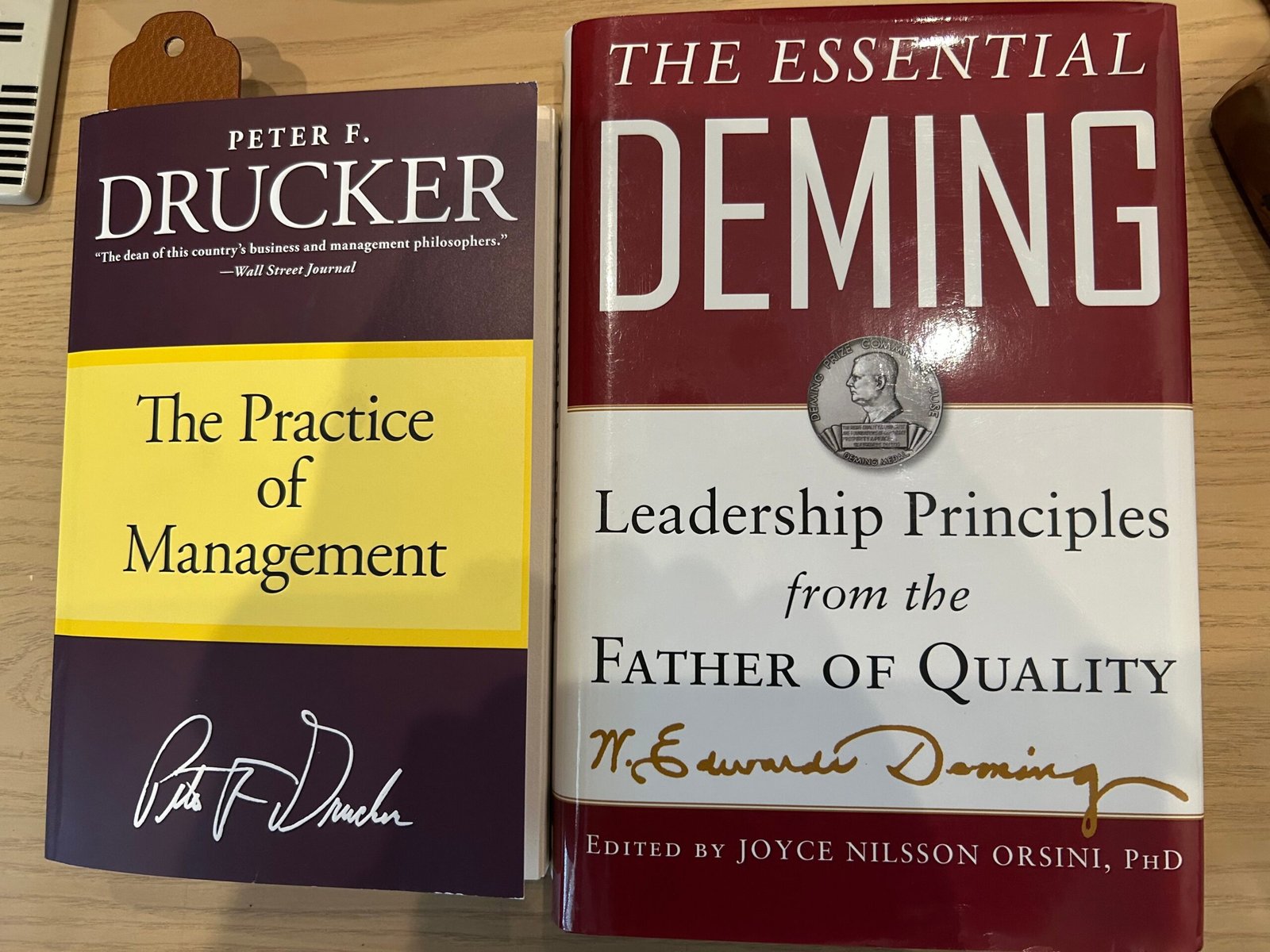
    I thing Deming’s “Out of the Crisis” is a better book, but I don’t have a physical copy of it

    Here I want to talk about why I think it is that Drucker’s ideas were stickier than Deming’s in the U.S. It all comes down to the nature of organizations and people.

    My rendering of an organization. Not to scale.

    An organization is a big, hairy, complex mess, and the bigger the organization is, the hairier and more complex it gets. Managers, on the other hand, have a very finite amount of bandwidth. There are only so many hours in a day, and this number does not increase with the complexity of an organization. And, let’s face it, they’re spending something close to 100% of that bandwidth attending meetings.

    How is a manger to make sense of this mess?

    OKRs as a mess-reduction mechanism

    In the Druckerian approach of OKRs, you set a small number of objectives, and then you identify quantifiable key results for each objective that provide a signal about whether progress towards the objective is being made, and then you monitor the key results. Key results reduce the bandwidth required to make sense of what’s happening in the system. Instead of the blooming, buzzing confusion of the entire system, monitoring key results means you can filter out all of that unnecessary detail to focus specifically on the aspects that are relevant to the bandwidth-limited manager. It’s no coincidence that when John Doerr wrote a book on his experience with OKRs at Intel and how he brought them to Google, he titled his book Measure What Matters.

    The beauty of a set of key results is that they take the messiness of the system as input and create a neat summary in spreadsheet or slide format as output.

    Deming’s critique

    Deming’s approach to the problem of management was radically different from Drucker’s. In his book Out of the Crisis, Deming puts his criticism of the Drucker-ish approach in stark terms. He uses the term deadly disease to describe managing through numerical targets.

    Eliminate management by objective. Eliminate management by numbers, numerical goals. Substitute leadership.

    Deming’s perspective can be summed up with the old saying: if you don’t change the system, the system doesn’t change. He argued that if you wanted improvements, you had to make systemic changes. Furthermore, you had to understand the system if you wanted to come up with a system improvement that would actually work.

    Deming advocated studying the system over numerical targets

    Classical control versus statistical control

    Deming was not opposed to the idea of goals: indeed, he was a passionate believer that management should strive to improve quality and productivity, and both of those are goals. He was also not opposed to metrics: he was an advocate of applying Walter Shewhart’s statistical techniques for management. It’s the use of metrics that’s radically different in the two approaches.

    The Drucker-ian approach is akin to a classical control system, like a thermostat. Specifying the key results are like setting the desired temperature (say, 68°F), and then the thermostat generates output in order to bring the current temperature of the room in line with the setpoint.

    The idea here is that you give the organization a setpoint, and it will implement the control system that will work to achieve the setpoint.

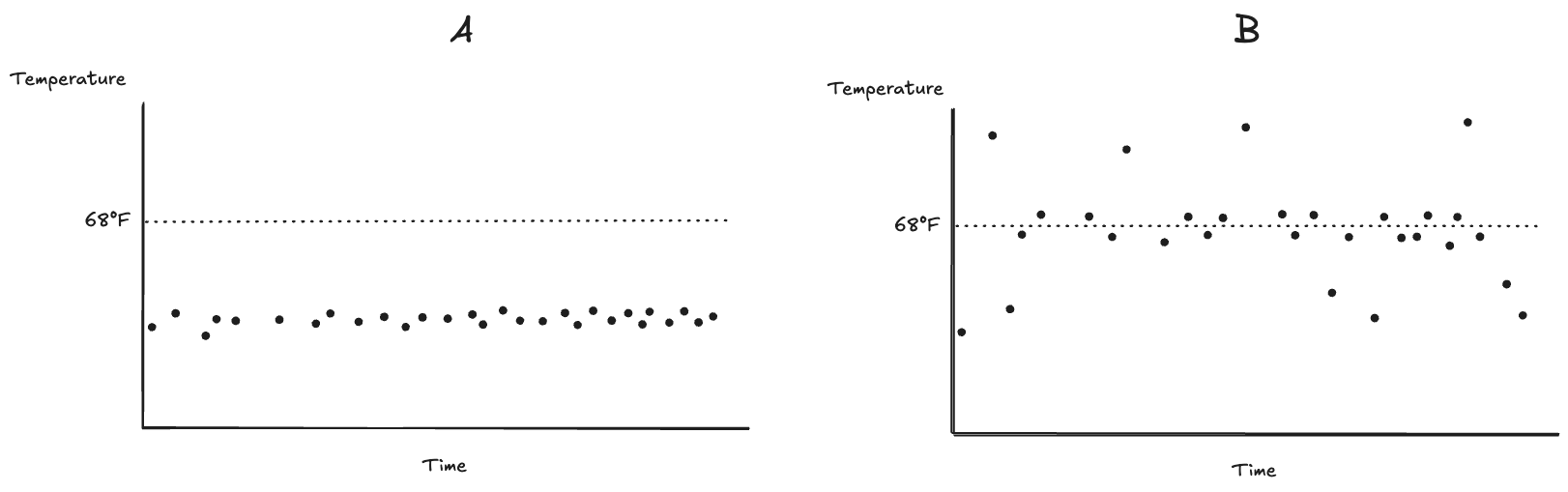
    Deming wrote in explicit terms about control, but he meant it in a different sense: we wrote about statistical process control, and statistical process control is about the variability of the output. I’ve written about statistical process control before, but here I’ll touch on the concepts again, with an example. Let’s imagine we are observing the behavior of two brands of thermostats, A and B, each controlling the temperature of a different room. Both thermostats have the same setpoint of 68°F. We observed their behavior by graphing the temperature of the two rooms over time.

    Note how the points for thermostat A all fall within a narrow band, whereas for thermostat B there are many more outliers. We’d say that thermostat A is under statistical process control whether thermostat B is not, even though the average temperature for thermostat B is closer to the setpoint then the average temperature for thermostat A. (In practice, you’d draw a control chart to identify whether the system is under statistical control).

    Deming argued that you had to understand whether your system was under statistical control in order to determine what intervention to do in order to make an improvement. For example, if your system was out of control, the next intervention would be to do a qualitative investigation into the outliers. On the other hand, if the system was under statistical control, then you’d have to figure out what systemic change to make to improve things.

    Note how you build a classical control system, whereas you observe whether your system is under statistical process control. Statistical process control is about understanding the system.

    Drucker makes a manager’s life easier, Deming makes it harder

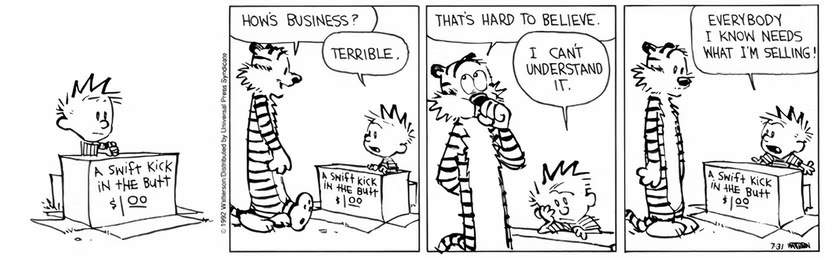
    Deming faced a similar challenge to Calvin

    One of the virtues of OKRs is that they are straightforward for managers to apply. You set direction by specifying objectives, and you enforce accountability by monitoring key results. Applying Deming’s approach, on the other hand, requires a much greater commitment of management bandwidth. Drucker offers a control mechanism with a bounded amount of information, where Deming requires a never-ending research program, with no upper bound on the kind of information that might be relevant. In fact, the information might even be unobservable. Deming approvingly quotes the statistician Lloyd Nelson, who said:

    The most important figures needed for management of any organization are unknown and unknowable.

    Myself, I’m in the Deming camp, but I can see why Drucker’s ideas won out. In reliability, we talk about “making the right thing easy and the wrong thing hard”, other people call this The Pit of Success. The rationale is that people will tend to do the easy thing over the hard thing. And managers are people too. But sometimes the right thing to do is the harder one, and nothing can be done about that.

    Share. Facebook Twitter Pinterest LinkedIn Reddit WhatsApp Telegram Email
    Previous ArticleThinking Hard Burns Almost No Calories–But Destroys Your Next Workout
    Next Article SvarDOS – an open-source DOS distribution
    TechAiVerse
    • Website

    Jonathan is a tech enthusiast and the mind behind Tech AI Verse. With a passion for artificial intelligence, consumer tech, and emerging innovations, he deliver clear, insightful content to keep readers informed. From cutting-edge gadgets to AI advancements and cryptocurrency trends, Jonathan breaks down complex topics to make technology accessible to all.

    Related Posts

    Noah Donohoe inquest reveals issues with police ControlWorks system

    February 17, 2026

    Pascal Brier, Capgemini: AI will prove its enterprise truth this year

    February 17, 2026

    Interview: Richard Corbridge, CIO, Segro

    February 17, 2026
    Leave A Reply Cancel Reply

    Top Posts

    Ping, You’ve Got Whale: AI detection system alerts ships of whales in their path

    April 22, 2025680 Views

    Lumo vs. Duck AI: Which AI is Better for Your Privacy?

    July 31, 2025261 Views

    6.7 Cummins Lifter Failure: What Years Are Affected (And Possible Fixes)

    April 14, 2025155 Views

    6 Best MagSafe Phone Grips (2025), Tested and Reviewed

    April 6, 2025114 Views
    Don't Miss
    Gaming February 17, 2026

    Castlevania and Bloodstained developer Shutaro Īda has died aged 52

    Castlevania and Bloodstained developer Shutaro Īda has died aged 52 “Shutaro’s adventure in this world…

    Call of Duty: Warzone Mobile servers to shut down in April 2026

    Anchor Point Studios set to break from NetEase and go independent

    Nintendo strikes more emulators with DMCA takedown notices

    Stay In Touch
    • Facebook
    • Twitter
    • Pinterest
    • Instagram
    • YouTube
    • Vimeo

    Subscribe to Updates

    Get the latest creative news from SmartMag about art & design.

    About Us
    About Us

    Welcome to Tech AI Verse, your go-to destination for everything technology! We bring you the latest news, trends, and insights from the ever-evolving world of tech. Our coverage spans across global technology industry updates, artificial intelligence advancements, machine learning ethics, and automation innovations. Stay connected with us as we explore the limitless possibilities of technology!

    Facebook X (Twitter) Pinterest YouTube WhatsApp
    Our Picks

    Castlevania and Bloodstained developer Shutaro Īda has died aged 52

    February 17, 20260 Views

    Call of Duty: Warzone Mobile servers to shut down in April 2026

    February 17, 20260 Views

    Anchor Point Studios set to break from NetEase and go independent

    February 17, 20260 Views
    Most Popular

    7 Best Kids Bikes (2025): Mountain, Balance, Pedal, Coaster

    March 13, 20250 Views

    VTOMAN FlashSpeed 1500: Plenty Of Power For All Your Gear

    March 13, 20250 Views

    This new Roomba finally solves the big problem I have with robot vacuums

    March 13, 20250 Views
    © 2026 TechAiVerse. Designed by Divya Tech.
    • Home
    • About Us
    • Contact Us
    • Privacy Policy
    • Terms & Conditions

    Type above and press Enter to search. Press Esc to cancel.