

Qi2.2 charging boost – Baseus PicoGo AM52 magnetic power bank review – NotebookCheck.net Reviews
ⓘ Benedikt Winkel
Significantly faster.
Only a few smartphones can currently charge via Qi2.2. The Baseus PicoGo AM52 power bank is ready for the new standard, and when paired with a compatible device, it can deliver very good charging times. It also feels well built and lasts a long time. We used the battery pack to charge smartphones, tablets, and laptops during everyday use.
Benedikt Winkel, ✓ Ninh Duy (translated by DeepL / Ninh Duy) Published 🇩🇪
Accessory Gadget Smartphone
With the PicoGo AM52, Baseus offers a reliable and, above all, high-output power bank. However, it can only really show its strengths with Qi2.2-compatible smartphones. Those are still few and far between—but that could change. When paired with a current iPhone, the PicoGo AM52 delivers very good charging times while staying cool.
ⓘ Benedikt Winkel
Pros
+ High-quality workmanship
+ Fast charging speeds
+ Multiple charging options
+ Future-proof
Cons
– Qi2.2 is still not widely supported
Baseus sells the PicoGo AM52 in two versions, with or without an integrated cable. The manufacturer offers the power bank in its own online store, as well as on other platforms such as Amazon. The MSRP for both versions is €90 ($106).
At the time of testing, Baseus was offering a discount, bringing the street price down to €60 ($70).
Baseus offers power banks in a range of designs. The PicoGo AM31 and AM41 series prioritize the most compact form factor possible while keeping a 5,000 mAh capacity. The new PicoGo AM52, by contrast, is mainly positioned around Qi2.2 support and wireless charging at up to 25 watts.
To reach the fastest charging speeds, the smartphone has to support the Qi2.2 standard. At the time of testing, that includes only the iPhone 16 and iPhone 17 series, as well as the Google Pixel 10 Pro XL. Some other smartphones can charge quickly over wireless, but they rely on different standards, some of them proprietary.
Regardless of charging speed, MagSafe and PixelSnap offer the advantage that compatible magnetic power banks such as the PicoGo AM52, as well as other accessories, can attach magnetically. Cases or films with integrated magnets can help if the phone itself does not support magnetic alignment.
ⓘ Benedikt Winkel
ⓘ Benedikt Winkel
ⓘ Benedikt Winkel
ⓘ Benedikt Winkel
ⓘ Benedikt Winkel
| USB | USB-C |
| Max. Wired output power | 45 W |
| Max. Wireless output power | 25 W |
| Max. Input power | 30 W |
| Capacity | 10,000 mAh |
| Dimensions | Length 10.5 cm; Width 6.5; Height 1.6 cm |
| Weight | 201.5 (with cable) g / 196 g |
| Miscellaneous | Qi2.2; Qi2.0; MagSafe; charge two devices simultaneously |
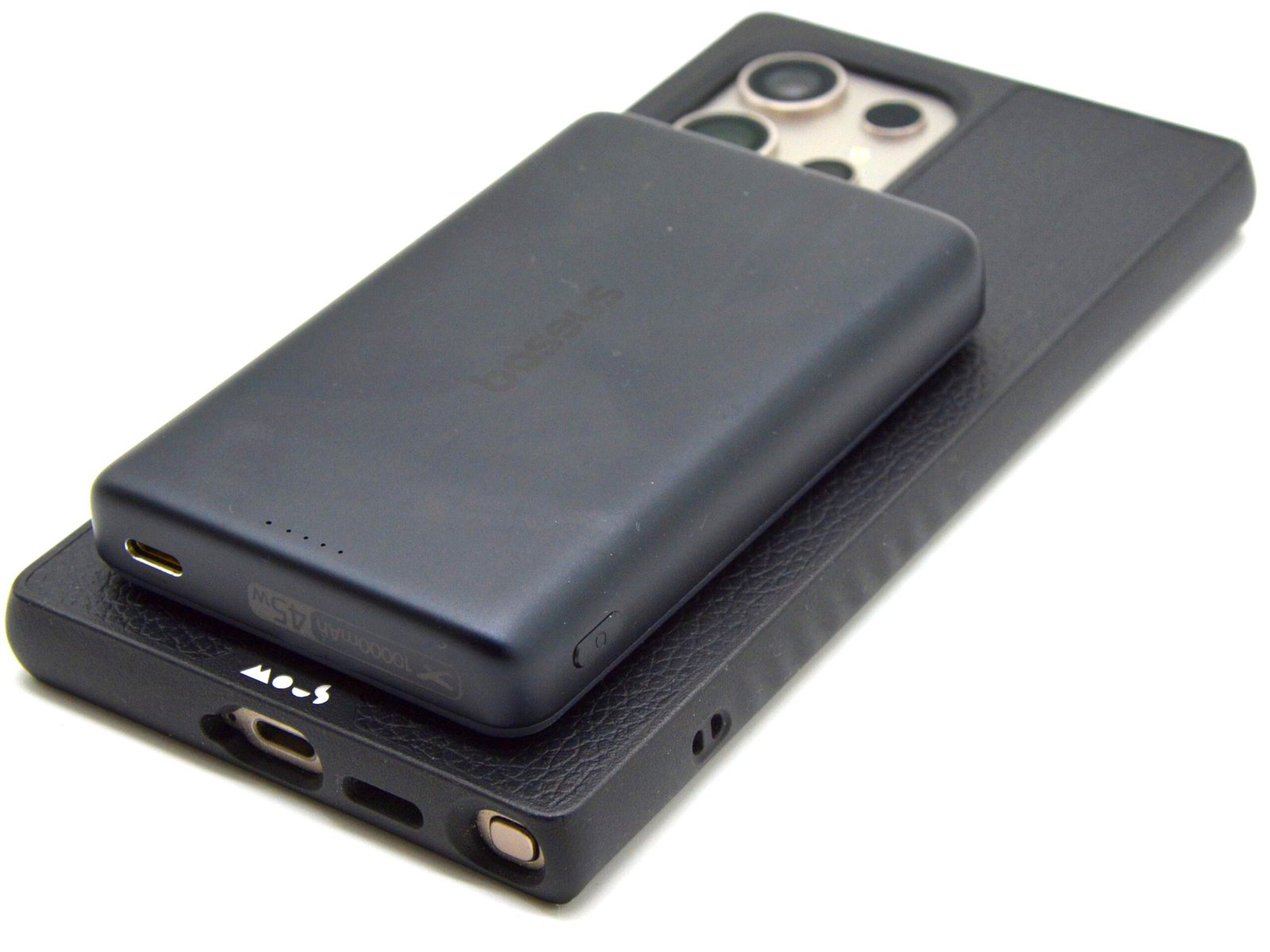
According to Baseus, the PicoGo AM52 is the thinnest Qi2.2 power bank in the world. There are not many Qi2.2 models on the market yet, though. We measured a thickness of 1.6 cm, a width of 6.5 cm, and a length of 10.5 cm. With the cable, the power bank weighs 201.5 grams; the version without the cable weighs 196 grams.
The exterior is made from a matte anthracite aluminum alloy. During the test period, the power banks did not pick up any scratches, but fingerprints were clearly visible. On the inside, Baseus uses a soft, silicone-like material designed to prevent scratches. Magnets sit underneath this layer to provide a secure magnetic hold on compatible devices.
Both versions have a USB-C port that can be used for charging and discharging. There are also four small LEDs that show the charge level; they can be activated by pressing a button on the side. Overall, the PicoGo AM52 makes a very high-quality impression.
The only difference between the two versions is an integrated, flat, fabric-covered cable designed as a loop. However, the loop opens when pulled firmly, revealing the USB-C plug. As a carry loop, it is only of limited use.
We charged a range of devices with the Baseus PicoGo AM52. The power bank supports Qi2.2, but it also charges devices wirelessly that only support Qi2, such as the Samsung Galaxy S24 Ultra. With a suitable case, the PicoGo AM52 also holds securely to devices that do not support MagSafe or PixelSnap out of the box.
The Samsung Galaxy S24 Ultra can charge wirelessly at up to 15 watts. As a result, it takes a lengthy three hours to charge a 5,000 mAh battery from 15% to 100%. An iPhone 16, by contrast, charges from 10% to 80% in 40 minutes thanks to its smaller battery and 25-watt charging. We saw the same charging time with an iPhone 17 Pro.
For comparison, we charged the iPhone 16 with a PicoGo AM41 power bank, which supports Qi2 only. In that setup, charging from 10% to 80% takes 90 minutes. Wireless charging also comes with noticeable losses. The Galaxy S24 Ultra can be charged twice from 10% to 80% before the power bank needs to be plugged in again.
Over a wired connection, the PicoGo AM52 can charge other devices at up to 45 watts. In our test, the Galaxy S24 Ultra charged from 15% to 90% in 50 minutes, which is the phone’s maximum charging rate. Tablets such as the Samsung Galaxy Tab S11 Ultra, as well as a laptop like the Honor MagicBook, also charged from the power bank without issues. Qi-capable smartwatches, including the Huawei Watch Ultimate 2, can be charged with the Baseus power bank as well.
The PicoGo AM52 also supports charging two devices at the same time. As promised by the manufacturer, the power bank stayed cool; we measured a peak temperature of 36.4 °C. Input power tops out at 30 watts. In our test with an Anker 335 power adapter, a full recharge took about 100 minutes.
ⓘ Benedikt Winkel
Baseus’ new PicoGo AM52 magnetic power bank feels well built and can charge compatible smartphones quickly, including over wireless charging. It can also charge two devices at the same time and, with its 10,000 mAh capacity, offers enough reserves for tablets as well. If you often charge devices via cable, the version with the integrated cable is the better choice.
Right now, the PicoGo AM52 is most appealing to owners of iPhone 16 and iPhone 17 models, since it can then make full use of its charging speed. If you are looking for a thinner power bank, the PicoGo AM41 is the better pick. Due to the lack of a display, the Baseus power bank does not provide any information on charging speed or cycle count.
Transparency
The selection of devices to be reviewed is made by our editorial team. The test sample was given to the author by the manufacturer free of charge for the purposes of review. There was no third-party influence on this review, nor did the manufacturer receive a copy of this review before publication. There was no obligation to publish this review. As an independent media company, Notebookcheck is not subjected to the authority of manufacturers, retailers or publishers.
Technology and journalism have always come together in my past. However, it was mostly cars and motorcycles that I put under the microscope. Since my active triathlon days, I’ve been a fan of sports watches and smartwatches – triathlon is history for me, but the enthusiasm for watches is still there. That’s why, in parallel to my dissertation in theology, I write at Notebookcheck mainly about smartwatches, but also about other news and technology that interests me.
Translator: Ninh Ngoc Duy – Editorial Assistant – 718822 articles published on Notebookcheck since 2008
My main responsibility as an editorial assistant is maintaining the Library section, which aggregates reviews from other publications and channels. In addition, my daily breakfast is Notebookcheck’s long list of new content, which I comb through to select the most interesting topics for translation from English to French, Italian, Spanish, Portuguese, and Dutch.”
Benedikt Winkel, 2026-03- 2 (Update: 2026-03- 2)

