

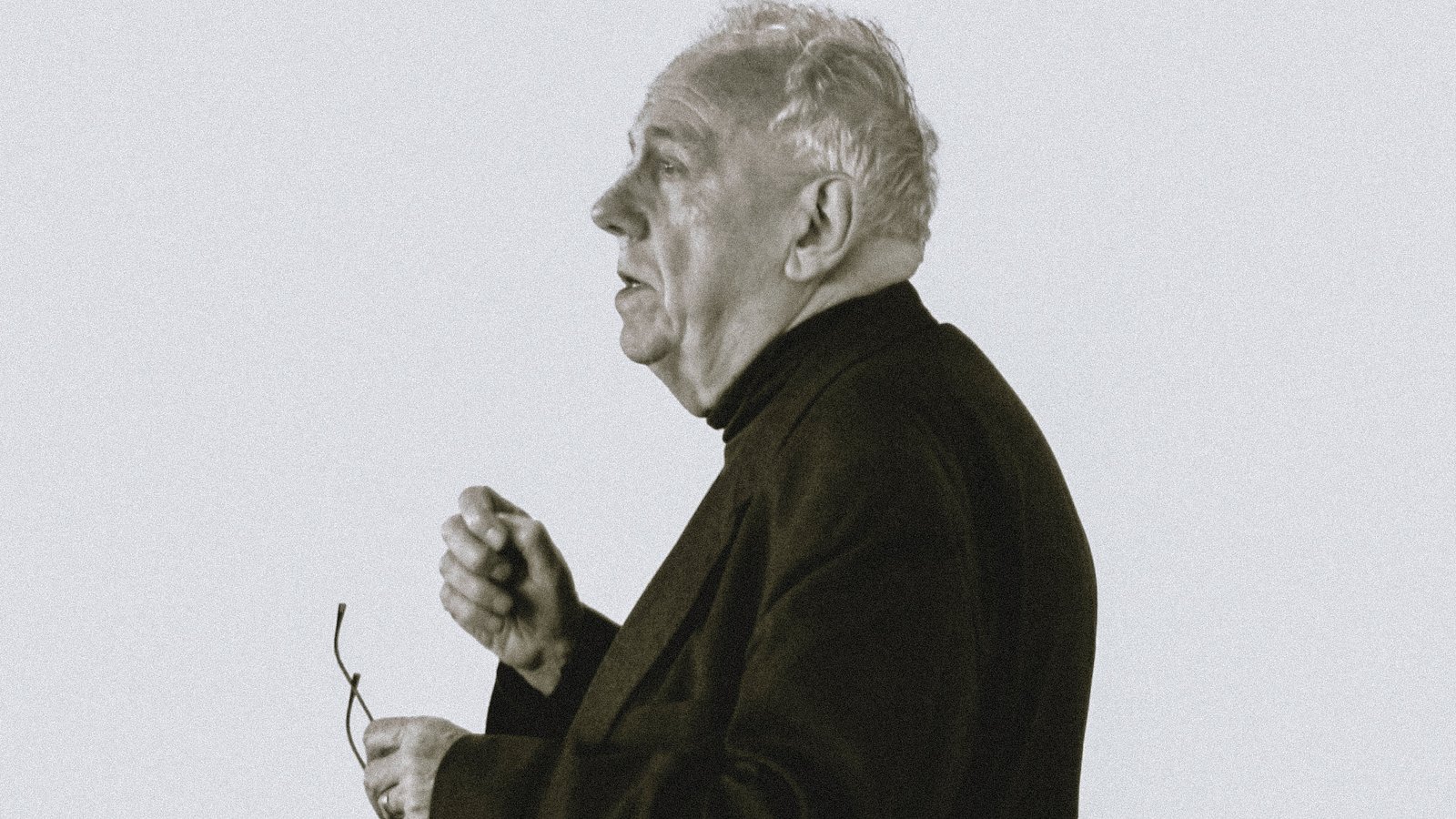
Remembering Alasdair MacIntyre
Start typing to search all Word on Fire content.
For more than seven decades, Alasdair MacIntyre was a prolific and provocative philosopher. The author of more than two hundred scholarly articles and more than twenty books, MacIntyre’s best known work, After Virtue, was described in 1981 by Newsweek as “a stunning new study of ethics by one of the foremost moral philosophers in the English-speaking world.” Conventional wisdom had offered the bare alternatives of Kantian duty based ethics and utilitarian consequentialist ethics. Echoing themes found in Elizabeth Anscombe’s “Modern Moral Philosophy,” After Virtue revolutionized the field by reintroducing virtue ethics as a viable alternative and by calling into question modern moral philosophy as an attempt to make sense of the shards left over from the shattered premodern synthesis of Athens and Jerusalem.
MacIntyre’s sequels Whose Justice? Which Rationality? and his Gifford Lectures Three Rival Versions of Moral Inquiry: Encyclopaedia, Genealogy, and Tradition defended, extended, and modified the claims of After Virtue. In Dependent Rational Animals: Why Human Beings Need the Virtues, MacIntyre explored the similarities and differences between humans and non-human animals, criticizing Enlightenment conceptions of the human being as insufficiently attentive to human vulnerability and interdependence. His book God, Philosophy, Universities was based on a popular undergraduate course offered during his last years of teaching. MacIntyre’s first academic publication, “Analogy in Metaphysics,” was written before he turned twenty-two years old. More than seventy years later, at ninety-three years old, his 2022 lecture “The Apparent Oddity of the Universe: How to Account for It?” attracted enormous attention.
Born in Glasgow in 1929, MacIntyre’s early imagination was fueled by Gaelic stories of fishermen and farmers facing challenges set in a communal life. After studying classics and earning degrees from Oxford, Manchester, and the University of London, MacIntyre began teaching philosophy in 1951—a job he liked, he told his graduate students, because it was “inside work with no heavy lifting.” MacIntyre was proud never to have earned a PhD: “I won’t go so far as to say that you have a deformed mind if you have a PhD, but you will have to work extra hard to remain educated.” However, his prolific research won him ten honorary doctorates and appointments as Corresponding Fellow of the British Academy, an Honorary Member of the Royal Irish Academy, and Fellow of the American Academy of Arts and Sciences. He held academic positions at Oxford, Yale, Manchester, Leeds, Essex, University of Copenhagen, Aarhus, Brandeis, Boston University, Wellesley College, Vanderbilt, London Metropolitan University, Duke, and three appointments at Princeton. But he found a lasting home at the University of Notre Dame.
MacIntyre saw no contradiction between his faith and his philosophy. He viewed them as mutually enriching.
These frequent changes in location paralleled MacIntyre’s restless mind. He joined and then left the Communist party, but never abandoned a Marxist critique of a capitalist social and economic order. He attended lectures by A.J. Ayer, but reading Wittgenstein convinced MacIntyre of the weakness of Ayer’s logical positivism. He found congenial, at different times, Freudianism and a non-metaphysical Aristotelianism, but later became a biologically grounded Aristotelian. MacIntyre’s synthetic approach was informed by seminal figures in analytic philosophy, such as Frege and Davidson, as well as by key authors in continental philosophy, such as Stein and Gadamer. MacIntyre’s work reflected a deep familiarity with sociology, psychology, biology, psychoanalysis (especially Lacan), and literature (especially Jane Austen).
MacIntyre’s multiple conversions were also religious. In the 1940s, he considered becoming a Presbyterian minister. In the 1950s, he became an Anglican. In the 1960s, he became an atheist. But he was “a Roman Catholic atheist. Only the Catholics worshiped a God worth denying.”
That too would change. As he put it, “I was already fifty-five years old when I discovered that I had become a Thomistic Aristotelian.” After previously rejecting them, he reconsidered arguments for God’s existence. In 1983, he became a Roman Catholic in faith and a Thomist in philosophy, a “result of being convinced of Thomism while attempting to disabuse his students of its authenticity.” What impressed him, in part, was “that Aquinas—to an extent not matched by either Plato or Ayer—does not commit himself to accepting any particular answer to whatever question it is that he is asking, until he has catalogued all the reasonable objections to that answer that he can identify and has found what he takes to be sufficient reason for rejecting each of them. Following his example seems an excellent way of ensuring that I become adequately suspicious of any philosophical theses which I am tempted to accept.” No longer Karl Barth, Alasdair’s favorite twentieth-century theologian became Joseph Ratzinger. Like other Catholic converts who were professors of philosophy, such as Elizabeth Anscombe, Nicholas Rescher, and Sir Michael Dummett, MacIntyre saw no contradiction between his faith and his philosophy. He viewed them as mutually enriching.
Through all these conversions, however, MacIntyre emphasized that the study of ethics cannot be separated from history, for it is an understanding of historically situated practices within communities that is needed to make sense of moral judgments. “We should, as far as it is possible, allow the history of philosophy to break down our present day conceptions, so that our too narrow views of what can and cannot be thought, said, and done are discarded in the face of the record of what has been thought, said, and done,” he wrote in A Short History of Ethics. “We have to steer between the danger of a dead antiquarianism, which enjoys the illusion that we can approach the past without preconceptions, and that other danger, so apparent in such philosophical historians as Aristotle and Hegel, of believing that the whole point of the past was that it should culminate with us. History is neither a prison nor a museum, nor is it a set of materials for self-congratulation.” Indeed, it is the telling of stories that makes us who we are: “Man is in his actions and practice, as well as in his fictions, essentially a story-telling animal.” Ethical questions presuppose narrative questions. As he put it, “I can only answer the question, ‘What am I to do?’ if I can answer the prior question, ‘Of what story or stories do I find myself a part?’”
MacIntyre often played the part of provocateur. Though more gentle with undergraduates, in his graduate classes as well as in his scholarly writings Alasdair exhibited an acerbic wit. He described the work of one philosopher as “the philosophical equivalent of Vogue.” In a review of Hans Küng’s book Does God Exist?, MacIntyre remarked, “Reading this book was not entirely without theological significance for me. Whenever in the future I try to imagine what Purgatory will be like, the thought of having to reread Dr. Küng’s book is certain to recur.” Indeed, most Roman Catholic theologians give the “impression of being only mildly interested in either God or the world; what they are passionately interested in are other Roman Catholic theologians.” As an article in The Nation noted, “When asked in 1996 what values he retained from his Marxist days, MacIntyre answered, ‘I would still like to see every rich person hanged from the nearest lamp post.’” Even the philosopher who had perhaps the greatest influence on him did not escape his caustic barbs: “Aristotle was not a nice or a good man: the words ‘supercilious prig’ spring to mind very often in reading the Ethics.”
In the classroom, MacIntyre followed the example of Socrates, who demonstrated to those in his company the depths of what they did not know. My first graduate class with him was on twentieth-century ethics. I read all the books for the fall semester the summer before, so I thought I was ready to impress. On the first day of class, he began in stern British schoolmaster style, “I’m Alasdair MacIntyre, but if you don’t already know that, you probably shouldn’t be in this class.” Unlike other professors, he did not address us as “Christopher” or “Rebecca,” but as “Mr. Kaczor” and “Ms. DeYoung.” The only exception was “Master Resnick,” who had gained his MA already. MacIntyre announced that in order to earn an A on a paper, we would have to write an essay of the caliber that he would put his own name on it. An A minus meant he would almost put his name on it. My first paper came back with a grade that I had never before received. Indeed, a grade I had never before seen: B minus minus.
A philosophical version of a Marine boot camp instructor, MacIntyre left us in much better shape than when we began. As Lee Marsh put it, “When I met Alasdair MacIntyre, I realized how much I did not know and why I should know it.” We learned that there was such a thing as a stupid question. One grad student asked, “What are the Thirty-Nine Articles?” MacIntyre replied, “Do you happen to know where the library is? It’s not too late to learn.” We were kept continually off balance, often not knowing where the jokes ended and the serious warnings began. One day, Alasdair announced, “I happen to be one who believes torture is not always wrong—something you may want to remember.” He warned us, “Never call me at home unless you want to no longer be a student in the graduate program.” This admonition was entirely unnecessary as most of us were afraid to speak with him even during class time. Graduate students brave enough to visit his office, dark as a cave and lit by a solitary lamp, found it adorned with a Gallic cross and a photo of the Jewish-born philosopher Edith Stein, who died in the gas chambers of Auschwitz. One day, having finally earned paper grades in his classes better than B minus minus, I ventured into his office to ask for his coveted letter of recommendation. It took courage to request one. He told one grad student, “I can certainly write you a letter, but it is the kind of letter that keeps you from getting a job.” Fortunately, his letter of recommendation for me was not that kind of letter.
Not only did he help us on the job market, MacIntyre’s virtues gave his students an example to emulate. When doing a directed readings class with one undergraduate, MacIntyre remarked that there was a recent article in French very much relevant for their discussion. Unfortunately, the student couldn’t read French. So the next time they met together, MacIntyre provided the student with a translation he had made of the article. Alasdair had a great love for American football, especially Notre Dame football. Yet he often gave grad students his football tickets, and this during the Lou Holtz-era when the Fighting Irish were perennial national championship contenders. His students saw him debating with Sir Bernard Williams about rival interpretations of Sophocles’ Oedipus Rex—a battle of titans who learned their Greek as youths. And we saw him at Mass in Notre Dame’s basilica on the feast of the Immaculate Conception, standing off at a distance from the altar and honoring the Mother of God.
Alasdair often joked that his most significant achievement was breaking up the Beatles. Conventional wisdom holds that Yoko Ono played a key role in the end of the band. In 1966, MacIntyre lived in the same apartment complex as Yoko. One day, she came to MacIntyre’s apartment and asked to borrow a ladder that she needed for her upcoming art show. It was at this art exhibit that John Lennon met Yoko. Lennon recounts, “There was another piece that really decided me for-or-against the artist: a ladder which led to a painting which was hung on the ceiling. It looked like a black canvas with a chain with a spyglass hanging on the end of it. This was near the door when you went in. I climbed the ladder, you look through the spyglass and in tiny little letters it says ‘yes.’ So it was positive. I felt relieved. It’s a great relief when you get up the ladder and you look through the spyglass and . . . it said ‘yes.’ . . . I was very impressed and John Dunbar introduced us.” Lennon mentions the ladder MacIntyre gave to Yoko three times. Without the ladder, would Lennon have been so impressed with the art exhibit? Without being so impressed, would he have asked to meet Yoko? If Lennon had not met Yoko, would the Beatles have broken up? I don’t know.
What I do know is this. I have never met, nor do I ever expect to meet, a philosopher as fascinating as the author of After Virtue. If we are waiting for Godot, he may well arrive before another—doubtless very different—Alasdair MacIntyre.
