Close Menu

    Subscribe to Updates

    Get the latest creative news from FooBar about art, design and business.

    What's Hot

    AMD surges 10 percent in desktop PC share, again

    Google now lets you delete your personal info from search results

    Microsoft just forked Windows

    Facebook X (Twitter) Instagram
    • Artificial Intelligence
    • Business Technology
    • Cryptocurrency
    • Gadgets
    • Gaming
    • Health
    • Software and Apps
    • Technology
    Facebook X (Twitter) Instagram Pinterest Vimeo
    Tech AI Verse
    • Home
    • Artificial Intelligence

      Read the extended transcript: President Donald Trump interviewed by ‘NBC Nightly News’ anchor Tom Llamas

      February 6, 2026

      Stocks and bitcoin sink as investors dump software company shares

      February 4, 2026

      AI, crypto and Trump super PACs stash millions to spend on the midterms

      February 2, 2026

      To avoid accusations of AI cheating, college students are turning to AI

      January 29, 2026

      ChatGPT can embrace authoritarian ideas after just one prompt, researchers say

      January 24, 2026
    • Business

      The HDD brand that brought you the 1.8-inch, 2.5-inch, and 3.5-inch hard drives is now back with a $19 pocket-sized personal cloud for your smartphones

      February 12, 2026

      New VoidLink malware framework targets Linux cloud servers

      January 14, 2026

      Nvidia Rubin’s rack-scale encryption signals a turning point for enterprise AI security

      January 13, 2026

      How KPMG is redefining the future of SAP consulting on a global scale

      January 10, 2026

      Top 10 cloud computing stories of 2025

      December 22, 2025
    • Crypto

      Berachain Jumps 150% as Strategic Pivot Lifts BERA

      February 12, 2026

      Tom Lee’s BitMine (BMNR) Stock Faces Cost-Basis Risk — Price Breakdown at 10%?

      February 12, 2026

      Why the US Jobs Data Makes a Worrying Case for Bitcoin

      February 12, 2026

      MYX Falls Below $5 as Short Sellers Take Control — 42% Decline Risk Emerges

      February 12, 2026

      Solana Pins Its $75 Support on Short-Term Buyers — Can Price Survive This Risky Setup?

      February 12, 2026
    • Technology

      AMD surges 10 percent in desktop PC share, again

      February 12, 2026

      Google now lets you delete your personal info from search results

      February 12, 2026

      Microsoft just forked Windows

      February 12, 2026

      This Lenovo USB-C dock with 65 watts of power is just $76

      February 12, 2026

      Anker’s USB-C hub turns 1 laptop port into 8 ports (best ever price)

      February 12, 2026
    • Others
      • Gadgets
      • Gaming
      • Health
      • Software and Apps
    Check BMI
    Tech AI Verse
    You are at:Home»Technology»Reports of Telnet’s Death Have Been Greatly Exaggerated
    Technology

    Reports of Telnet’s Death Have Been Greatly Exaggerated

    TechAiVerseBy TechAiVerseFebruary 12, 2026No Comments5 Mins Read2 Views
    Facebook Twitter Pinterest Telegram LinkedIn Tumblr Email Reddit
    Reports of Telnet’s Death Have Been Greatly Exaggerated
    Share
    Facebook Twitter LinkedIn Pinterest WhatsApp Email

    Reports of Telnet’s Death Have Been Greatly Exaggerated

    TL;DR: we see no evidence that specific core network autonomous systems have blocked Telnet, contrary to previous reports. We specifically see continued non-spoofable Telnet traffic from networks on which GreyNoise saw 100% drop-off. We suspect initial results may have been measurement artifacts or specific threat actors explicitly avoiding GreyNoise infrastructure, though determining this root cause is impossible without internal data.

    You may have seen the recent news that Telnet traffic from major US ISPs dropped precipitously around the time that a CVE against GNU Inetutils was announced. Because this report has led to intense discussion around the role of core network infrastructure providers and implications for the security of network services globally, we at Terrace felt it was important to share our results and correct the record. After analyzing both our internal and open data, we believe there are critical errors that undermine the basic findings of the report.

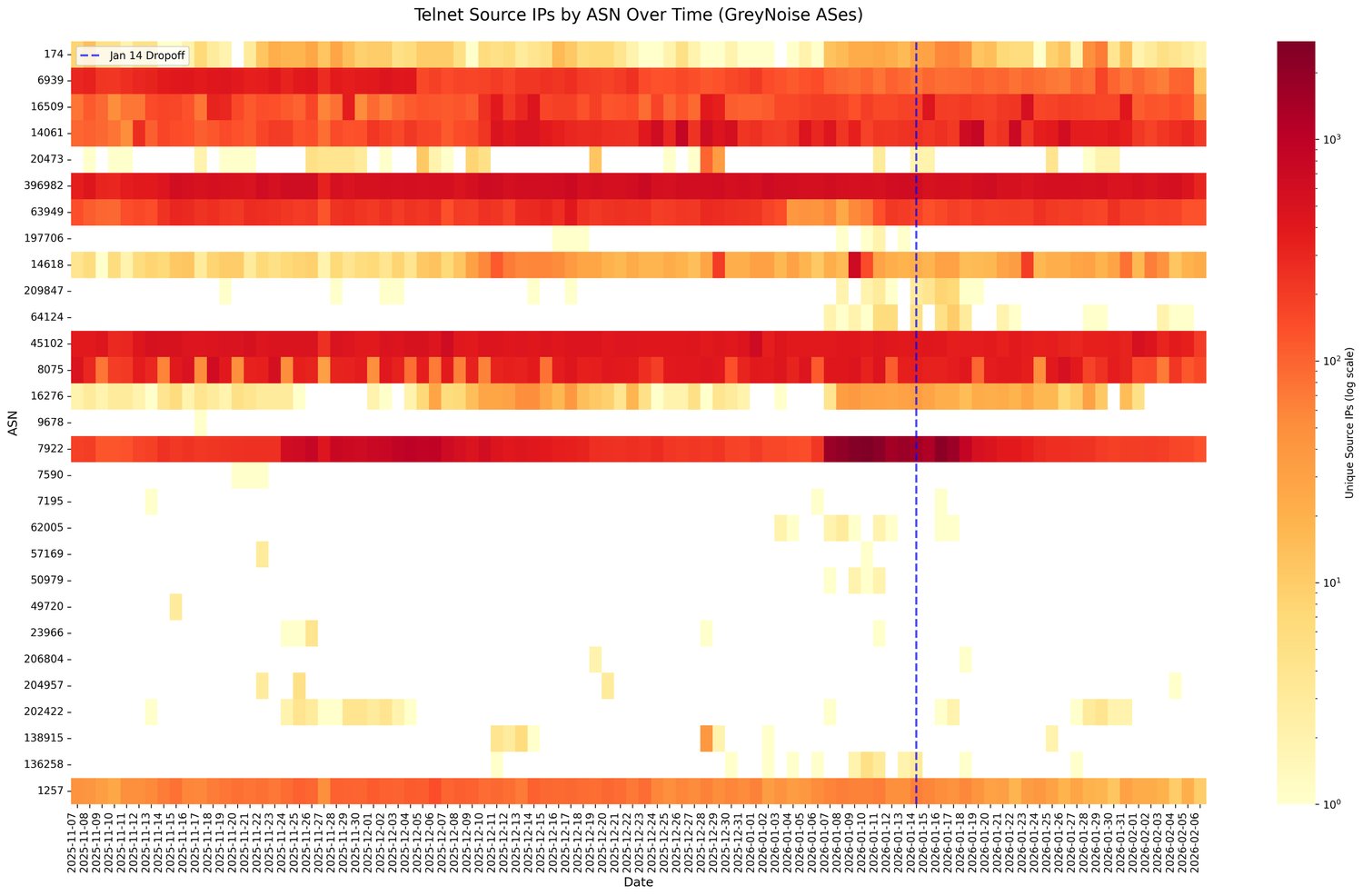
    The original report shows the number of Telnet sessions observed from GreyNoise across many source autonomous systems (ASes) by day. Their data show a dramatic shift in observed network traffic:

    a sudden, sustained collapse in global telnet traffic — not a gradual decline, not scanner attrition, not a data pipeline problem, but a step function. One hour, ~74,000 sessions. The next, ~22,000. By the following hour, we were down to ~11,000 and the floor held. (Link)

    We cross-checked this data against traffic observed by Terrace, other open observation data, and measurements of underlying routing infrastructure through RIPE Atlas. In sum, our results show that there is no new filtering of Telnet being performed by core ISPs. To be clear, we successfully performed Telnet traceroutes from reportedly-affected ASes to our servers as of today at 18:47 UTC.

    Evaluating Telnet Scanning

    Naturally, seeing such a dramatic and coordinated drop in traffic (from 10s of thousands down to zero) would make you suspect that the network is the common factor. As we describe below, the fundamental flaw of this approach is that sessions can be highly correlated: thousands of scans from disparate networks can be directly tied to individual noisy actions.

    At Terrace we use artificial intelligence to detect trends from our global deployment of network sensors in real-time, so when we saw this our first thought was “how could we have missed this?” We went to the data, and as far as we can tell, the answer is that we didn’t.

    We cross-checked ASes reported by GreyNoise against port 23 scanning data from Terrace. Of course, we filtered these to only incoming traffic that successfully completed the three-way TCP handshake to factor out IP spoofing. Here are those results:

    We next look at all the ASes observed by Terrace, the sum of sources seen in GreyNoise-referenced ASes, and specifically at the group that saw complete drop-off. In each case, there is no change in port 23 Telnet scanning behavior that we can attribute to broad ISP-level blocking. In fact, January 14 is part of a relative spike of Telnet scanning traffic.

    We also cross-checked our results against open network threat data. For instance, Dataplane.org does not see a large correlated drop in Telnet traffic, aligning with our results.

    Measuring Telnet Routing with RIPE Atlas

    To confirm our results, we also performed a measurement of Telnet traffic deliverability using RIPE Atlas. For ASes mentioned in the report as being blocked completely, we performed a Telnet traceroute, confirming that in 55 of 56 cases Telnet sessions were successfully established with our server. Our results confirm that, across referenced ASes, there is no observable widespread blocking of port 23 as of February 11.

    It’s not A, it’s B

    Looking at the original report’s data in light of our analysis, we can posit several potential interpretations that align with our observations.

    When you see such a coordinated drop-off, there’s likely a common factor. One possibility is core network backbones. However, in the context of data from Terrace and others we believe a more likely factor is the vantage point itself. Internet scanning often consists of large campaigns coordinated by specific actors, and in this case it is possible that an Internet scanner has managed to fingerprint GreyNoise’s apparatus and actively avoid it. Notably, such apparatus avoidance is something we’ve previously investigated in academic research.

    Another confounding factor is the use of total sessions to visualize this trend. Because a single Telnet exploit attempt could consist of many sessions, visuals can overstate the statistical significance of observed trends. In this case, it again is possible that the thousands of observed sessions in GreyNoise’s data are actually coming from a single coordinated actor, or even just a small handful of IPs. We recommend analyzing trends such as these in terms of unique network endpoints or fingerprintable behaviors rather than raw number of sessions.

    Takeaways

    The sky is not falling. Suggestions that core ISPs are censoring or filtering Telnet traffic are not supported by our observations. Of course, we fully support and echo GreyNoise’s encouragement to take CVE-2026-24061 seriously. In fact, the lack of core network protections yet further exemplifies that edge systems must be patched immediately.

    However, we strongly believe that any changes to operations or policy based on the expectation that Telnet is being filtered at the core are not warranted.

    Share. Facebook Twitter Pinterest LinkedIn Reddit WhatsApp Telegram Email
    Previous ArticleMarch’s Full Blood Moon Will Feature a Total Lunar Eclipse: Here’s When to See It
    Next Article Q&A: New UK onshore wind and solar is ‘50% cheaper’ than new gas
    TechAiVerse
    • Website

    Jonathan is a tech enthusiast and the mind behind Tech AI Verse. With a passion for artificial intelligence, consumer tech, and emerging innovations, he deliver clear, insightful content to keep readers informed. From cutting-edge gadgets to AI advancements and cryptocurrency trends, Jonathan breaks down complex topics to make technology accessible to all.

    Related Posts

    AMD surges 10 percent in desktop PC share, again

    February 12, 2026

    Google now lets you delete your personal info from search results

    February 12, 2026

    Microsoft just forked Windows

    February 12, 2026
    Leave A Reply Cancel Reply

    Top Posts

    Ping, You’ve Got Whale: AI detection system alerts ships of whales in their path

    April 22, 2025667 Views

    Lumo vs. Duck AI: Which AI is Better for Your Privacy?

    July 31, 2025256 Views

    6.7 Cummins Lifter Failure: What Years Are Affected (And Possible Fixes)

    April 14, 2025152 Views

    6 Best MagSafe Phone Grips (2025), Tested and Reviewed

    April 6, 2025111 Views
    Don't Miss
    Technology February 12, 2026

    AMD surges 10 percent in desktop PC share, again

    AMD surges 10 percent in desktop PC share, again Image: Adam Patrick Murray / Foundry…

    Google now lets you delete your personal info from search results

    Microsoft just forked Windows

    This Lenovo USB-C dock with 65 watts of power is just $76

    Stay In Touch
    • Facebook
    • Twitter
    • Pinterest
    • Instagram
    • YouTube
    • Vimeo

    Subscribe to Updates

    Get the latest creative news from SmartMag about art & design.

    About Us
    About Us

    Welcome to Tech AI Verse, your go-to destination for everything technology! We bring you the latest news, trends, and insights from the ever-evolving world of tech. Our coverage spans across global technology industry updates, artificial intelligence advancements, machine learning ethics, and automation innovations. Stay connected with us as we explore the limitless possibilities of technology!

    Facebook X (Twitter) Pinterest YouTube WhatsApp
    Our Picks

    AMD surges 10 percent in desktop PC share, again

    February 12, 20263 Views

    Google now lets you delete your personal info from search results

    February 12, 20263 Views

    Microsoft just forked Windows

    February 12, 20263 Views
    Most Popular

    7 Best Kids Bikes (2025): Mountain, Balance, Pedal, Coaster

    March 13, 20250 Views

    VTOMAN FlashSpeed 1500: Plenty Of Power For All Your Gear

    March 13, 20250 Views

    This new Roomba finally solves the big problem I have with robot vacuums

    March 13, 20250 Views
    © 2026 TechAiVerse. Designed by Divya Tech.
    • Home
    • About Us
    • Contact Us
    • Privacy Policy
    • Terms & Conditions

    Type above and press Enter to search. Press Esc to cancel.