

Research roundup: 6 cool science stories we almost missed
Also: final Muon g-2 results, an ultrasonic mobile brain imaging helmet, and re-creating Egyptian blue.
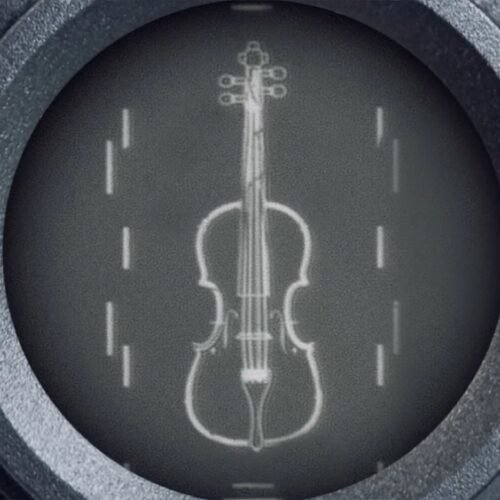
The “world’s smallest violin” created by Loughborough University physicists.
Credit:
Loughborough University
It’s a regrettable reality that there is never enough time to cover all the interesting scientific stories we come across each month. In the past, we’ve featured year-end roundups of cool science stories we (almost) missed. This year, we’re experimenting with a monthly collection. June’s list includes the final results from the Muon g-2 experiment, re-creating the recipe for Egyptian blue, embedding coded messages in ice bubbles, and why cats seem to have a marked preference for sleeping on their left sides.
Re-creating Egyptian blues
Close-up image of an ancient wooden Egyptian falcon. Researchers have found a way to reproduce the blue pigment visible on the artifact.
Credit:
Matt Unger, Carnegie Museum of Natural History
Artists in ancient Egypt were particularly fond of the color known as Egyptian blue—deemed the world’s oldest synthetic pigment—since it was a cheap substitute for pricier materials like lapis lazuli or turquoise. But archaeologists have puzzled over exactly how it was made, particularly given the wide range of hues, from deep blue to gray or green. That knowledge had long been forgotten. However, scientists at Washington State University have finally succeeded in recreating the recipe, according to a paper published in the journal npj Heritage Science.
The interdisciplinary team came up with 12 different potential recipes using varying percentages of silicon dioxide, copper, calcium, and sodium carbonate. They heated the samples to 1,000° Celsius (about what ancient artists could have achieved), varying the time between one and 11 hours. They also cooled the samples at different rates. Then they analyzed the samples using microscopy and other modern techniques and compared them to the Egyptian blue on actual Egyptian artifacts to find the best match.
Their samples are now on display at the Carnegie Museum of Natural History in Pittsburgh. Apart from its historical interest, Egyptian blue also has fascinating optical, magnetic, and biological properties that could prove useful in practical applications today, per the authors. For instance, it might be used for counterfeit-proof inks, since it emits light in the near-infrared, and its chemistry is similar to high-temperature superconductors.
npj Heritage Science, 2025. DOI: 10.1038/s40494-025-01699-7 (About DOIs).
World’s smallest violin
It’s an old joke, possibly dating back to the 1970s. Whenever someone is complaining about an issue that seems trivial in the grand scheme of things, it’s tradition to rub one’s thumb and forefinger together and declare, “This the world’s smallest violin playing just for you.” (In my snarky circles we used to say the violin was “playing ‘My Heart Bleeds for You.'”) Physicists at Loughborough University have now made what they claim really is the world’s smallest violin, just 35 microns long and 13 microns wide.
There are various lithographic methods for creating patterned electronic devices, such as photolithography, which can be used either with a mask or without. The authors relied on scanning probe thermal lithography instead, specifically a cutting-edge nano-sculpting machine they dubbed the NanoFrazor. The first step was to coat a small chip with two layers of a gel material and then place it under the NanoFrazor. The instrument’s heated tip burned the violin pattern into the gel. Then they “developed” the gel by dissolving the underlayer so that only a violin-shaped cavity remained.
Next, they poured on a thin layer of platinum and rinsed off the chip with acetone. The resulting violin is a microscopic image rather than a playable tiny instrument—you can’t even see it without a microscope—but it’s still an impressive achievement that demonstrates the capabilities of the lab’s new nano lithography system. And the whole process can take as little as three hours.
Muon g-2 anomaly no more?
Overhead view of the Muon g-2 experiment at Fermilab.
Credit:
Fermilab
The Muon g-2 experiment (pronounced “gee minus two”) is designed to look for tantalizing hints of physics beyond the Standard Model of particle physics. It does this by measuring the magnetic field (aka the magnetic moment) generated by a subatomic particle known as the muon. Back in 2001, an earlier run of the experiment at Brookhaven National Laboratory found a slight discrepancy, hinting at possible new physics, but that controversial result fell short of the critical threshold required to claim discovery.
Physicists have been making new measurements ever since in hopes of resolving this anomaly. For instance, in 2021, we reported on data from the updated Muon g-2 experiment that showed “excellent agreement” with the discrepancy Brookhaven recorded. They improved on their measurement precision in 2023. And now it seems the anomaly is very close to being resolved, according to a preprint posted to the physics arXiv based on analysis of a data set triple the size as the one used for the 2023 analysis. (You can watch a video explanation here.)
The final Muon g-2 result is in agreement with the 2021 and 2023 results, but much more precise, with error bars four times smaller than those of the original Brookhaven experiment. Combine that with new predictions by the related Muon g-2 Theory Initiative using a new means of calculating the muon’s magnetic moment, and the discrepancy between theoretical prediction and experiment narrows even further.
While some have declared victory, and the Muon g-2 experiment is completed, theorists are still sounding a note of caution as they seek to further refine their models. Meanwhile, Fermilab is building a new experiment designed to hunt for muon-to-electron conversions. If they find any, that would definitely comprise new physics beyond the Standard Model.
arXiv, 2025. DOI: 10.48550/arXiv.2506.03069 (About DOIs).
Message in a bubble
Physicists have embedded Morse code messages in ice bubbles.
Credit:
Keke Shao et al., 2025
Forget sending messages in a bottle. Scientists have figured out how to encode messages in both binary and Morse code in air bubbles trapped in ice, according to a paper published in the journal Cell Physical Science. Trapped air bubbles are usually shaped like eggs or needles, and the authors discovered that they could manipulate the sizes, shapes, and distribution of those ice bubbles by varying the freezing rate. (Faster rates produce egg-shaped bubbles, slower rates produce needle-shaped ones, for example.)
To encode messages, the researchers assigned different bubble sizes, shapes, and orientations to Morse code and binary characters and used their freezing method to produce ice bubbles representing the desired characters. Next, they took a photograph of the ice layer and converted it to gray scale, training a computer to identify the position and the size of the bubbles and decode the message into English letters and Arabic numerals. The team found that binary coding could store messages 10 times longer than Morse code.
Someday, this freezing method could be used for short message storage in Antarctica and similar very cold regions where traditional information storage methods are difficult and/or too costly, per the authors. However, Qiang Tang of the University of Australia, who was not involved in the research, told New Scientist that he did not see much practical application for the breakthrough in cryptography or security, “unless a polar bear may want to tell someone something.”
Cell Physical Science, 2025. DOI: 10.1016/j.xcrp.2025.102622 (About DOIs).
Cats prefer to sleep on left side
Caliban marches to his own drum and prefers to nap on his right side.
Credit:
Sean Carroll
The Internet was made for cats, especially YouTube, which features millions of videos of varying quality, documenting the crazy antics of our furry feline friends. Those videos can also serve the interests of science, as evidenced by the international team of researchers who analyzed 408 publicly available videos of sleeping cats to study whether the kitties showed any preference for sleeping on their right or left sides. According to a paper published in the journal Current Biology, two-thirds of those videos showed cats sleeping on their left sides.
Why should this behavioral asymmetry be the case? There are likely various reasons, but the authors hypothesize that it has something to do with kitty perception and their vulnerability to predators while asleep (usually between 12 to 16 hours a day). The right hemisphere of the brain dominates in spatial attention, while the right amygdala is dominant for processing threats. That’s why most species react more quickly when a predator approaches from the left. Because a cat’s left visual field is processed in the dominant right hemisphere of their brains, “sleeping on the left side can therefore be a survival strategy,” the authors concluded.
Current Biology, 2025. DOI: 10.1016/j.cub.2025.04.043 (About DOIs).
A mobile ultrasonic brain imaging helmet
A personalized 3D-printed helmet for mobile functional ultrasound brain imaging.
Credit:
Sadaf Soloukey et al., 2025
Brain imaging is a powerful tool for both medical diagnosis and neuroscience research, from noninvasive methods like EEGs, MRI, fMRI, and diffuse optical tomography, to more invasive techniques like intracranial EEG. But the dream is to be able to capture the human brain functioning in real-world scenarios instead of in the lab. Dutch scientists are one step closer to achieving that goal with a specially designed 3D-printed helmet that relies upon functional ultrasound imaging (fUSi) to enable high-quality 2D imaging, according to a paper published in the journal Science Advances.
Unlike fMRI, which requires subjects to remain stationary, the helmet monitors the brain as subjects are walking and talking (accompanied by a custom mobile fUSi acquisition cart). The team recruited two 30-something male subjects who had undergone cranioplasty to embed an implant made of polyetheretherketone (PEEK). While wearing the helmet, the subjects were asked to perform stationary motor and sensory tasks: pouting or brushing their lips, for example. Then the subjects walked in a straight line, pushing the cart for a minute up to 30 meters while licking their lips to demonstrate multitasking. The sessions ran over a 20-month period, thereby demonstrating that the helmet is suitable for long-term use. The next step is to improve the technology to enable mobile 3D imaging of the brain.
Science Advances, 2025. DOI: 10.1126/sciadv.adu9133 (About DOIs).
Jennifer is a senior writer at Ars Technica with a particular focus on where science meets culture, covering everything from physics and related interdisciplinary topics to her favorite films and TV series. Jennifer lives in Baltimore with her spouse, physicist Sean M. Carroll, and their two cats, Ariel and Caliban.
