

Rocket Report: SpaceX probes upper stage malfunction; Starship testing resumes
Amazon has booked 10 more launches with SpaceX, citing a “near-term shortage in launch capacity.”
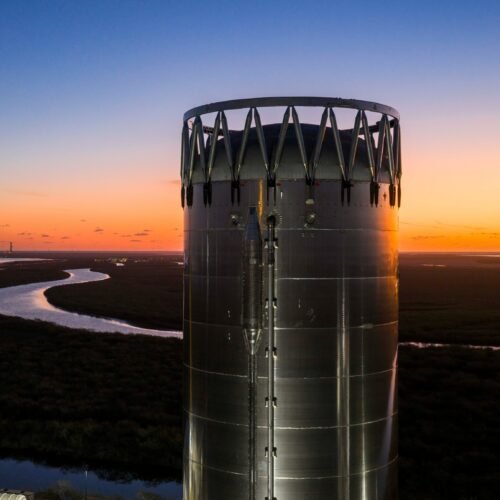
The top of SpaceX’s next Super Heavy booster, designated Booster 19, as the rocket undergoes testing at Starbase, Texas. The Rio Grande River is visible in the background.
Credit:
SpaceX
Welcome to Edition 8.28 of the Rocket Report! The big news in rocketry this week was that NASA still hasn’t solved the problem with hydrogen leaks on the Space Launch System. The problem caused months of delays before the first SLS launch in 2022, and the fuel leaks cropped up again Monday during a fueling test on NASA’s second SLS rocket. It is a continuing problem, and NASA’s sparse SLS launch rate makes every countdown an experiment, as my colleague Eric Berger wrote this week. NASA will conduct another fueling test in the coming weeks after troubleshooting the rocket’s leaky fueling line, but the launch of the Artemis II mission is off until March.
As always, we welcome reader submissions. If you don’t want to miss an issue, please subscribe using the box below (the form will not appear on AMP-enabled versions of the site). Each report will include information on small-, medium-, and heavy-lift rockets, as well as a quick look ahead at the next three launches on the calendar.
Blue Origin “pauses” New Shepard flights. Blue Origin has “paused” its New Shepard program for the next two years, a move that likely signals a permanent end to the suborbital space tourism initiative, Ars reports. The small rocket and capsule have been flying since April 2015 and have combined to make 38 launches, all but one of which were successful, and 36 landings. In its existence, the New Shepard program flew 98 people to space, however briefly, and launched more than 200 scientific and research payloads into the microgravity environment.
Moon first… So why is Blue Origin, founded by Jeff Bezos more than a quarter of a century ago, ending the company’s longest-running program? “We will redirect our people and resources toward further acceleration of our human lunar capabilities inclusive of New Glenn,” wrote the company’s chief executive, Dave Limp, in an internal email on January 30. “We have an extraordinary opportunity to be a part of our nation’s goal of returning to the Moon and establishing a permanent, sustained lunar presence.” The cancellation came, generally, as a surprise to Blue Origin employees. The company flew its most recent mission a week prior to the announcement, launching six people into space.
The easiest way to keep up with Eric Berger’s and Stephen Clark’s reporting on all things space is to sign up for our newsletter. We’ll collect their stories and deliver them straight to your inbox.
Firefly nears return to flight. Firefly Aerospace is preparing to launch its next 1-ton-class Alpha rocket later this month from Vandenberg Space Force Base, California. The Texas-based company announced last month that it shipped the Alpha rocket to the California spaceport, and a follow-up post on social media on January 29 showed a video of the rocket rolling out to its launch pad for testing. “Alpha is vertical on the pad and getting ready for our static fire ahead of the Stairway to Seven mission!” Firefly wrote on X.
Getting back on track... This is an important mission for Firefly’s Alpha rocket program. On the most recent Alpha flight last April, the rocket’s first stage exploded in flight, moments after separation from the second stage. The blast wave damaged the upper stage engine, preventing it from reaching orbit with a small commercial tech demo satellite. Then, in September, the booster stage for the next Alpha launch was destroyed during a preflight test in Texas. Firefly says the upcoming mission is purely a test flight and won’t fly with any customer payloads. The company announced that an upgraded “Block II” version of the Alpha rocket will debut on the subsequent mission.
China to test next-gen crew capsule. China is gearing up for an important test of its new Mengzhou spacecraft, perhaps as soon as February 11, according to airspace warning notices issued around the Wenchang spaceport on Hainan Island. Images from public viewing sites around the launch site showed a test model of the Mengzhou spacecraft being lifted atop a booster stage this week. The flight next week is expected to include an in-flight test of the capsule’s launch abort system. Mengzhou is China’s next-generation crew spacecraft for human flights to the Moon. It will also replace China’s Shenzhou crew spacecraft used for flights to the Tiangong space station in low-Earth orbit.
Proceeding apace... The in-flight abort test follows a pad abort test of the Mengzhou spacecraft last year as China marches toward the program’s first orbital test flight. The booster stage for the in-flight abort test is a subscale version of China’s new Long March 10 rocket, the partially reusable human-rated launcher under development for the country’s lunar program. Therefore, next week’s milestone flight will serve as an important test of not only the Mengzhou spacecraft but also its rocket.
SpaceX confirms upper stage malfunction. SpaceX kicked off the month of February with a Monday morning Falcon 9 rocket launch from Vandenberg Space Force Base in California. However, the rocket experienced an anomaly near the end of the mission, Spaceflight Now reports. The rocket deployed its payload of 25 Starlink satellites as planned, but SpaceX said the Falcon 9’s second stage “experienced an off-nominal condition” during preparation for an engine firing to steer back into the atmosphere for a guided, destructive reentry. The rocket remained in a low-altitude orbit and made an unguided reentry later in the week.
Launches temporarily on hold... “Teams are reviewing data to determine root cause and corrective actions before returning to flight,” SpaceX said in a statement. A Starlink launch from Florida originally planned for this week is now on hold. SpaceX returned the Falcon 9 rocket’s payload fairing, containing the Starlink payloads, from the launch pad back to the hangar at Kennedy Space Center to wait for the next launch opportunity. SpaceX’s Falcon 9 team in Florida is now focusing on preparations for launch of the Crew-12 mission to the International Space Station, targeted for no earlier than February 11. The schedule for Crew-12 will hinge on how quickly SpaceX can complete the investigation into Monday’s upper stage malfunction. (submitted by EllPeaTea)
Amazon’s new booking with SpaceX. Amazon has purchased an additional 10 Falcon 9 launches from SpaceX as part of its efforts to accelerate deployment of its broadband satellite constellation, Space News reports. The deal, which neither Amazon nor SpaceX previously announced, was disclosed in an Amazon filing with the Federal Communications Commission on January 30, seeking an extension of a July deadline to deploy half of its Amazon Leo constellation. Amazon has launched only 180 satellites of its planned 3,232-satellite constellation, rendering the July deadline unattainable. Amazon asked the FCC to extend the July deadline by two years or waive it entirely, but did not request an extension to the 2029 deadline for full deployment of the constellation.
“Near-term shortage in launch capacity”… In the filing with the FCC, Amazon said it faces a “near-term shortage of launch capacity” and is securing additional launch options “wherever available.” That effort includes working with SpaceX, whose Starlink constellation directly competes with Amazon Leo. Amazon bypassed SpaceX entirely when it made its initial orders for more than 80 Amazon Leo launches with United Launch Alliance, Arianespace, and Blue Origin, owned by Amazon founder Jeff Bezos. But Amazon later reserved three launches with SpaceX that flew last year and has now added 10 more SpaceX launches to its manifest. So far, Amazon has only launched satellites on ULA’s soon-to-retire Atlas V rocket and SpaceX’s Falcon 9. Amazon has not started flying on the new Vulcan, Ariane 6, or New Glenn rockets, which comprise the bulk of the constellation’s launch bookings. That could change next week with the first launch of Amazon Leo satellites on Europe’s Ariane 6 rocket. (submitted by EllPeaTea)
China launches satellite for Algeria. Algeria’s Alsat-3B mission, an Earth observation satellite developed in collaboration with China, launched aboard a Chinese Long March 2C rocket on January 30, Connecting Africa reports. Alsat-3B is the twin of Alsat-3A, which launched from China earlier in the month. Algeria’s government signed a contract with China in 2023 covering the development and launch of the two Alsat-3 satellites. Both satellites are designed to provide high‑resolution Earth observation imagery, enhancing Algeria’s geospatial intelligence capabilities.
Belt, road, and orbit… In a joint statement, Chinese President Xi Jinping said the Algerian remote-sensing satellite project is another successful example of China-Algeria aerospace cooperation and an important demonstration of the two nations’ comprehensive strategic partnership. China has inked similar space-related partnerships to produce and launch satellites for other African nations, including Egypt, Ethiopia, Nigeria, and Sudan.
Soyuz-5 launch set for March. Just a few months ago, Russia aimed to launch the first flight of the new Soyuz-5 medium-lift rocket before the end of 2025. Now, the Soyuz-5’s debut test flight is targeted for the end of March, Aviation Week & Space Technology reports. Dmitry Baranov, the deputy head of Roscosmos, announced the new schedule at a scientific conference in Moscow. The mission from the Baikonur Cosmodrome in Kazakhstan would mark the first flight of a new Russian rocket since 2014.
A reactionary rocket… Ars has reported on the Soyuz-5 project before. While the rocket will use a new overall design, the underlying technology is not all that new. The Soyuz-5, also named Irtysh, is intended to be a replacement for the Zenit rocket, a medium-lift launcher developed in the final years before the fall of the Soviet Union. The Zenit rocket’s main stages were manufactured in Ukraine, and tensions between Russia and Ukraine spelled the end of the Zenit program even before Russia invaded its neighbor in 2022. The Soyuz-5 uses a modified version of the RD-171 engine that has flown since the 1980s. This new RD-171 design uses all Russian components. The upper stage engine is based on the same design flown on Russia’s workhorse Soyuz-2 rocket.
Fueling test reveals leaks on SLS rocket. The launch of NASA’s Artemis II mission, the first flight of astronauts to the Moon in more than 53 years, will have to wait another month after a fueling test on Monday uncovered hydrogen leaks in the connection between the rocket and its launch platform at Kennedy Space Center in Florida, Ars reports. The practice countdown was designed to identify problems and provide NASA an opportunity to fix them before launch. Most importantly, the test revealed NASA still has not fully resolved recurring hydrogen leaks that delayed the launch of the unpiloted Artemis I test flight by several months in 2022. Artemis I finally launched successfully after engineers revised their hydrogen loading procedures to overcome the leak.
Hardware poor… Now, the second Space Launch System (SLS) rocket is on the cusp of launching a crew for the first time. Even as it reaches maturity, the rocket is going nowhere fast. It has been more than three years since NASA discovered leaks on the first SLS rocket. The rocket alone costs more than $2 billion to build. The program is hardware poor, leaving NASA unable to build a test model that might have been used to troubleshoot and resolve the hydrogen leaks before the agency proceeded into the Artemis II launch campaign. “Every SLS rocket is a work of art, every launch campaign an adventure, every mission subject to excessive delays. It’s definitely not ideal,” Ars reported in a story examining this problem.
SpaceX, meet xAI. SpaceX has formally acquired another one of Elon Musk’s companies, xAi, Ars reports. The merging of what is arguably Musk’s most successful company, SpaceX, with the more speculative xAI venture is a risk. Founded in 2023, xAI’s main products are the generative AI chatbot Grok and the social media site X, formerly known as Twitter. The company aims to compete with OpenAI and other artificial intelligence firms. However, Grok has been controversial, including the sexualization of women and children through AI-generated images, as has Musk’s management of Twitter.
Lots of assumptions… There can be no question that the merger of SpaceX—the world’s premier spaceflight company—and the artificial intelligence firm offers potential strategic advances. With this merger, Musk plans to use SpaceX’s deep expertise in rapid launch and satellite manufacturing and management to deploy a constellation of up to 1 million orbital data centers, providing the backbone of computing power needed to support xAI’s operations. All of this is predicated on several assumptions, including that AI is not a bubble, orbital data centers are cost-competitive compared to ground-based data centers, and that compute is the essential roadblock that will unlock widespread adoption of AI in society. Speculative, indeed, but only SpaceX has a rocket that might one day be able to realistically deploy a million satellites.
Starship testing resumes. The enormous rocket we’re talking about, of course, is SpaceX’s Starship. Ground teams at Starbase, Texas, have rolled the Super Heavy booster for SpaceX’s next Starship flight to a test stand for a series of checkouts ahead of the flight, currently slated for sometime in March. This will be the first launch of SpaceX’s upgraded “Block 3” Starship, with improvements aimed at making the rocket more reliable following several setbacks with Starship Block 2 last year.
Frosty night on the border… This is the second time a Block 3 booster has made the trip to the test stand at Starbase, located just north of the US-Mexico border. Booster 18 suffered a structural failure at the test site in November, forcing SpaceX to scrap it and complete the next rocket in line, Booster 19. On Wednesday night, SpaceX put Booster 19 through cryogenic proof testing, clearing a key milestone on the path to launch. The next flight will likely follow a similar profile as previous Starship missions, with a suborbital arc carrying the ship from its South Texas launch base to a splashdown in the Indian Ocean. If successful, the test will pave the way for bigger tests to come, including an in-space refueling demo and the catch and recovery of a Starship vehicle returning from space.
Next three launches
Feb. 7: Long March 2F | Chinese spaceplane? | Jiuquan Satellite Launch Center, China | 03:55 UTC
Feb. 7: Falcon 9 | Starlink 17-33 | Vandenberg Space Force Base, California | 17:05 UTC
Feb. 11: Falcon 9 | Crew-12 | Cape Canaveral Space Force Station, Florida | 11:01 UTC
Stephen Clark is a space reporter at Ars Technica, covering private space companies and the world’s space agencies. Stephen writes about the nexus of technology, science, policy, and business on and off the planet.
