Close Menu

    Subscribe to Updates

    Get the latest creative news from FooBar about art, design and business.

    What's Hot

    Ditch the Adobe subscription: This PDF editor is yours for life for $25

    Her AI agent nuked 200 emails. This guardrail stops the next disaster

    The Rundown: Why YouTube has become key for brand GEO strategies

    Facebook X (Twitter) Instagram
    • Artificial Intelligence
    • Business Technology
    • Cryptocurrency
    • Gadgets
    • Gaming
    • Health
    • Software and Apps
    • Technology
    Facebook X (Twitter) Instagram Pinterest Vimeo
    Tech AI Verse
    • Home
    • Artificial Intelligence

      Tensions between the Pentagon and AI giant Anthropic reach a boiling point

      February 21, 2026

      Read the extended transcript: President Donald Trump interviewed by ‘NBC Nightly News’ anchor Tom Llamas

      February 6, 2026

      Stocks and bitcoin sink as investors dump software company shares

      February 4, 2026

      AI, crypto and Trump super PACs stash millions to spend on the midterms

      February 2, 2026

      To avoid accusations of AI cheating, college students are turning to AI

      January 29, 2026
    • Business

      How Smarsh built an AI front door for regulated industries — and drove 59% self-service adoption

      February 24, 2026

      Where MENA CIOs draw the line on AI sovereignty

      February 24, 2026

      Ex-President’s shift away from Xbox consoles to cloud gaming reportedly caused friction

      February 24, 2026

      Gartner: Why neoclouds are the future of GPU-as-a-Service

      February 21, 2026

      The HDD brand that brought you the 1.8-inch, 2.5-inch, and 3.5-inch hard drives is now back with a $19 pocket-sized personal cloud for your smartphones

      February 12, 2026
    • Crypto

      BitMine Buys $93 Million in ETH, but Ethereum Slides as Holders Resume Selling

      February 24, 2026

      XRP Ledger Sets Multiple Key Records in February Despite Price Decline

      February 24, 2026

      Bhutan Rolls Out Solana-Backed Visas Even As Demand Stays Weak

      February 24, 2026

      ZachXBT Teases Major Crypto Exposé Ahead of Feb. 26 — How Is Smart Money Positioned?

      February 24, 2026

      Acurast turns 225,000 smartphones into a secure AI network on Base

      February 24, 2026
    • Technology

      Ditch the Adobe subscription: This PDF editor is yours for life for $25

      February 25, 2026

      Her AI agent nuked 200 emails. This guardrail stops the next disaster

      February 25, 2026

      The Rundown: Why YouTube has become key for brand GEO strategies

      February 25, 2026

      Brands celebrate tariff reprieve, but fresh uncertainty looms

      February 25, 2026

      In Graphic Detail: Publishers chase video podcast growth, but audio still leads

      February 25, 2026
    • Others
      • Gadgets
      • Gaming
      • Health
      • Software and Apps
    Check BMI
    Tech AI Verse
    You are at:Home»Technology»Simulating a Planet on the GPU: Part 1 (2022)
    Technology

    Simulating a Planet on the GPU: Part 1 (2022)

    TechAiVerseBy TechAiVerseNovember 12, 2025No Comments6 Mins Read2 Views
    Facebook Twitter Pinterest Telegram LinkedIn Tumblr Email Reddit
    Simulating a Planet on the GPU: Part 1 (2022)
    Share
    Facebook Twitter LinkedIn Pinterest WhatsApp Email

    Simulating a Planet on the GPU: Part 1 (2022)

    An epic tale from one of the Internetu2019s finest, LGR

    “},”hSize”:null,”floatDir”:null,”isOldBlock”:false,”html”:”“,”url”:”https://www.youtube.com/watch?v=3O_yXk8A98U”,”width”:854,”height”:480,”providerName”:”YouTube”,”thumbnailUrl”:”https://i.ytimg.com/vi/3O_yXk8A98U/hqdefault.jpg”,”resolvedBy”:”youtube”}” data-block-type=”32″ id=”block-yui_3_17_2_1_1654090592564_49617″>

    An epic tale from one of the Internet’s finest, LGR

    To be fair, it didn’t go anywhere. You can still boot up a copy, mess around with evolution, atmospheric conditions, and continental drift like it’s 1990… but it’s not 1990. We have 32 years of computing advances at our backs and yet no SimEarth 2. Sure there’s WorldBox and Worlds and a bunch of awesome planet generation projects, (1, 2, 3) but none allow me to play with plate tectonics, currents, or any of the “deep” factors underlying how the Earth really works.

    Sometime last year, I decided against writing Will Wright a letter, begging him to spend hundreds of hours making a SimEarth 2. Instead, I did what any good programmer would do and decided to devote thousands of my own hours into the same thing. This blog describes my first step toward such a goal: describing well over a year’s worth of work and the many detours taken along the way. While there’s a long way to go from here, I’m very happy to share my progress to this point, and promise to follow up with a “part 2” at some future date.

    Polygon-Based Approaches

    My first dozen or so approaches at realistic world generation involved generating polygons on a sphere, using Delaunay Triangulation and Voronoi Tessellation. These fancy-sounding processes allow us to cheaply turn a 2D surface (or indeed, spheres, thanks to this amazing blog) into a number of polygons for representing geographic features. Once I wrapped my head around wrapping Voronoi polygons around the North and South Poles, I managed to get something vaguely passing as a planet generated, and applied a nice water shader.

    The fundamental issue with a polygon-centric approach is one of tectonic plate realism: plate collisions require an incredible number of polygons to model correctly. Increasing the number of polygons in a Unity & C# environment proved prohibitively expensive, so I turned to an old favorite: C++. After finding Brendan Galea’s excellent YouTube channel and building the first of the three demos above in SDL2 & Vulkan I realized what a titanic task writing a custom engine for this project would be, and went back to the (Unity) drawing board.

    Cubemap-Overlap-Based Approaches

    Frustrated with the poor performance of my polygonal approach, I began to research Unity’s performance optimization tools. I chunked up and parallelized the Voronoi tessellation to no avail. I tried rearranging memory to no avail. Clearly, something about doing this amount of math on the CPU was beyond current processing capabilities… but what about the GPU?

    Like most programmers, I’d heard of the legendary power of GPUs, but had only really harnessed it via graphics programming or CUDA (for my Music ex Machina project). While I had some experience writing conventional shaders, learning how to write compute shaders seemed like a massive undertaking… but what option did I have? I had no room left on the CPU.

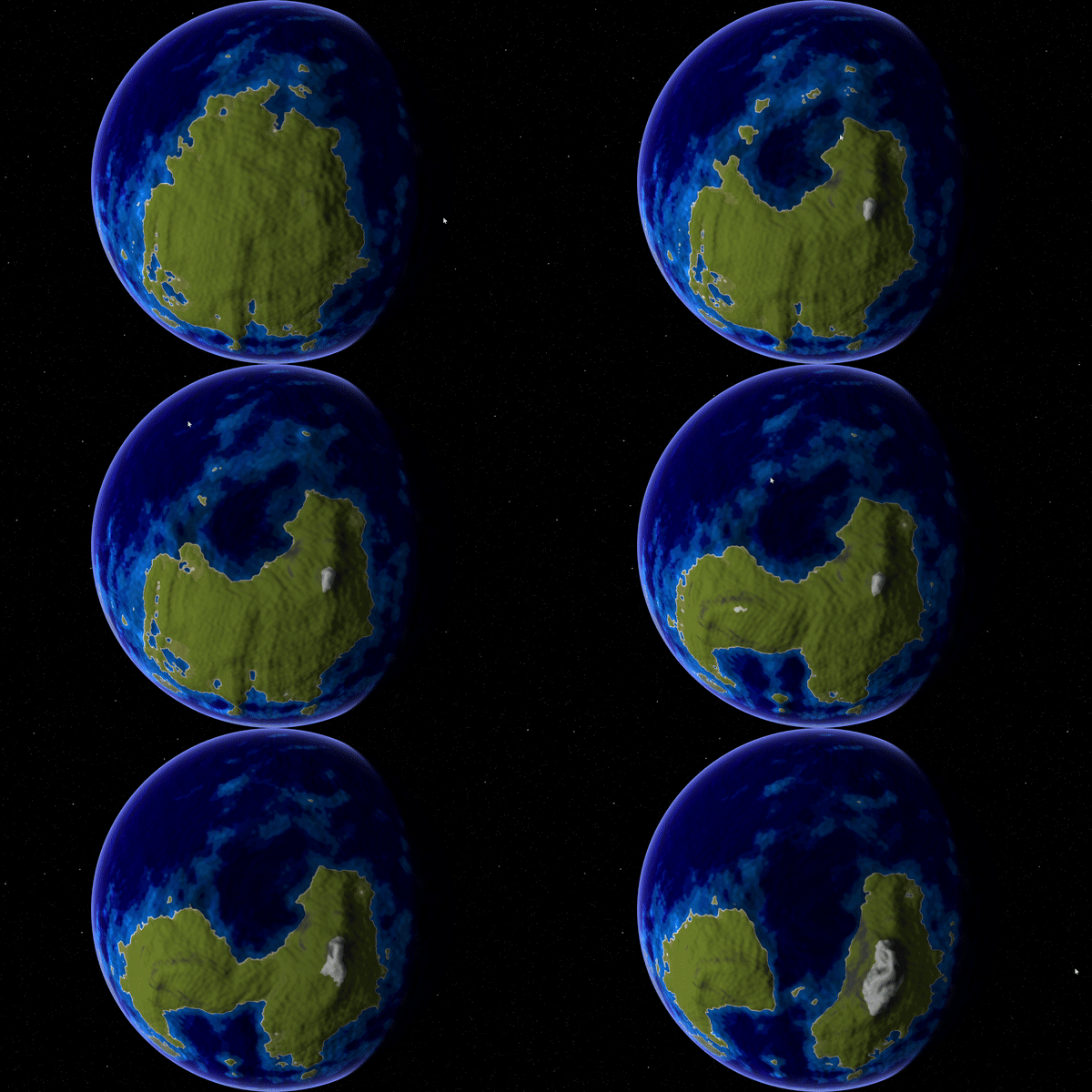
    Put simply, compute shaders are capable of applying a GPU’s heavily-parallelized workflow to arbitrary data, meaning I could simulate a world full of tectonic plates one “pixel” at a time. Once I figured out how to represent potentially world-spanning plates as cubemaps, I managed to create a neat compute shader-based simulation with plates colliding, subducting, and emerging from seafloor spreading… but never deforming.

    While I liked the direction this adventure in compute shaders had taken me, I needed some new technique which could realistically deform crust at convergent plate boundaries.

    Smoothed-Particle Hydrodynamics

    Inspiration can come from anywhere, and as luck would have it, the inspiration for my next step forward came from watching this physical simulation of a plate boundary. The use of sand for crust material makes realistic deformation possible… and reminded me of the falling sand games which were so popular when I was a kid. Could I simulate little bits of “crust” which could bump into one another, forming mountains and valleys? Could I use the same system for air and water?

    After a little digging, I discovered Smoothed-Particle Hydrodynamics, a technique commonly used in place of cellular fluid simulations. If I could just implement SPH on a sphere using my newfound knowledge of compute shaders, I’d have the fundamentals of a truly-unique planet sim. With a clear implementation strategy in mind, how long could implementing it possibly take?

    As it turns out, quite a while.

    Writing compute shaders is difficult, as is debugging and profiling them. I found myself performing true computer “science” on multiple occasions: forming a hypothesis about the performance impact of some new algorithm on the GPU and verifying it through good, old-fashioned experimentation. I learned a great deal in the process, most notably that computation is cheap and memory is expensive! More in depth, I’d highly recommend this incredible talk on compute shader performance optimization. I owe much of this project’s success to that talk.

    What’s Next?

    This project has proved one of the most difficult I’ve ever worked on, and yet, one of the most satisfying. I hope to build a great deal on this foundation, slowly approaching a fully-featured planetary simulation. Here are a few thoughts as to what might be next:

    • Create map modes to display the direction of the currents (at present you can only see the waves moving in the right direction)

    • Show the air currents in some clever way, perhaps with a moving cloud layer on top of the planet

    • Allow the wind to pick up moisture from warm bodies of water and precipitate it back on land… including rain shadows caused by mountain ranges

    • Allow currents to warm up the surrounding air, causing phenomenon like the North Atlantic Current’s miraculous warming of Europe.

    • Add hotspots, volcanoes, and a variety of rock types

    • Optimize it to run on hardware beyond my Surface Book 2

    Here’s to blog #2, with whatever new features that brings! Oh, and looking for a download link? Follow through to this page. Happy simulating : )


    Previous

    Joining the RPI HASS Leadership Council

    Patrick Celentano

    January 7, 2023

    Next

    Sonos Tech Blog #2

    Work

    Patrick Celentano

    May 13, 2022


    Share. Facebook Twitter Pinterest LinkedIn Reddit WhatsApp Telegram Email
    Previous ArticleYou will own nothing and be (un)happy
    Next Article Yann LeCun to depart Meta and launch AI startup focused on ‘world models’
    TechAiVerse
    • Website

    Jonathan is a tech enthusiast and the mind behind Tech AI Verse. With a passion for artificial intelligence, consumer tech, and emerging innovations, he deliver clear, insightful content to keep readers informed. From cutting-edge gadgets to AI advancements and cryptocurrency trends, Jonathan breaks down complex topics to make technology accessible to all.

    Related Posts

    Ditch the Adobe subscription: This PDF editor is yours for life for $25

    February 25, 2026

    Her AI agent nuked 200 emails. This guardrail stops the next disaster

    February 25, 2026

    The Rundown: Why YouTube has become key for brand GEO strategies

    February 25, 2026
    Leave A Reply Cancel Reply

    Top Posts

    Ping, You’ve Got Whale: AI detection system alerts ships of whales in their path

    April 22, 2025692 Views

    Lumo vs. Duck AI: Which AI is Better for Your Privacy?

    July 31, 2025279 Views

    6.7 Cummins Lifter Failure: What Years Are Affected (And Possible Fixes)

    April 14, 2025160 Views

    6 Best MagSafe Phone Grips (2025), Tested and Reviewed

    April 6, 2025122 Views
    Don't Miss
    Technology February 25, 2026

    Ditch the Adobe subscription: This PDF editor is yours for life for $25

    Ditch the Adobe subscription: This PDF editor is yours for life for $25 Image: StackCommerce…

    Her AI agent nuked 200 emails. This guardrail stops the next disaster

    The Rundown: Why YouTube has become key for brand GEO strategies

    Brands celebrate tariff reprieve, but fresh uncertainty looms

    Stay In Touch
    • Facebook
    • Twitter
    • Pinterest
    • Instagram
    • YouTube
    • Vimeo

    Subscribe to Updates

    Get the latest creative news from SmartMag about art & design.

    About Us
    About Us

    Welcome to Tech AI Verse, your go-to destination for everything technology! We bring you the latest news, trends, and insights from the ever-evolving world of tech. Our coverage spans across global technology industry updates, artificial intelligence advancements, machine learning ethics, and automation innovations. Stay connected with us as we explore the limitless possibilities of technology!

    Facebook X (Twitter) Pinterest YouTube WhatsApp
    Our Picks

    Ditch the Adobe subscription: This PDF editor is yours for life for $25

    February 25, 20262 Views

    Her AI agent nuked 200 emails. This guardrail stops the next disaster

    February 25, 20262 Views

    The Rundown: Why YouTube has become key for brand GEO strategies

    February 25, 20262 Views
    Most Popular

    7 Best Kids Bikes (2025): Mountain, Balance, Pedal, Coaster

    March 13, 20250 Views

    VTOMAN FlashSpeed 1500: Plenty Of Power For All Your Gear

    March 13, 20250 Views

    This new Roomba finally solves the big problem I have with robot vacuums

    March 13, 20250 Views
    © 2026 TechAiVerse. Designed by Divya Tech.
    • Home
    • About Us
    • Contact Us
    • Privacy Policy
    • Terms & Conditions

    Type above and press Enter to search. Press Esc to cancel.