

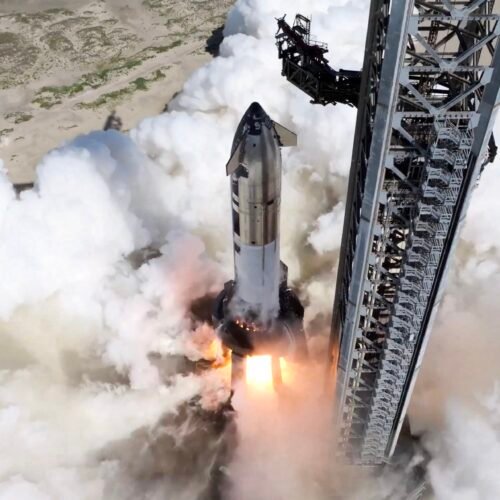
SpaceX reveals why the last two Starships failed as another launch draws near
“SpaceX can now proceed with Starship Flight 10 launch operations under its current license.”
SpaceX completed a six-engine static fire of the next Starship upper stage on August 1.
Credit:
SpaceX
SpaceX is continuing with final preparations for the 10th full-scale test flight of the company’s enormous Starship rocket after receiving launch approval Friday from the Federal Aviation Administration.
Engineers completed a final test of Starship’s propulsion system with a so-called “spin prime” test Wednesday at the launch site in South Texas. Ground crews then rolled the ship back to a nearby hangar for engine inspections, touchups to its heat shield, and a handful of other chores to ready it for liftoff.
SpaceX has announced the launch is scheduled for no earlier than next Sunday, August 24, at 6:30 pm local time in Texas (23:30 UTC).
Like all previous Starship launches, the huge 403-foot-tall (123-meter) rocket will take off from SpaceX’s test site in Starbase, Texas, just north of the US-Mexico border. The rocket consists of a powerful booster stage named Super Heavy, with 33 methane-fueled Raptor engines. Six Raptors power the upper stage, known simply as Starship.
With this flight, SpaceX officials hope to put several technical problems with the Starship program behind them. SpaceX is riding a streak of four disappointing Starship test flights from January through May, and and the explosion and destruction of another Starship vehicle during a ground test in June.
These setbacks followed a highly successful year for the world’s largest rocket in 2024, when SpaceX flew Starship four times and achieved new objectives on each flight. These accomplishments included the first catch of a Super Heavy booster back at the launch pad, proving the company’s novel concept for recovering and reusing the rocket’s first stage.
Starship’s record so far in 2025 is another story. The rocket’s inability to make it through an entire suborbital test flight has pushed back future program milestones, such as the challenging tasks of recovering and reusing the rocket’s upper stage, and demonstrating the ability to refuel another rocket in orbit. Those would both be firsts in the history of spaceflight.
These future tests, and more, are now expected to occur no sooner than next year. This time last year, SpaceX officials hoped to achieve them in 2025. All of these demonstrations are vital for Elon Musk to meet his promise of sending numerous Starships to build a settlement on Mars. Meanwhile, NASA is eager for SpaceX to reel off these tests as quickly as possible because the agency has selected Starship as the human-rated lunar lander for the Artemis Moon program. Once operational, Starship will also be key to building out SpaceX’s next-generation Starlink broadband network.
A good outcome on the next Starship test flight would give SpaceX footing to finally take a step toward these future demos after months of dithering over design dilemmas.
Elon Musk, SpaceX’s founder and CEO, presented an update on Starship to company employees in May. This chart shows the planned evolution from Starship Version 2 (left) to Version 3 (middle), and an even larger rocket (right) in the more distant future.
The FAA said Friday it formally closed the investigation into Starship’s most recent in-flight failure in May, when the rocket started leaking propellant after reaching space, rendering it unable to complete the test flight.
“The FAA oversaw and accepted the findings of the SpaceX-led investigation,” the federal regulator said in a statement. “The final mishap report cites the probable root cause for the loss of the Starship vehicle as a failure of a fuel component. SpaceX identified corrective actions to prevent a reoccurrence of the event.”
Diagnosing failures
SpaceX identified the most probable cause for the May failure as a faulty main fuel tank pressurization system diffuser located on the forward dome of Starship’s primary methane tank. The diffuser failed a few minutes after launch, when sensors detected a pressure drop in the main methane tank and a pressure increase in the ship’s nose cone just above the tank.
The rocket compensated for the drop in main tank pressure and completed its engine burn, but venting from the nose cone and a worsening fuel leak overwhelmed Starship’s attitude control system. Finally, detecting a major problem, Starship triggered automatic onboard commands to vent all remaining propellant into space and “passivate” itself before an unguided reentry over the Indian Ocean, prematurely ending the test flight.
Engineers recreated the diffuser failure on the ground during the investigation, and then redesigned the part to better direct pressurized gas into the main fuel tank. This will also “substantially decrease” strain on the diffuser structure, SpaceX said.
The FAA, charged with ensuring commercial rocket launches don’t endanger public safety, signed off on the investigation and gave the green light for SpaceX to fly Starship again when it is ready.
“SpaceX can now proceed with Starship Flight 10 launch operations under its current license,” the FAA said.
“The upcoming flight will continue to expand the operating envelope on the Super Heavy booster, with multiple landing burn tests planned,” SpaceX said in an update posted to its website Friday. “It will also target similar objectives as previous missions, including Starship’s first payload deployment and multiple reentry experiments geared towards returning the upper stage to the launch site for catch.”
File photo of Starship’s six Raptor engines firing on a test stand in South Texas.
Credit:
SpaceX
In the aftermath of the test flight in May, SpaceX hoped to fly Starship again by late June or early July. But another accident June 18, this time on the ground, delayed the program another couple of months. The Starship vehicle SpaceX assigned to the next flight, designated Ship 36, exploded on a test stand in Texas as teams filled it with cryogenic propellants for an engine test-firing.
The accident destroyed the ship and damaged the test site, prompting SpaceX to retrofit the sole active Starship launch pad to support testing of the next ship in line—Ship 37. Those tests included a brief firing of all six of the ship’s Raptor engines August 1.
After Ship 37’s final spin prime test Wednesday, workers transported the rocket back to a hangar for evaluation, and crews immediately got to work transitioning the launch pad back to its normal configuration to host a full Super Heavy/Starship stack.
SpaceX said the explosion on the test stand in June was likely caused by damage to a high-pressure nitrogen storage tank inside Starship’s payload bay section. This tank, called a composite overwrapped pressure vessel, or COPV, violently ruptured and led to the ship’s fiery demise. SpaceX said COPVs on upcoming flights will operate at lower pressures, and managers ordered additional inspections on COPVs to look for damage, more proof testing, more stringent acceptance criteria, and a hardware change to address the problem.
Try, try, try, try again
This year began with the first launch of an upgraded version of Starship, known as Version 2 or Block 2, in January. But the vehicle suffered propulsion failures and lost control before the upper stage completed its engine burn to propel the rocket on a trajectory carrying it halfway around the world to splash down in the Indian Ocean. Instead, the rocket broke apart and rained debris over the Bahamas and the Turks and Caicos Islands more than 1,500 miles downrange from Starbase.
That was followed in March by another Starship launch that had a similar result, again scattering debris near the Bahamas. In May, the ninth Starship test flight made it farther downrange and completed its engine burn before spinning out of control in space, preventing it from making a guided reentry to gather data on its heat shield.
Mastering the design of Starship’s heat shield is critical the future of the program. As it has on all of this year’s test flights, SpaceX has installed on the next Starship several different ceramic and metallic tile designs to test alternative materials to protect the vehicle during its scorching plunge back into Earth’s atmosphere. Starship successfully made it through reentry for a controlled splashdown in the sea several times last year, but sensors detected hot spots on the rocket’s stainless steel skin after some of the tiles fell off during launch and descent.
Making the Starship upper stage reusable like the Super Heavy booster will require better performance from the heat shield. The demands of flying the ship home from orbit and attempting a catch at the launch pad far outweigh the challenge of recovering a booster. Coming back from space, the ship encounters much higher temperatures than the booster sees at lower velocities.
Therefore, SpaceX’s most important goal for the 10th Starship flight will be gathering information about how well the ship’s different heat shield materials hold up during reentry. Engineers want to have this data as soon as possible to inform design decisions about the next iteration of Starship—Version 3 or Block 3—that will actually fly into orbit. So far, all Starship launches have intentionally targeted a speed just shy of orbital velocity, bringing the vehicle back through the atmosphere halfway around the world.
Other objectives on the docket for Starship Flight 10 include the deployment of spacecraft simulators mimicking the size of SpaceX’s next-generation Starlink Internet satellites. Like the heat shield data, this has been part of the flight plan for the last three Starship launches, but the rocket never made it far enough to attempt any payload deployment tests.
Thirty-three Raptor engines power the Super Heavy booster downrange from SpaceX’s launch site near Brownsville, Texas, in January.
Credit:
SpaceX
Engineers also plan to put the Super Heavy booster through the wringer on the next launch. Instead of coming back to Starbase for a catch at the launch pad—something SpaceX has now done three times—the massive booster stage will target a controlled splashdown in the Gulf of Mexico east of the Texas coast. This will give SpaceX room to try new things with the booster, such as controlling the rocket’s final descent with a different mix of engines to see if it could overcome a problem with one of its three primary landing engines.
SpaceX tried to experiment with new ways of landing of the Super Heavy booster on the last test flight, too. The Super Heavy exploded before reaching the ocean, likely due to a structural failure of the rocket’s fuel transfer tube, an internal pipe where methane flows from the fuel tank at the top of the rocket to the engines at the bottom of the booster. SpaceX said the booster flew a higher angle of attack during its descent in May to test the limits of the rocket’s performance. It seems engineers found the limit, and the booster won’t fly at such a high angle of attack next time.
SpaceX has just two Starship Version 2 vehicles in its inventory before moving on to the taller Version 3 configuration, which will also debut improved Raptor engines.
“Every lesson learned, through both flight and ground testing, continues to feed directly into designs for the next generation of Starship and Super Heavy,” SpaceX said. “Two flights remain with the current generation, each with test objectives designed to expand the envelope on vehicle capabilities as we iterate towards fully and rapidly reusable, reliable rockets.”
Stephen Clark is a space reporter at Ars Technica, covering private space companies and the world’s space agencies. Stephen writes about the nexus of technology, science, policy, and business on and off the planet.
