

Stem cell startup proclaims ‘inflection point’ for medicine as mass production nears
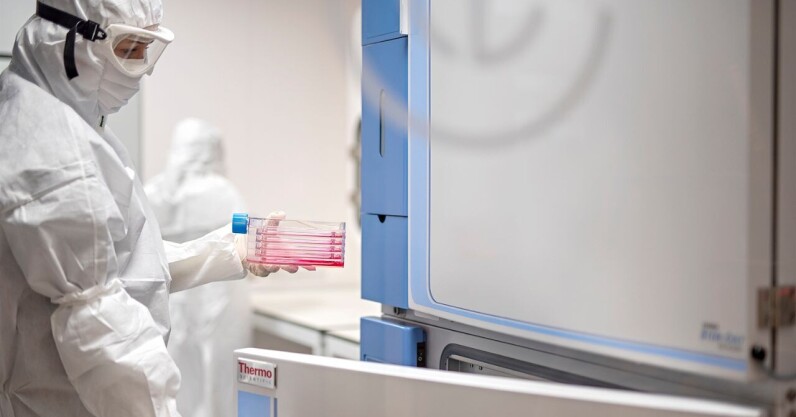
It’s harvest day at the Karolinska Institute in Stockholm. As sunshine bathes the leafy university campus, scientists inside the labs work under cool fluorescent light. Clad in green protective gear, they tend meticulously to test tubes within hermetically sealed cleanrooms. The containers hold the fruits of today’s labour: mesenchymal stem cells (MSCs).
Each cell is barely a quarter the width of a human hair but wields remarkable power. MSCs reduce inflammation, repair damaged tissue, and modulate the immune system. They can treat chronic diseases and delay ageing. They may even prevent illness before it begins. But to become a mainstay of modern healthcare, MSCs must be produced at scale, affordably and reliably.
That seemed a distant prospect until recently, but the Karolinska scientists believe it’s approaching reality. They’re working for Cellcolabs, a Swedish startup formed to tackle the global scarcity of stem cell treatments.
Cellcolabs believes this shortage could soon be overcome. Thanks to a blend of scientific, regulatory, and technological advances, MSCs are edging towards the consumer market. Within the next decade, Cellcolabs aims to cut prices by up to 90%.
The 💜 of EU tech
The latest rumblings from the EU tech scene, a story from our wise ol’ founder Boris, and some questionable AI art. It’s free, every week, in your inbox. Sign up now!
In the lab, the progress looks impressive. The latest harvest — cultivated from a single donation — has yielded 4.1 billion cells, enough for up to 200 standard doses.
Cellcolabs CEO Dr Mattias Bernow is in a buoyant mood. The 43-year-old sees today’s cultivation as just a taste of what’s to come.
“I truly believe that we’re at an inflection point in the history of medicine,” he says.
The power of MSCs
MSCs exist naturally in the body. A typical human contains billions of them. They act like a repair crew, fixing and tuning our insides. They can also be extracted, multiplied, and turned into medical treatments.
Karolinska was the site of one of the field’s biggest milestones. In 2012, its Nobel Assembly awarded the Nobel Prize in Physiology or Medicine to John Gurdon and Shinya Yamanaka. They discovered that mature cells can be made pluripotent — able to become almost any cell type in the body. The breakthrough rewrote the rules of regenerative medicine, igniting fresh regulatory momentum and fast-tracking stem cell therapies.
MSCs are among the most promising examples. When injected, they release signals that trigger healing. The body then repairs itself.
They can treat countless conditions, from arthritis and heart disease to immune disorders. But first, you need to extract a small sample from a living, breathing human.
Cellcolabs sources its MSCs from the bone marrow of healthy donors aged 18 to 30. Just 50 millilitres — about a shot glass — produces up to 200 doses. The marrow naturally regenerates in six to eight weeks.
The donation process is quick and minimally invasive, but mass production is notoriously challenging. MSCs are living cells that require complex biomanufacturing, careful handling, and strict quality control, which makes scaling a formidable task.
Cellcolabs nonetheless sees industrial-scale production on the horizon — largely thanks to the pioneering research of Professor Katarina Le Blanc.
Le Blanc’s landmark work showed MSCs could combat inflammatory and immune diseases. Her findings also proved that donated cells were suitable for therapeutic use — a crucial step for commercialisation.
She helped establish clinical-grade production standards, paving the way for large-scale trials and broader therapeutic use. Her research laid the foundations for Bernow’s inflection point.
“This is not brain surgery or rocket science, but it is stem cells — so it’s quite close,” he says. “It’s super complex. And the only reason we can do this and move so fast is Professor Le Blanc’s research.”
As a haematologist, Le Blanc explored the potential of MSCs to support blood cancer patients. Her early clinical work focused on graft-versus-host disease — a severe and often fatal complication of bone marrow transplants. In a small trial, her team administered MSCs to patients who hadn’t responded to standard therapies. The impact was striking: more than half the participants survived. “The entire field just blew up,” says Bernow.
Le Blanc continued pushing into new territory. One trial repaired vocal folds, restoring speech with minimal scarring. Another study used MSCs in COVID-19 patients to reduce inflammation. The results were promising — but she hit a wall. “She ran out of cells,” Bernow says.
Scaling became a new focus. To expand treatment access, To expand treatment access, Le Blanc donated her research to Cellcolabs in 2021. Two years later, the Karolinska facility received production approval.
Production costs have fallen rapidly since then, fuelling hopes of a tenfold reduction. As prices drop and output scales, Bernow has his eyes on a target: “to truly democratise access to stem cells.”
A new world of treatments
Back in the lab, CPO Lina Sörvik leads a tour of the facilities. Previously a senior figure in big pharma, she joined Cellcolabs after being captivated by the potential of MSCs.
“I was inspired by what they could do and by the idea of setting up a facility to produce them,” she says.
On a harvest day, her team’s work begins at 7:00 AM. Scientists don full protective gear and spend the day working inside the Karolinska cleanrooms. Once they’ve harvested the MSCs, the cells are tested for quality and frozen for future use.
The range of their applications is extensive. Middle-aged patients can gain relief from joint pain and injuries. Athletes can accelerate their recovery from injuries. The elderly could slow their ageing.
Brian Johnson, a tech entrepreneur and celebrity longevity advocate, has also explored their powers. He had 300 million MSCs produced by Cellcolabs injected into his knees, shoulders, and hips.
Bernow lauds the variety of treatments. He says MSCs are interesting “for almost any indication.”
His path to them was winding. Raised in Malmö, southwestern Sweden, Bernow moved to the country’s capital to study at the Stockholm School of Economics (SSE).
“At that time, everybody wanted to become bankers in London,” he recalls. “That was not the future I saw for myself.”
He expanded his studies, earning a medical degree from Karolinska Institute and an MSc from SSE. After working as a clinical physician and management consultant, he co-founded Doctrin, a digital healthcare platform. Then Cellcolabs came calling: the leadership team needed a CEO and saw Bernow as a perfect fit.
“I knew it was going to be more blood, sweat, and tears,” he says. “But the more I read, the more fascinated I became.”
What fascinated him the most was the potential of MSCs to treat chronic conditions — the leading cause of death in the world. “That is why I think we’re truly at an inflection point in the history of medicine.”
The new antibiotics?
Bernow likes to share a quote from Joseph Martin, former Dean of Harvard Medical School: “Stem cell therapies have the potential to do for chronic diseases what antibiotics did for infectious diseases.”
It’s a bold comparison. Before Alexander Fleming discovered penicillin in 1928, minor infections could be fatal. Healthy people died young or quickly aged.
A century later, antibiotics let us live longer, better lives. Infectious diseases are no longer the leading causes of death. They’ve been supplanted by chronic conditions like heart disease, stroke, Alzheimer’s, Parkinson’s, and diabetes. We’re also now living with more age-related illnesses, which severely reduce quality of life.
MSCs, Bernow says, can help alleviate the growing burden of chronic illness. “But as a physician, what I find most interesting is the potential to prevent — or at least delay — the onset of disease.”
He recalls his time working in the ER, treating cardiac patients. A typical case was a middle-aged man who had just suffered his first cardiac event, now resigned to a lower quality and potentially shorter life. MSCs could have transformed that outcome.
Their regenerative and anti-inflammatory powers could support recovery — or even prevent the event altogether.
To reach this potential, Cellcolabs is targeting a new launchpad for scale: bioreactors.
Scaling for the future
Inside the Karolinska cleanrooms, Cellcolabs currently grows MSCs on flat surfaces in cell medium. Bioreactors offer a promising upgrade.
By vastly expanding cultivation surfaces and enabling automated, tightly controlled growth conditions, they could scale production far beyond what’s feasible with today’s methods.
Cellcolabs is developing its bioreactor platform with the Royal Institute of Technology in Stockholm. Bernow expects it to transform production, multiplying MSC output many times over.
Full-scale launch is slated for 2028. By then, Cellcolabs also hopes to have compelling new evidence for the benefits of MSCs.
The startup is currently involved in promising tests in the Bahamas and Abu Dhabi. Both locations have created progressive, patient-friendly, and ethically regulated frameworks for MSC trials, which have made them industry trailblazers.
Across their test sites, scientists are investigating treatments for a variety of conditions: musculoskeletal injuries, knee osteoarthritis, cardiovascular risk, arthritis, and age-related frailty.
In smaller territories such as these, it’s easier to update medical regulations for emerging therapies. If they’re successful, Bernow expects other nations to follow their lead and accelerate their support for MSCs. The potential benefits, he argues, are enormous.
He envisions the tiny cells shifting healthcare systems from reactive to preventative, cutting costs while tackling chronic conditions. Our lives wouldn’t just grow longer — they’d be healthier and happier.
Bernow draws a contrast with recent advances in Western medicine. We live longer, but our later years are often marred by frailty, illness, and a confined existence.
“We’ve added years with lower life quality,” he says. “If stem cells can delay chronic disease onset, we can start prolonging our healthy lifespan.”
That doesn’t mean, he adds, that MSCs will create a fountain of youth. They won’t expand our lives forever, but they dramatically improve the time we have.
“I want to spend the first 100 years being highly active and with my family — with my children, my grandchildren, and maybe even my great great grandchildren.”
