Close Menu

    Subscribe to Updates

    Get the latest creative news from FooBar about art, design and business.

    What's Hot

    The enterprise voice AI split: Why architecture — not model quality — defines your compliance posture

    Former ULA President and CEO Tory Bruno Joins Blue Origin

    QNX Self-Hosted Developer Desktop

    Facebook X (Twitter) Instagram
    • Artificial Intelligence
    • Business Technology
    • Cryptocurrency
    • Gadgets
    • Gaming
    • Health
    • Software and Apps
    • Technology
    Facebook X (Twitter) Instagram Pinterest Vimeo
    Tech AI Verse
    • Home
    • Artificial Intelligence

      AI has become the norm for students. Teachers are playing catch-up.

      December 23, 2025

      Trump signs executive order seeking to ban states from regulating AI companies

      December 13, 2025

      Apple’s AI chief abruptly steps down

      December 3, 2025

      The issue that’s scrambling both parties: From the Politics Desk

      December 3, 2025

      More of Silicon Valley is building on free Chinese AI

      December 1, 2025
    • Business

      Top 10 cloud computing stories of 2025

      December 22, 2025

      Saudia Arabia’s STC commits to five-year network upgrade programme with Ericsson

      December 18, 2025

      Zeroday Cloud hacking event awards $320,0000 for 11 zero days

      December 18, 2025

      Amazon: Ongoing cryptomining campaign uses hacked AWS accounts

      December 18, 2025

      Want to back up your iPhone securely without paying the Apple tax? There’s a hack for that, but it isn’t for everyone… yet

      December 16, 2025
    • Crypto

      Bitcoin Under Trump Vs Biden: Who Actually Helped Crypto the Most? 

      December 27, 2025

      Vitalik Buterin Slams EU’s ‘No-Space’ Digital Rules

      December 27, 2025

      3 Altcoins To Watch This Weekend | December 27 – 28

      December 27, 2025

      Trust Wallet Incident Deepens as CZ Suggests Possible Insider Role

      December 27, 2025

      3 Altcoins That Could Hit New All-Time Highs In January 2026

      December 27, 2025
    • Technology

      The enterprise voice AI split: Why architecture — not model quality — defines your compliance posture

      December 27, 2025

      Former ULA President and CEO Tory Bruno Joins Blue Origin

      December 27, 2025

      QNX Self-Hosted Developer Desktop

      December 27, 2025

      Publishing your work increases your luck

      December 27, 2025

      Always Bet on Text

      December 27, 2025
    • Others
      • Gadgets
      • Gaming
      • Health
      • Software and Apps
    Check BMI
    Tech AI Verse
    You are at:Home»Technology»The paints, coatings, and chemicals making the world a cooler place
    Technology

    The paints, coatings, and chemicals making the world a cooler place

    TechAiVerseBy TechAiVerseDecember 27, 2025No Comments4 Mins Read1 Views
    Facebook Twitter Pinterest Telegram LinkedIn Tumblr Email Reddit
    The paints, coatings, and chemicals making the world a cooler place
    Share
    Facebook Twitter LinkedIn Pinterest WhatsApp Email

    The paints, coatings, and chemicals making the world a cooler place

    It’s getting harder to beat the heat. During the summer of 2025, heat waves knocked out power grids in North America, Europe, and the Middle East. Global warming means more people need air-­conditioning, which requires more power and strains grids. But a millennia-old idea (plus 21st-century tech) might offer an answer: radiative cooling. Paints, coatings, and textiles can scatter sunlight and dissipate heat—no additional energy required.

    “Radiative cooling is universal—it exists everywhere in our daily life,” says Qiaoqiang Gan, a professor of materials science and applied physics at King Abdullah University of Science and Technology in Saudi Arabia. Pretty much any object will absorb heat from the sun during the day and radiate some of it back at night. It’s why cars parked outside overnight are often covered with condensation, Gan says—their metal roofs dissipate heat into the sky, cooling the surfaces below the ambient air temperature. That’s how you get dew.

    Humans have harnessed this basic natural process for thousands of years. Desert peoples in Iran, North Africa, and India manufactured ice by leaving pools of water exposed to clear desert skies overnight, when radiative cooling happens naturally; other cultures constructed “cool roofs” capped with reflective materials that scattered sunlight and lowered interior temperatures. “People have taken advantage of this effect, either knowingly or unknowingly, for a very long time,” says Aaswath Raman, a materials scientist at UCLA and cofounder of the radiative­cooling startup SkyCool Systems.

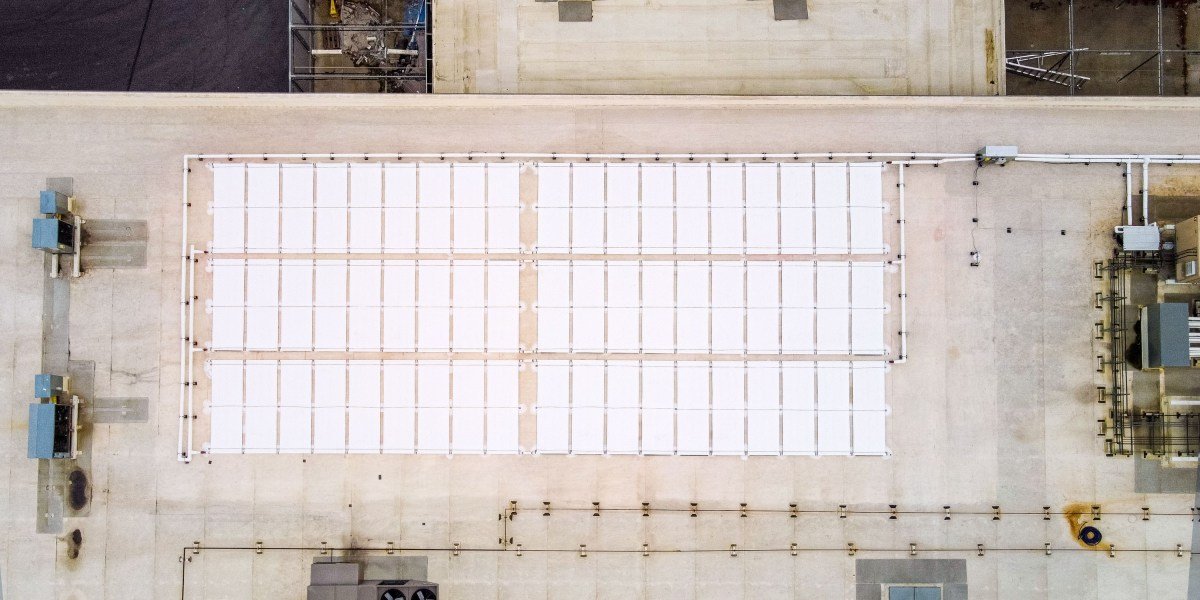
    Modern approaches, as demonstrated everywhere from California supermarket rooftops to Japan’s Expo 2025 pavilion, go even further. Normally, if the sun is up and pumping in heat, surfaces can’t get cooler than the ambient temperature. But back in 2014, Raman and his colleagues achieved radiative cooling in the daytime. They customized photonic films to absorb and then radiate heat at infrared wavelengths between eight and 13 micrometers—a range of electromagnetic wavelengths called an “atmospheric window,” because that radiation escapes to space rather than getting absorbed. Those films could dissipate heat even under full sun, cooling the inside of a building to 9 °F below ambient temperatures, with no AC or energy source required.

    That was proof of concept; today, Raman says, the industry has mostly shifted away from advanced photonics that use the atmospheric-window effect to simpler sunlight-scattering materials. Ceramic cool roofs, nanostructure coatings, and reflective polymers all offer the possibility of diverting more sunlight across all wavelengths, and they’re more durable and scalable.

    Now the race is on. Startups such as SkyCool, Planck Energies, Spacecool, and i2Cool are competing to commercially manufacture and sell coatings that reflect at least 94% of sunlight in most climates, and above 97% in humid tropical ones. Pilot projects have already provided significant cooling to residential buildings, reducing AC energy needs by 15% to 20% in some cases. 

    This idea could go way beyond reflective rooftops and roads. Researchers are developing reflective textiles that can be worn by people most at risk of heat exposure. “This is personal thermal management,” says Gan. “We can realize passive cooling in T-shirts, sportswear, and garments.” 

    A thermal image captured during a SkyCool installation shows treated areas (white, yellow) that are roughly 35 ºC cooler than the surrounding rooftop.

    COURTESY OF SKYCOOL SYSTEMS

    Of course, these technologies and materials have limits. Like solar power grids, they’re vulnerable to weather. Clouds prevent reflected sunlight from bouncing into space. Dust and air pollution dim materials’ bright surfaces. Lots of coatings lose their reflectivity after a few years. And the cheapest and toughest materials used in radiative cooling tend to rely on Teflon and other fluoropolymers, “forever chemicals” that don’t biodegrade, posing an environmental risk. “They are the best class of products that tend to survive outdoors,” says Raman. “So for long-term scale-up, can you do it without materials like those fluoropolymers and still maintain the durability and hit this low cost point?”

    As with any other solution to the problems of climate change, one size won’t fit all. “We cannot be overoptimistic and say that radiative cooling can address all our future needs,” Gan says. “We still need more efficient active air-conditioning.” A shiny roof isn’t a panacea, but it’s still pretty cool. 

    Becky Ferreira is a science reporter based in upstate New York and author of First Contact: The Story of Our Obsession with Aliens.

    Share. Facebook Twitter Pinterest LinkedIn Reddit WhatsApp Telegram Email
    Previous ArticleFake GrubHub emails promise tenfold return on sent cryptocurrency
    Next Article MIT Technology Review’s most popular stories of 2025
    TechAiVerse
    • Website

    Jonathan is a tech enthusiast and the mind behind Tech AI Verse. With a passion for artificial intelligence, consumer tech, and emerging innovations, he deliver clear, insightful content to keep readers informed. From cutting-edge gadgets to AI advancements and cryptocurrency trends, Jonathan breaks down complex topics to make technology accessible to all.

    Related Posts

    The enterprise voice AI split: Why architecture — not model quality — defines your compliance posture

    December 27, 2025

    Former ULA President and CEO Tory Bruno Joins Blue Origin

    December 27, 2025

    QNX Self-Hosted Developer Desktop

    December 27, 2025
    Leave A Reply Cancel Reply

    Top Posts

    Ping, You’ve Got Whale: AI detection system alerts ships of whales in their path

    April 22, 2025543 Views

    Lumo vs. Duck AI: Which AI is Better for Your Privacy?

    July 31, 2025191 Views

    6.7 Cummins Lifter Failure: What Years Are Affected (And Possible Fixes)

    April 14, 202597 Views

    6 Best MagSafe Phone Grips (2025), Tested and Reviewed

    April 6, 202587 Views
    Don't Miss
    Technology December 27, 2025

    The enterprise voice AI split: Why architecture — not model quality — defines your compliance posture

    The enterprise voice AI split: Why architecture — not model quality — defines your compliance…

    Former ULA President and CEO Tory Bruno Joins Blue Origin

    QNX Self-Hosted Developer Desktop

    Publishing your work increases your luck

    Stay In Touch
    • Facebook
    • Twitter
    • Pinterest
    • Instagram
    • YouTube
    • Vimeo

    Subscribe to Updates

    Get the latest creative news from SmartMag about art & design.

    About Us
    About Us

    Welcome to Tech AI Verse, your go-to destination for everything technology! We bring you the latest news, trends, and insights from the ever-evolving world of tech. Our coverage spans across global technology industry updates, artificial intelligence advancements, machine learning ethics, and automation innovations. Stay connected with us as we explore the limitless possibilities of technology!

    Facebook X (Twitter) Pinterest YouTube WhatsApp
    Our Picks

    The enterprise voice AI split: Why architecture — not model quality — defines your compliance posture

    December 27, 20250 Views

    Former ULA President and CEO Tory Bruno Joins Blue Origin

    December 27, 20250 Views

    QNX Self-Hosted Developer Desktop

    December 27, 20250 Views
    Most Popular

    What to Know and Where to Find Apple Intelligence Summaries on iPhone

    March 12, 20250 Views

    A Team of Female Founders Is Launching Cloud Security Tech That Could Overhaul AI Protection

    March 12, 20250 Views

    Senua’s Saga: Hellblade 2 leads BAFTA Game Awards 2025 nominations

    March 12, 20250 Views
    © 2025 TechAiVerse. Designed by Divya Tech.
    • Home
    • About Us
    • Contact Us
    • Privacy Policy
    • Terms & Conditions

    Type above and press Enter to search. Press Esc to cancel.