

The Reason Nuclear Reactors Glow Blue Is Surprisingly Simple
Parilov/Shutterstock
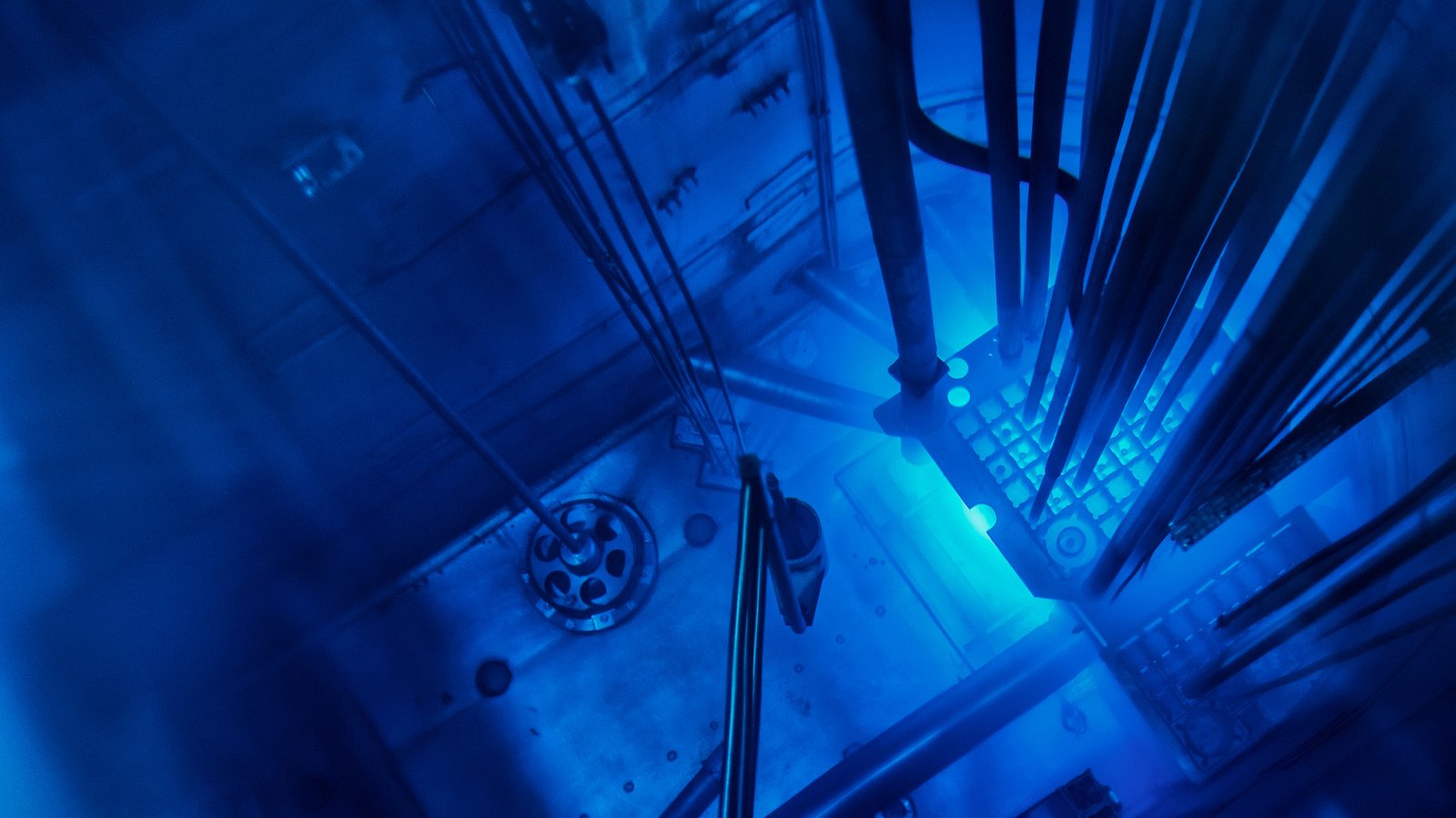
Nuclear reactors remain controversial. Events such as the Chernobyl disaster, with fallout so severe it may be creating a new kind of dog, continue to fuel safety concerns. Quite apart from the enormously significant concerns regarding nuclear waste, many don’t understand the complex processes that take place at the average reactor. The fact that they are sometimes seen to glow blue, for instance, is well known, but the question of why isn’t as complicated as you might think. Nor is it necessarily as worrisome: That blue glow is Cherenkov radiation, or the Cherenkov effect. It was named for Pavel Cherenkov of the former Soviet Union, who won the Nobel Prize in Physics in 1958 (along with Ilya Frank and Igor Tamm) for discovering and explaining how this effect occurs.
The answer, for those of us who aren’t brilliant Nobel Prize-winning physicists, is that the effect is caused by the movement of particles. The U.S. Department of Energy explains that particles with an electric charge, whether typically negatively-charged ones like electrons or positively-charged ones like protons, interrupt molecules of water when passing them. This causes a reaction that produces photons, or light particles, resulting in what the department refers to as “a visible shockwave of blue or violet light.”
It certainly looks very eerie, but in and of itself, there’s no threat from it. It’s just light produced as a byproduct of the activities at a given facility, creating an effect similar to the lightning in an aquarium tank in a way. The comparison is quite apt because, often, Cherenkov radiation is observed in water. Here’s why this is the case, as well as some of the scientific uses of Cherenkov radiation and some other places it can be found.
The connection between this blue glow and water
Parilov/Shutterstock
The United States boasts a huge amount of nuclear power plants, and the U.S. Department of Energy explains that the country predominantly uses light-water nuclear reactors. This specific type uses a process that requires a lot of water, into which the fuel rods (metal poles of sorts that contain carefully-deposited containers of uranium) are placed to help regulate their temperature. This is critical because the rods could potentially begin to melt if they reach extreme temperatures, causing exposure and risking meltdown. Such an event could have occurred at the number two reactor at Japan’s Fukushima Daiichi plant in 2011, when the rods were damaged.
The process of nuclear fission is reliant on the energy produced each time atoms split, and the efficiency of this process is increased when the chain reaction occurs at the optimal speed. The water through which the particles move keeps them at a more effective pace. The other thing that the water does with regards to Cherenkov radiation is slow down light as it moves through it. Particles are able to move faster than the light in this circumstance, which is how the aforementioned reaction that causes the glow happens.
It’s not just water. Light loses about one-third of its speed when passing through glass, for instance, meaning that the Cherenkov effect can be seen elsewhere, too. Hadron colliders, such as CERN’s iconic LHC, accelerate particles to incredible speeds, and so can produce the effect too. It can actually be incredibly useful for scientists because the angle and other qualities of the light are affected by the particular particles affected. Therefore, studying that glow tells researchers a lot about the particles and the circumstances that went into producing it.
