

The world’s smallest AI supercomputer is the size of a power bank
A palm-sized machine that can run a 120-billion-parameter model.
Tiiny AI
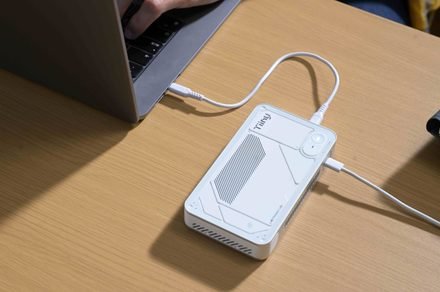
Tiiny AI has unveiled what Guinness World Records has verified as the world’s smallest personal AI supercomputer. It is called the Tiiny AI Pocket Lab, and despite being about the size of a power bank, it promises performance levels that normally require very expensive hardware. Other small supercomputers such as NVIDIA’s Project Digits, priced around $3,000, and the DGX Spark, which comes for $4,000, sit at price points that put them out of reach for most everyday users.
Tiiny AI argues that today’s real AI bottleneck is not computing power but our reliance on the cloud. GTM director Samar Bhoj says, “intelligence shouldn’t belong to data centers, but to people.” By running large models locally, the Pocket Lab aims to reduce cloud dependency, improve privacy, and make advanced AI feel personal rather than remote.
The tech that powers Tiiny AI’s supercomputer
The Pocket Lab measures just 14.2 × 8 × 2.53 cm and weighs only 300 grams, yet the company says it can deploy large language models with up to 120 billion parameters. Models of this size are normally associated with server racks or professional GPUs, but Tiiny AI wants to bring that capability to a device that fits in your hand.
The Pocket Lab is built on the newest ARM v9.2 12-cores CPU and supports popular open-source models such as GPT-OSS, Llama, Qwen, DeepSeek, Mistral, and Phi. At the heart of the device is a discrete neural processing unit capable of delivering 190 TOPS. It also includes 80 gigabytes of LPDDR5X memory, which allows for aggressive quantization so massive models can run locally without depending on cloud infrastructure.
Tiiny AI has also built two key technologies into the system. TurboSparse is a neuron-level sparse activation method that improves inference efficiency without reducing model intelligence. PowerInfer is a heterogeneous inference engine that splits AI workloads across the CPU and NPU, giving server-grade performance while keeping power demands low. This combination makes the Pocket Lab a compelling option for anyone experimenting with local AI, whether for research, robotics, or advanced reasoning tasks.
Tiiny AI plans to showcase the device at CES 2026. Pricing and release details are still under wraps, but the industry will be watching closely to see how a supercomputer this small performs once it reaches real users.
Manisha likes to cover technology that is a part of everyday life, from smartphones & apps to gaming & streaming…
Bridging the hybrid workforce: How AI-powered devices are empowering SMBs
For small and midsize businesses (SMBs), the shift to hybrid work brought both freedom and friction. Employees now expect to work from anywhere — home, office, adventure van, airport lounge, or café — but meeting those expectations with limited resources puts a lot of strain on an organization. Fortunately, a new wave of personalized, AI-driven technology is leveling the playing field. By minimizing friction across locations, personalized tech helps teams stay connected no matter where they work.
“For many small business owners, hybrid work can feel like juggling a dozen systems at once,” says Eric Yu, SVP of Worldwide Small and Medium Business Segment at Lenovo. “AI-powered devices help simplify that complexity.”
T-Mobile Fiber Home Internet delivers speed, stability, and simplicity
Today’s households need internet that can keep up with 4K streaming, remote working, competitive gaming, and all of our connected devices. Traditional broadband can’t always deliver the consistency required, and that’s where T-Mobile Fiber Home Internet stands out.
Built on advanced fiber-optic technology, T-Mobile Fiber is designed for the demands of today and tomorrow. Get multi-gig upload and download speeds and installation included. Plus, no annual contracts, no upfront equipment fees, and no surprise charges!
McDonald’s pulls its AI-generated Christmas ad after backlash
It’s safe to say that AI-generated ads are not going down well with audiences.
After the backlash that greeted Coca-Cola’s AI-generated Christmas ad last month, you’d expect other corporate giants to be more cautious about releasing their own AI-infused efforts.
But no.
