

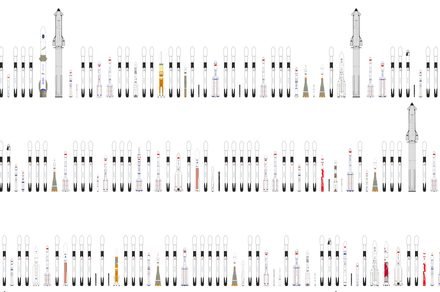
These awesome rocket charts are perfect for space nerds
Filters let you dive deep.
FlightAtlas
If you’re a fan of rocket launches, then you’ll absolutely love these charts created by Flight Atlas.
The site launched earlier this year but a recent post on X by Rocket Lab chief Peter Beck has brought it wider exposure.
Flight Atlas lets you filter rocket launches in a myriad of ways, including rocket type, date, country, and company. Hover the mouse over each rocket image to pull up the vehicle information and launch details.
Even better, it presents the data using stunning visuals that depict each and every rocket ever used, and presents them in size proportion based on real dimensions. With that in mind, notice how SpaceX’s 123-meter-tall Starship towers over all the others, and don’t miss Rocket Lab’s titchy Electron rocket, which is just 18 meters tall.
The default view on the Flight Atlas home page shows every rocket launch that’s taken place around the world from January 1 this year, and you’ll probably be surprised to see just how many there have been.
Once you start playing about with the filters, you’ll get some fascinating insight into the world of rocket launches. For example, compare the number of launches in 2011 to 2025 and you’ll see the impact that SpaceX has had with its workhorse Falcon 9 rocket.
In 2011, for example, there were only 78 rocket launches globally, with just two Falcon 9 launches taking place then. But in 2025, the chart expands dramatically, mainly due to the Falcon 9’s 160 launches to date, most of which have involved the deployment of Starlink internet satellites.
SpaceX’s massive Starship rocket first appears in the chart in 2023 when it took its maiden test flight. But look out — this beast will start to dominate the visuals, possibly from next year, as SpaceX seeks to significantly increase its test program for the next-gen rocket.
Not so many moons ago, Trevor moved from one tea-loving island nation that drives on the left (Britain) to another (Japan)…
Bridging the hybrid workforce: How AI-powered devices are empowering SMBs
For small and midsize businesses (SMBs), the shift to hybrid work brought both freedom and friction. Employees now expect to work from anywhere — home, office, adventure van, airport lounge, or café — but meeting those expectations with limited resources puts a lot of strain on an organization. Fortunately, a new wave of personalized, AI-driven technology is leveling the playing field. By minimizing friction across locations, personalized tech helps teams stay connected no matter where they work.
“For many small business owners, hybrid work can feel like juggling a dozen systems at once,” says Eric Yu, SVP of Worldwide Small and Medium Business Segment at Lenovo. “AI-powered devices help simplify that complexity.”
T-Mobile Fiber Home Internet delivers speed, stability, and simplicity
Today’s households need internet that can keep up with 4K streaming, remote working, competitive gaming, and all of our connected devices. Traditional broadband can’t always deliver the consistency required, and that’s where T-Mobile Fiber Home Internet stands out.
Built on advanced fiber-optic technology, T-Mobile Fiber is designed for the demands of today and tomorrow. Get multi-gig upload and download speeds and installation included. Plus, no annual contracts, no upfront equipment fees, and no surprise charges!
McDonald’s pulls its AI-generated Christmas ad after backlash
It’s safe to say that AI-generated ads are not going down well with audiences.
After the backlash that greeted Coca-Cola’s AI-generated Christmas ad last month, you’d expect other corporate giants to be more cautious about releasing their own AI-infused efforts.
But no.
