

This architect wants to build cities out of lava
Arnhildur Pálmadóttir was around three years old when she saw a red sky from her living room window. A volcano was erupting about 25 miles away from where she lived on the northeastern coast of Iceland. Though it posed no immediate threat, its ominous presence seeped into her subconscious, populating her dreams with streaks of light in the night sky.
Fifty years later, these “gloomy, strange dreams,” as Pálmadóttir now describes them, have led to a career as an architect with an extraordinary mission: to harness molten lava and build cities out of it.
Pálmadóttir today lives in Reykjavik, where she runs her own architecture studio, S.AP Arkitektar, and the Icelandic branch of the Danish architecture company Lendager, which specializes in reusing building materials.
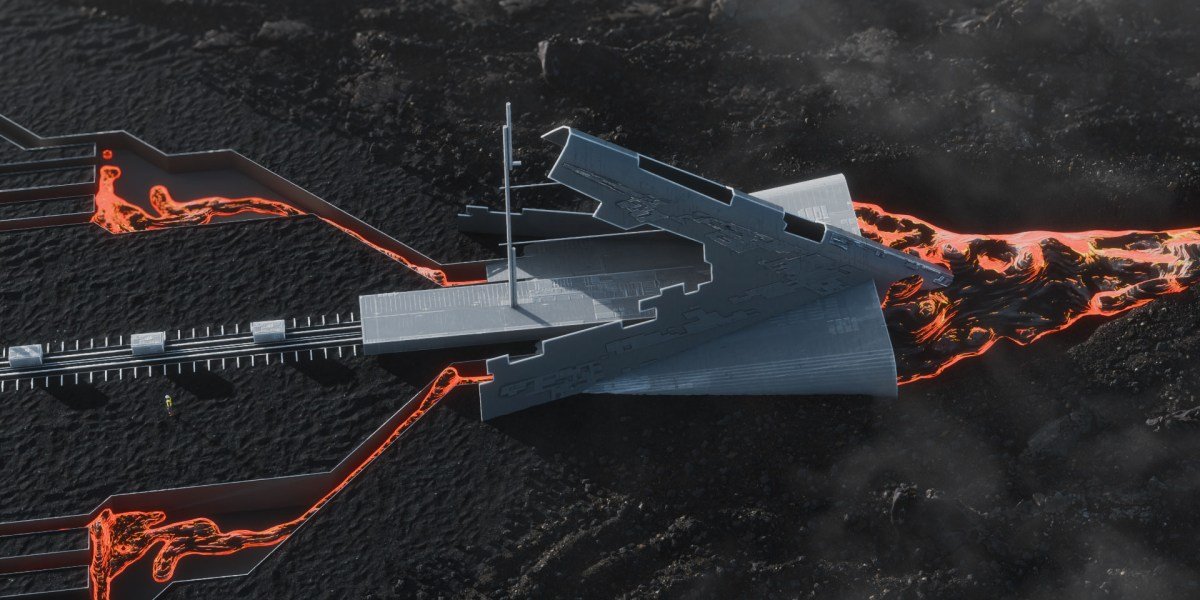
The architect believes the lava that flows from a single eruption could yield enough building material to lay the foundations of an entire city. She has been researching this possibility for more than five years as part of a project she calls Lavaforming. Together with her son and colleague Arnar Skarphéðinsson, she has identified three potential techniques: drill straight into magma pockets and extract the lava; channel molten lava into pre-dug trenches that could form a city’s foundations; or 3D-print bricks from molten lava in a technique similar to the way objects can be printed out of molten glass.
Pálmadóttir and Skarphéðinsson first presented the concept during a talk at Reykjavik’s DesignMarch festival in 2022. This year they are producing a speculative film set in 2150, in an imaginary city called Eldborg. Their film, titled Lavaforming, follows the lives of Eldborg’s residents and looks back on how they learned to use molten lava as a building material. It will be presented at the Venice Biennale, a leading architecture festival, in May.
COURTESY OF S.AP ARKITEKTAR
Buildings and construction materials like concrete and steel currently contribute a staggering 37% of the world’s annual carbon dioxide emissions. Many architects are advocating for the use of natural or preexisting materials, but mixing earth and water into a mold is one thing; tinkering with 2,000 °F lava is another.
Still, Pálmadóttir is piggybacking on research already being done in Iceland, which has 30 active volcanoes. Since 2021, eruptions have intensified in the Reykjanes Peninsula, which is close to the capital and to tourist hot spots like the Blue Lagoon. In 2024 alone, there were six volcanic eruptions in that area. This frequency has given volcanologists opportunities to study how lava behaves after a volcano erupts. “We try to follow this beast,” says Gro Birkefeldt M. Pedersen, a volcanologist at the Icelandic Meteorological Office (IMO), who has consulted with Pálmadóttir on a few occasions. “There is so much going on, and we’re just trying to catch up and be prepared.”
Pálmadóttir’s concept assumes that many years from now, volcanologists will be able to forecast lava flow accurately enough for cities to plan on using it in building. They will know when and where to dig trenches so that when a volcano erupts, the lava will flow into them and solidify into either walls or foundations.
Today, forecasting lava flows is a complex science that requires remote sensing technology and tremendous amounts of computational power to run simulations on supercomputers. The IMO typically runs two simulations for every new eruption—one based on data from previous eruptions, and another based on additional data acquired shortly after the eruption (from various sources like specially outfitted planes). With every event, the team accumulates more data, which makes the simulations of lava flow more accurate. Pedersen says there is much research yet to be done, but she expects “a lot of advancement” in the next 10 years or so.
To design the speculative city of Eldborg for their film, Pálmadóttir and Skarphéðinsson used 3D-modeling software similar to what Pedersen uses for her simulations. The city is primarily built on a network of trenches that were filled with lava over the course of several eruptions, while buildings are constructed out of lava bricks. “We’re going to let nature design the buildings that will pop up,” says Pálmadóttir.
The aesthetic of the city they envision will be less modernist and more fantastical—a bit “like [Gaudi’s] Sagrada Familia,” says Pálmadóttir. But the aesthetic output is not really the point; the architects’ goal is to galvanize architects today and spark an urgent discussion about the impact of climate change on our cities. She stresses the value of what can only be described as moonshot thinking. “I think it is important for architects not to be only in the present,” she told me. “Because if we are only in the present, working inside the system, we won’t change anything.”
Pálmadóttir was born in 1972 in Húsavik, a town known as the whale-watching capital of Iceland. But she was more interested in space and technology and spent a lot of time flying with her father, a construction engineer who owned a small plane. She credits his job for the curiosity she developed about science and “how things were put together”—an inclination that proved useful later, when she started researching volcanoes. So was the fact that Icelanders “learn to live with volcanoes from birth.” At 21, she moved to Norway, where she spent seven years working in 3D visualization before returning to Reykjavik and enrolling in an architecture program at the Iceland University of the Arts. But things didn’t click until she moved to Barcelona for a master’s degree at the Institute for Advanced Architecture of Catalonia. “I remember being there and feeling, finally, like I was in the exact right place,” she says.
Before, architecture had seemed like a commodity and architects like “slaves to investment companies,” she says. Now, it felt like a path with potential.
COURTESY OF S.AP ARKITEKTAR
COURTESY OF S.AP ARKITEKTAR
COURTESY OF S.AP ARKITEKTAR
COURTESY OF S.AP ARKITEKTAR
Lava has proved to be a strong, durable building material, at least in its solid state. To explore its potential, Pálmadóttir and Skarphéðinsson envision a city built on a network of trenches that have filled with lava over the course of several eruptions, while buildings are constructed with lava bricks.
She returned to Reykjavik in 2009 and worked as an architect until she founded S.AP (for “studio Arnhildur Pálmadóttir”) Arkitektar in 2018; her son started working with her in 2019 and officially joined her as an architect this year, after graduating from the Southern California Institute of Architecture.
In 2021, the pair witnessed their first eruption up close, near the Fagradalsfjall volcano on the Reykjanes Peninsula. It was there that Pálmadóttir became aware of the sheer quantity of material coursing through the planet’s veins, and the potential to divert it into channels.
Lava has already proved to be a strong, long-lasting building material—at least in its solid state. When it cools, it solidifies into volcanic rock like basalt or rhyolite. The type of rock depends on the composition of the lava, but basaltic lava—like the kind found in Iceland and Hawaii—forms one of the hardest rocks on Earth, which means that structures built from this type of lava would be durable and resilient.
For years, architects in Mexico, Iceland, and Hawaii (where lava is widely available) have built structures out of volcanic rock. But quarrying that rock is an energy-intensive process that requires heavy machines to extract, cut, and haul it, often across long distances, leaving a big carbon footprint. Harnessing lava in its molten state, however, could unlock new methods for sustainable construction. Jeffrey Karson, a professor emeritus at Syracuse University who specializes in volcanic activity and who cofounded the Syracuse University Lava Project, agrees that lava is abundant enough to warrant interest as a building material. To understand how it behaves, Karson has spent the past 15 years performing over a thousand controlled lava pours from giant furnaces. If we figure out how to build up its strength as it cools, he says, “that stuff has a lot of potential.”
In his research, Karson found that inserting metal rods into the lava flow helps reduce the kind of uneven cooling that would lead to thermal cracking—and therefore makes the material stronger (a bit like rebar in concrete). Like glass and other molten materials, lava behaves differently depending on how fast it cools. When glass or lava cools slowly, crystals start forming, strengthening the material. Replicating this process—perhaps in a kiln—could slow down the rate of cooling and let the lava become stronger. This kind of controlled cooling is “easy to do on small things like bricks,” says Karson, so “it’s not impossible to make a wall.”
Pálmadóttir is clear-eyed about the challenges before her. She knows the techniques she and Skarphéðinsson are exploring may not lead to anything tangible in their lifetimes, but they still believe that the ripple effect the projects could create in the architecture community is worth pursuing.
Both Karson and Pedersen caution that more experiments are necessary to study this material’s potential. For Skarphéðinsson, that potential transcends the building industry. More than 12 years ago, Icelanders voted that the island’s natural resources, like its volcanoes and fishing waters, should be declared national property. That means any city built from lava flowing out of these volcanoes would be controlled not by deep-pocketed individuals or companies, but by the nation itself. (The referendum was considered illegal almost as soon as it was approved by voters and has since stalled.)
For Skarphéðinsson, the Lavaforming project is less about the material than about the “political implications that get brought to the surface with this material.” “That is the change I want to see in the world,” he says. “It could force us to make radical changes and be a catalyst for something”—perhaps a social megalopolis where citizens have more say in how resources are used and profits are shared more evenly.
Cynics might dismiss the idea of harnessing lava as pure folly. But the more I spoke with Pálmadóttir, the more convinced I became. It wouldn’t be the first time in modern history that a seemingly dangerous idea (for example, drilling into scalding pockets of underground hot springs) proved revolutionary. Once entirely dependent on oil, Iceland today obtains 85% of its electricity and heat from renewable sources. “[My friends] probably think I’m pretty crazy, but they think maybe we could be clever geniuses,” she told me with a laugh. Maybe she is a little bit of both.
Elissaveta M. Brandon is a regular contributor to Fast Company and Wired.
