

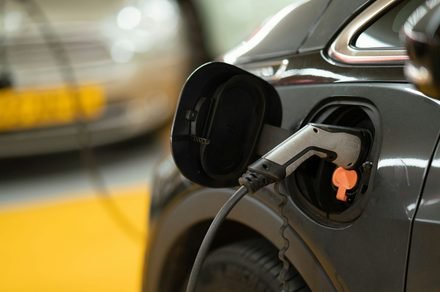
This new battery tech will let you fast-charge your EV without hurting battery health
CATL says its latest battery can handle ultra-fast charging without accelerating long-term degradation.
Unsplash
Chinese EV battery giant CATL claims it has cracked the code on ultra-fast charging without wrecking long-term battery health. If true, this breakthrough could eliminate one of the biggest pain points holding electric vehicles back.
In a video released late January, the battery maker unveiled its latest 5C lithium-ion battery, which is designed to handle ultra-fast charging without having a significant effect on long-term battery health. According to Inside EVs, the company claims the 5C battery can retain 80% of its original capacity after 1,400 charge cycles at an operating temperature of 140°F (60°C), translating to roughly 522,000 miles of use.
The battery can reportedly perform even better at a milder ambient temperature of 68°F (20°C), retaining 80% capacity even after 3,000 charge cycles, which equates to around 1.12 million miles of use. That’s far beyond what most current EV battery packs can manage, and enough to outlast many vehicles themselves.
How CATL says it pulled it off
CATL says these improvements were made possible by implementing a denser, more uniform cathode coating that slows degradation, a proprietary electrolyte additive that heals microcracks, and a temperature-responsive separator that migrates heat-induced stress. The company has also upgraded the battery management system, which can now actively cool hotspots to keep charging stress in check.
For now, CATL hasn’t said when these batteries will hit production vehicles or how they’ll perform in the real world. Lab figures often differ from how batteries behave in everyday conditions, but if the company’s claims hold up outside the lab, fast charging without a battery health penalty could finally stop being a trade-off for EV buyers.
Pranob is a seasoned tech journalist with over eight years of experience covering consumer technology. His work has been…
Honda just tested an AI system that lets your car automatically report potholes and damaged signs
The pilot in Ohio used sensors to detect road hazards and send real-time data to authorities.
If you’ve driven the same route long enough, you probably know exactly where a sign has faded away or where a pothole keeps getting “fixed” but never really goes away. Road problems like these are easy to spot from behind the wheel, but getting them onto a maintenance schedule often takes far longer. To address this, Honda has joined hands with DriveOhio on a new AI-powered road safety initiative that aims to spot and report issues proactively, using data gathered directly from vehicles as they move through everyday traffic.
In its official announcement, Honda says it has completed what it’s calling a nation-first test in Ohio that uses advanced vision and LiDAR sensors to identify issues like potholes, deteriorating pavements, damaged guardrails, and missing or obstructed road signs. During the pilot, a small fleet of Honda vehicles covered around 3,000 miles across a mix of urban and rural routes, operating in varying weather conditions and at different times of day, to identify these issues with impressive accuracy.
You might finally see CarPlay Ultra beyond a $200,000 Aston Martin
After a slow start limited to ultra-expensive cars, Apple’s bespoke dashboard system is tipped for a major mainstream model later this year.
CarPlay Ultra has had a rough start. So far, it’s been tough to find outside of an Aston Martin priced north of $200,000, which is an odd place for a company with Apple’s scale to leave a new platform.
That may change before year’s end, according to a report from Bloomberg. CarPlay Ultra is said to be headed to at least one big new Hyundai or Kia model in the second half of this year, a move that would put the system in front of far more drivers than its current niche run.
Slate wants to build more than just a cheap truck
The EV startup behind the affordable Slate pickup teases future models as demand surges.
Electric vehicle startup Slate Auto may have grabbed headlines with its ultra-affordable electric pickup, but it doesn’t intend to stop there. In a recent interview with InsideEVs, CEO Chris Barman said that while the company’s first model, a stripped-down EV truck designed to cost in the “mid-$20,000” range, still needs a final price and production ramp-up, Slate aspires to build additional electric vehicles beyond its debut model.
The first Slate truck, a compact rear-motor, two-door electric pickup with an optional extended range battery, has quickly become one of the EVs to look forward to, which is expected to start production toward the end of 2026 at a Midwestern U.S. plant. Slate claimed more than 150,000 refundable reservations late last year, roughly matching the company’s targeted maximum annual output once production peaks in 2027.
