

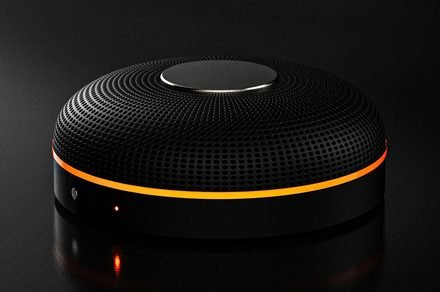
This smart device stops sneaky AI devices and gadgets from listening to your conversations
Spectre I creates a two meter privacy zone to block nearby microphones
Deveillance
A new device aims to give people control over who can hear them in a world filled with gadgets that are always listening and capturing your conversations. A startup called Deveillance has introduced Spectre I, a portable device designed to stop microphones in nearby devices from recording your voice.
Today, we’re introducing Spectre I, the first smart device to stop unwanted audio recordings.
We live in a world of always-on listening devices.
Smart devices and AI dominate our world in business and private conversations.
With Deveillance, you will @be_inaudible. pic.twitter.com/WdxmnyFq1I
— Aida Baradari (@aidaxbaradari) March 3, 2026
The company says the device can make conversations unintelligible to phones, smart speakers, laptops, and other gadgets that constantly listen for audio. The idea addresses a growing concern around always-on devices.
According to the company, about 14.4 billion devices worldwide are continuously listening for voice input. These recordings often become valuable data sources used for data mining, training artificial intelligence systems, influencing our buying behaviours or deepest opinions.
Even a short sample of speech can reveal sensitive personal details. Around 30 seconds of voice data can help determine traits such as age, weight, income level, and even health information.
A device that creates a privacy bubble around your voice
Spectre I works by creating a two meter protection zone around the user. When activated, it scans for nearby microphones and emits signals that humans cannot hear, but microphones can detect.
These signals overlay your speech so that recording devices receive distorted audio that cannot be understood.
Unlike traditional signal jammers that rely on strong radio interference, the device uses artificial intelligence, signal processing, and physics based research to target microphones directly.
The system operates locally on the device and does not send any data to the cloud. The portable design of Spectre I makes it easy to carry anywhere.
Deveillance says this makes it useful in business meetings, personal conversations, or any situation where people want to keep discussions private.
The company has opened pre-orders for Spectre I with a refundable deposit of $1,199. The device is currently in development, with the first shipments expected in the second half of 2026.
Privacy groups like the Electronic Frontier Foundation have long warned about the risks of always-on surveillance. Deveillance says Spectre I is only the beginning of its effort to give users more control over how their data is collected and shared.
Manisha likes to cover technology that is a part of everyday life, from smartphones & apps to gaming & streaming…
This low-cost orange-sized sensor could be what self-driving cars need to hit public roads
The missing piece for self-driving car safety might be an “extra set of eyes”.
A team of engineers at Rice University has developed a tiny new sensor that could dramatically improve the safety of self-driving cars on public roads. This is a compact, low-power millimeter-wave radar sensor roughly the size of an orange. The new tech, dubbed EyeDar, is designed to work as an “extra set of eyes” by enhancing radar perception in places where a vehicle’s own sensors may struggle, such as blind spots, intersections, or poor visibility conditions.
Why existing sensors fall short
Forget Starlink. ESA just tested gigabit-class satellite-to-airplane internet service
ESA and Airbus hit 2.6 Gbps from a plane to a satellite 36,000 km away, paving the way for streaming at 35,000 feet.
Airplane Wi-Fi might finally catch up to the 21st century. The European Space Agency and Airbus just proved it’s possible to beam gigabit internet from space to a moving aircraft using lasers.
The test hit 2.6 gigabits per second between a plane and the Alphasat satellite 36,000 kilometers above Earth. That speed held for several minutes. An HD movie downloads in seconds at that rate. The connection stayed stable the whole time, even with the aircraft moving and punching through clouds.
Scientists crack the code to using DNA like a computer hard drive
The same molecule that stores your genetic code might soon be storing your vacation photos.
Even before the AI boom, data centers were already consuming staggering amounts of energy and natural resources. Now, generative AI has intensified that strain, exposing just how unsustainable our current storage infrastructure really is. It’s forcing us to rethink how we store data and pushing us toward alternative storage solutions.
One area gaining serious attention is DNA-based data storage, which encodes digital information into synthetic strands of DNA. A storage medium so compact and durable that it could dramatically reduce the need for sprawling, energy-hungry data centers.
