

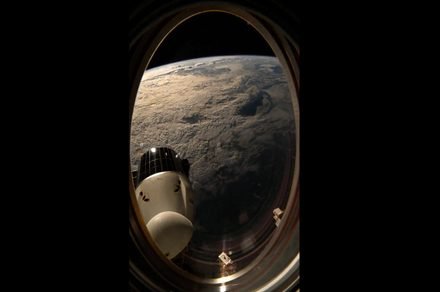
This stunning space time lapse ‘shows a little of everything’
It was made during a special maneuver that made big changes to the space station’s orientation.
NASA
Orbiting 250 miles above Earth, the views from the International Space Station (ISS) are second to none, and always make a huge impact on astronauts lucky enough to stay there.
NASA’s Zena Cardman, who returned form the ISS in January after a visit lasting just over five months, this week shared a gorgeous time lapse (below) showing “a little of everything,” including sunset, lightning storms, air glow, moon glint, stars, and sunrise, and even a docked Dragon spacecraft bathing in the ever-changing light.
“The space station rarely makes big changes to its orientation, but we were lucky to experience such maneuvers (flipping around to fly butt-first, then flipping back again) before and after each CRS-33 reboost,” Cardman wrote in her post, referring to how the station is occasionally nudged to a higher orbit by a docked spacecraft to counteract atmospheric drag that gradually lowers its altitude.
“This 60x speed time lapse was one of my favorites since it captures a little of everything — sunset, lightning storms, air glow, moon glint, stars, and sunrise — as we did one (actually very slow) orbital cartwheel from Atlantic to Pacific.”
The @Space_Station rarely makes big changes to its orientation, but we were lucky to experience such maneuvers (flipping around to fly butt-first, then flipping back again) before and after each @spacex CRS-33 reboost. This 60x speed timelapse was one of my favorites since it… pic.twitter.com/7IsZnb1G7G
— Zena Cardman (@zenanaut) February 17, 2026
The station is orbiting Earth at about 17,500 mph (28,000 kph), circling the planet around 16 times in every 24-hour period. That means astronauts aboard the ISS get to experience 16 sunsets and 16 sunrises during that period.
Whether light or dark, many astronauts like to head to the seven-window Cupola during their time off, grabbing a camera to get some shots of Earth or set up a time lapse.
French astronaut Thomas Pesquet even published a book showcasing his impressive work. Pesquet planned his time aboard the ISS carefully, taking breaks from science work when he knew the station would be passing over a visually striking part of Earth. Camera in hand, the astronaut would capture breathtaking shots before sharing them on social media.
American astronaut Don Pettit has also earned a reputation for his stunning visual work captured aboard the ISS, with some of his more surreal images also receiving much praise.
Not so many moons ago, Trevor moved from one tea-loving island nation that drives on the left (Britain) to another (Japan)…
NASA confirms target date for crewed Artemis II lunar flight
It’s also announced a date for the second wet dress rehearsal.
NASA has announced a date for the second wet dress rehearsal for the SLS rocket that will send a crew of astronauts on a voyage around the moon in the highly anticipated Artemis II mission.
The space agency also confirmed that the earliest the rocket could launch is Friday, March 6.
Watch NASA’s trailer for imminent crewed launch to ISS
NASA and SpaceX are targeting early Friday morning for launch.
NASA is just hours away from its first crewed launch of 2026, and its first since Crew-11 flew to orbit in August last year.
Just ahead of Crew-12’s liftoff, the space agency has released a short trailer (above) for the mission, which will send four astronauts to the International Space Station (ISS). The crew will travel aboard a SpaceX Dragon capsule carried to orbit by a SpaceX Falcon 9 rocket.
Space Coast to light up tonight with ULA’s Vulcan blastoff — how to watch
It’s the rocket’s first launch since August last year.
As SpaceX and NASA gear up for the Crew-12 launch from Cape Canaveral in Florida early on Friday morning, its colleagues at United Launch Alliance (ULA) are just hours away from sending the Vulcan Centaur rocket skyward on only its fourth flight.
A two-hour launch window opens at 3:30 a.m. ET (12:30 a.m. PT) on Thursday, February 12, at Cape Canaveral’s Space Launch Complex-41.
