

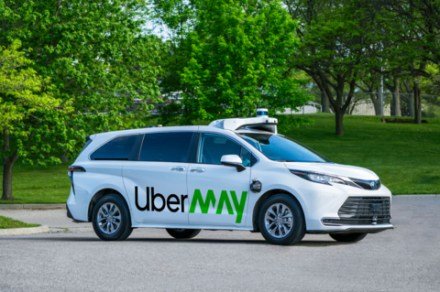
Uber partners with May Mobility to bring thousands of autonomous vehicles to U.S. streets
Image used with permission by copyright holder
The self-driving race is shifting into high gear, and Uber just added more horsepower. In a new multi-year partnership, Uber and autonomous vehicle (AV) company May Mobility will begin rolling out driverless rides in Arlington, Texas by the end of 2025—with thousands more vehicles planned across the U.S. in the coming years.
Uber has already taken serious steps towards making autonomous ride-hailing a mainstream option. The company already works with Waymo, whose robotaxis are live in multiple cities, and now it’s welcoming May Mobility’s hybrid-electric Toyota Sienna vans to its platform. The vehicles will launch with safety drivers at first but are expected to go fully autonomous as deployments mature.
May Mobility isn’t new to this game. Backed by Toyota, BMW, and other major players, it’s been running AV services in geofenced areas since 2021. Its AI-powered Multi-Policy Decision Making (MPDM) tech allows it to react quickly and safely to unpredictable real-world conditions—something that’s helped it earn trust in city partnerships across the U.S. and Japan.
This expansion into ride-hailing is part of a broader industry trend. Waymo, widely seen as the current AV frontrunner, continues scaling its service in cities like Phoenix and Austin. Tesla, meanwhile, is preparing to launch its first robotaxis in Austin this June, with a small fleet of Model Ys powered by its camera-based Full Self-Driving (FSD) system. While Tesla aims for affordability and scale, Waymo and May are focused on safety-first deployments using sensor-rich systems, including lidar—a tech stack regulators have so far favored.
Beyond ride-hailing, the idea of personally owned self-driving cars is also gaining traction. Waymo and Toyota recently announced they’re exploring how to bring full autonomy to private vehicles, a move that could eventually bring robotaxi tech right into your garage.
With big names like Uber, Tesla, Waymo, and now May Mobility in the mix, the ride-hailing industry is evolving fast—and the road ahead looks increasingly driver-optional.
Please enable Javascript to view this content
Nick Godt has covered global business news on three continents for over 25 years.
You may have to wait longer for a more affordable Tesla Model Y
It’s been a while since Tesla gave a long-awaited makeover to its Model 3 EV, and followed it with the introduction of an updated Model Y in its home market. However, the company’s rumored plans for a more affordable SUV that will be assembled in the US have reportedly run into a delay.
According to Reuters, Tesla was hoping to assemble nearly a quarter million units of its cheaper Model Y variant in 2026. The goalpost has now been shifted, and there is no clarity regarding a revised market launch plans for the vehicle, which is said to be in development under the codename E41. .
Samsung is looking to iPad technology for new automotive OLED screens
According to industry sources, Samsung Display is reportedly looking to adapt technology similar to that used in Apple’s iPad displays for implementation in automotive OLED screens. This strategic move signals Samsung’s continued push into the growing market for high-end vehicle displays.
Technology crossover
Mercedes’ Vision V concept proves luxury vans are a great idea
Whether it’s big sedans or SUVs, Mercedes-Benz is one of the top names in luxury vehicles for people who can’t be bothered to drive themselves. And now the automaker is trying to apply that expertise to a very different form factor.
Mercedes is launching a new generation of vans that are also its first to be designed from the ground up for electric powertrains, while still performing all of the functions of its current van lineup. But before it shows the everyday delivery vehicles and hotel shuttles, Mercedes is heralding the arrival of these new vans with the Vision V — a concept vehicle that shows just how luxurious a van can be.
