

ULA’s Vulcan rocket suffers another booster problem on the way to orbit
Vulcan’s Blue Origin-made BE-4 engines appear to have saved the rocket from failure.
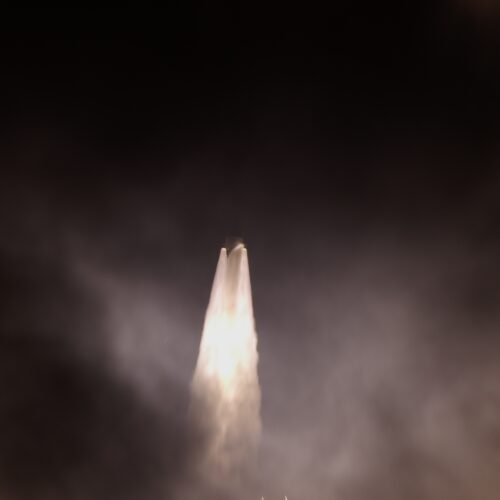
A fiery plume appeared near the bottom of one of the Vulcan rocket’s boosters, seen here on the right side of the vehicle shortly after liftoff Thursday from Cape Canaveral Space Force Station, Florida.
Credit:
Adam Bernstein/Spaceflight Now
Moments after liftoff from Florida’s Space Coast early Thursday morning, a shower of sparks emerged in the exhaust plume of United Launch Alliance’s Vulcan rocket. Seconds later, the rocket twisted on its axis before recovering and continuing the climb into orbit with a batch of US military satellites.
The sight may have appeared familiar to seasoned rocket watchers. Sixteen months ago, a Vulcan rocket lost one of its booster nozzles shortly after launch from Cape Canaveral Space Force Station. The rocket recovered from the malfunction and still reached the mission’s planned orbit.
Details of Thursday’s booster problem remain unclear. An investigation into the matter is underway, according to ULA, a 50-50 joint venture between Boeing and Lockheed Martin. But the circumstances resemble those of the booster malfunction in October 2024. Closeup video from Thursday’s launch shows a fiery plume near the throat of one of the rocket’s four solid-fueled boosters, the area where the motor’s propellant casing connects to its bell-shaped exhaust nozzle. The throat drives super-hot gas from the burning solid propellant through the nozzle to generate thrust.
Anomalous plume
The plume first appeared less than 30 seconds after liftoff at 4:22 am EST (09:22 UTC) on Thursday. The rocket later released a cloud of sparks and debris a little more than a minute into the flight. That was followed by a sudden rolling motion along the long axis of the Vulcan launcher. Finally, the rocket’s four strap-on boosters burned out and were jettisoned, falling into the Atlantic Ocean, and ULA said the rest of the mission continued without incident.
“Early during flight, the team observed a significant performance anomaly on one of the four solid rocket motors. Despite the observation, the Vulcan booster and Centaur performed nominally and delivered the spacecraft directly to geosynchronous orbit,” said Gary Wentz, ULA’s vice president of Atlas and Vulcan programs. “The integrated US government and contractor team is reviewing the technical data, available imagery, and establishing a recovery team to collect any debris. We will conduct a thorough investigation, identify root cause, and implement any corrective action necessary before the next Vulcan mission.”
The Vulcan’s solid rocket boosters, or Graphite Epoxy Motors (GEMs), are built by Northrop Grumman. The 72-foot-long (22-meter) solid-fueled motor is a larger version of the booster used on ULA’s Atlas V rocket, which Vulcan is replacing. The GEM 63XL variant used on the Vulcan rocket is designed to burn through more than 105,000 pounds of pre-packed propellant in less than 90 seconds.
The Vulcan rocket lifted off from Space Launch Complex-41 at Cape Canaveral Space Force Station, Florida, at 4:22 am EST (09:22 UTC) on Thursday.
The Vulcan rocket lifted off from Space Launch Complex-41 at Cape Canaveral Space Force Station, Florida, at 4:22 am EST (09:22 UTC) on Thursday.
The 2024 booster malfunction occurred on the Vulcan rocket’s second test flight. The rocket did not return to action for 10 months as engineers probed the nozzle failure. Investigators determined that a carbon composite insulator, or heat shield, inside the nozzle failed to protect the nozzle’s metallic structure from the superheated exhaust coming from the booster. Engineers traced the cause of the failure to a “manufacturing defect” in one of the insulators, which led to the melting and burn-through of the booster nozzle. Officials said the damaged motor continued firing on the 2024 launch, albeit with less thrust and lower efficiency, and the Vulcan’s BE-4 main engines, supplied by Blue Origin, compensated for the thrust differential. The BE-4s on Thursday’s flight appeared to save the rocket once again.
ULA officials last year said they inspected other boosters in the company’s inventory to ensure they did not exhibit the same defect. The incident on Thursday’s mission suggests the defect was not fixed, or there is a separate problem with Northrop’s boosters.
Despite the booster problem, the Vulcan rocket deployed multiple military satellites into an on-target geosynchronous orbit more than 22,000 miles (nearly 36,000 kilometers) over the equator. This mission, codenamed USSF-87, launched the Space Force’s seventh and eighth GSSAP surveillance satellites, also manufactured by Northrop Grumman. The satellites will maneuver around geosynchronous orbit to monitor other spacecraft, such as the clandestine fleets operated by China and Russia.
A third payload aboard the USSF-87 mission will test “additional research, development and training systems” the Space Force will use to “refine tactics, techniques and procedures for precision on-orbit maneuvers,” Space Systems Command said in a statement. “These systems will also enhance and validate resiliency and protection in geosynchronous orbit.”
While there’s something to be said for the Vulcan rocket’s ability to overcome an anomaly as dramatic as a nozzle failure, two similar failures in three flights will give military officials pause before entrusting ULA to launch another national security payload.
The next Vulcan launch is scheduled for no earlier than March with a GPS navigation satellite for the US Space Force. This schedule is now in doubt. The military’s Space Systems Command said in a statement it will “work closely with ULA per our mission assurance space flightworthiness process before the next Vulcan national security space mission.”
Thursday’s launch was just the second operational national security mission to fly on ULA’s Vulcan rocket. It was the fourth Vulcan launch overall since the rocket’s debut 25 months ago. Pentagon officials have called out ULA for delays in getting the Vulcan rocket into service. The Space Force, which also awards launch contracts for the National Reconnaissance Office’s spy satellites, currently has 27 launches booked on Vulcan rockets.
Going into Thursday, ULA planned to launch 16 to 18 missions with the Vulcan rocket, plus two to four flights of the legacy Atlas V rocket, which is nearing retirement. Highlights for the Vulcan rocket this year were to include the first Vulcan launch with Amazon Leo broadband satellites and the first Vulcan mission from Vandenberg Space Force Base in California.
ULA missed its goal of up to 10 Vulcan launches last year, ending 2025 with just a single Vulcan flight. The company once controlled the national security launch market with its Atlas V and Delta IV rockets, but SpaceX overtook ULA last year as the Pentagon’s leading launch provider. Newcomer Blue Origin, ULA’s engine supplier, is also vying for military launch contracts with its heavy-lift New Glenn rocket.
Stephen Clark is a space reporter at Ars Technica, covering private space companies and the world’s space agencies. Stephen writes about the nexus of technology, science, policy, and business on and off the planet.
