

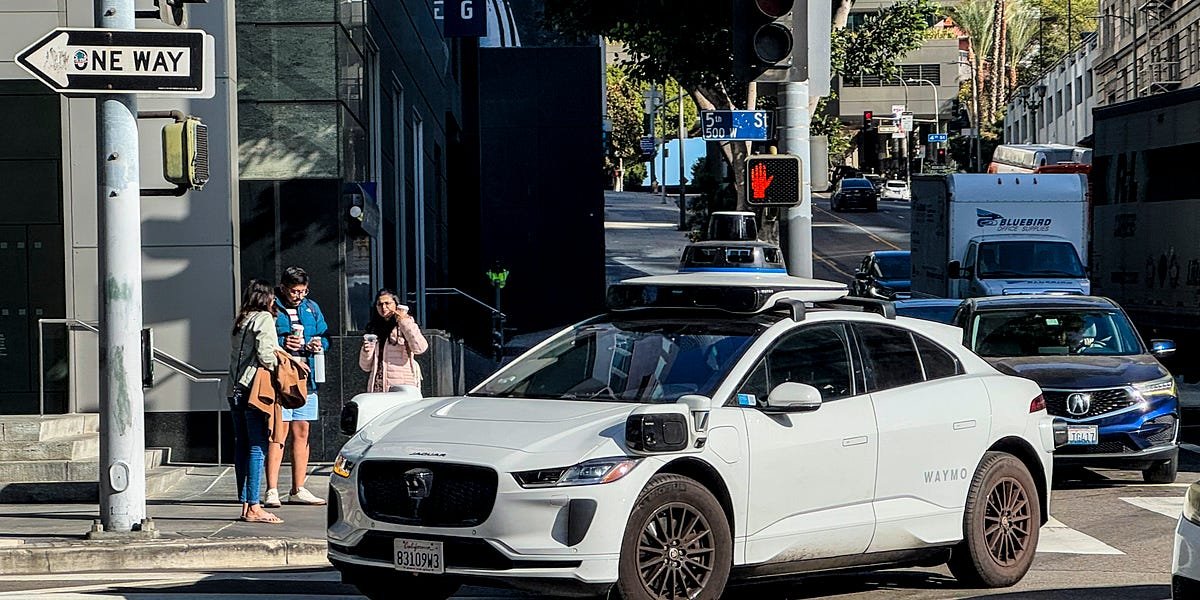
Waymos crash less than human drivers
I’ve been thinking a lot about autonomous vehicles as I prepare for next Wednesday’s Ride AI Summit in Los Angeles.
I’ll be moderating two panels. One features three companies—Waabi, Bot.auto, and Torc—that are working to automate long-haul trucking. The other features Nuro and Wayve, two of the leading companies developing next-generation driver asssistance systems for customer-owned cars.
We still have some tickets available, so if you are involved—or interested—in the AV industry, you’ll want to join us in Los Angeles.
The first ever fatal crash involving a fully driverless vehicle occurred in San Francisco on January 19. The driverless vehicle belonged to Waymo, but the crash was not Waymo’s fault.
Here’s what happened: a Waymo with no driver or passengers stopped for a red light. Another car stopped behind the Waymo. Then, according to Waymo, a human-driven SUV rear-ended the other vehicles at high speed, causing a six-car pileup that killed one person and injured five others. Someone’s dog also died in the crash.
Another major Waymo crash occurred in October in San Francisco. Once again, a driverless Waymo was stopped for a red light. According to Waymo, a vehicle traveling in the opposite direction crossed the double yellow line and crashed into an SUV that was stopped to the Waymo’s left. The force of the impact shoved the SUV into the Waymo. One person was seriously injured.
These two incidents produced worse injuries than any other Waymo crash in the last nine months. But in other respects they were typical Waymo crashes. Most Waymo crashes involve a Waymo vehicle scrupulously following the rules while a human driver flouts them: speeding, running red lights, careening out of their lanes, and so forth.
Waymo’s service will only grow in the coming months and years. So Waymo will inevitably be involved in more crashes—including some crashes that cause serious injuries and even death.
But as this happens, it’s crucial to keep the denominator in mind. Since 2020, Waymo has reported roughly 60 crashes serious enough to trigger an airbag or cause an injury. But those crashes occurred over more than 50 million miles of driverless operations. If you randomly selected 50 million miles of human driving—that’s roughly 70 lifetimes behind the wheel—you would likely see far more serious crashes than Waymo has experienced to date.
Federal regulations require Waymo to report all significant crashes, whether or not the Waymo vehicle was at fault—indeed, whether or not the Waymo is even moving at the time of the crash. I’ve spent the last few days poring over Waymo’s crash reports from the last nine months. Let’s dig in.
Last September, I analyzed Waymo crashes through June 2024. So this section will focus on crashes between July 2024 and February 2025. During that period, Waymo reported 38 crashes that were serious enough to either cause an (alleged) injury or an airbag deployment.
In my view only one of these crashes was clearly Waymo’s fault. Waymo may have been responsible for three other crashes—there wasn’t enough information to say for certain. The remaining 34 crashes seemed to be mostly or entirely the fault of others:
-
The two serious crashes I mentioned at the start of this article are among 16 crashes where another vehicle crashed into a stationary Waymo (or caused a multi-car pileup involving a stationary Waymo). This included ten rear-end crashes, three side-swipe crashes, and three crashes where a vehicle coming from the opposite direction crossed the center line.
-
Another eight crashes involved another car (or in one case a bicycle) rear-ending a moving Waymo.
-
A further five crashes involved another vehicle veering into a Waymo’s right of way. This included a car running a red light, a scooter running a red light, and a car running a stop sign.
-
Three crashes occurred while Waymo was dropping a passenger off. The passenger opened the door and hit a passing car or bicycle. Waymo has a “Safe Exit” program to alert passengers and prevent this kind of crash, but it’s not foolproof.
There were two incidents where it seems like no crash happened at all:
-
In one incident, Waymo says that its vehicle “slowed and moved slightly to the left within its lane, preparing to change lanes due to a stopped truck ahead.” This apparently spooked an SUV driver in the next lane, who jerked the wheel to the left and ran into the opposite curb. Waymo says its vehicle never left its lane or made contact with the SUV.
-
In another incident, a pedestrian walked in front of a stopped Waymo. The Waymo began moving after the pedestrian had passed, but then the pedestrian “turned around and approached the Waymo AV.” According to Waymo, the pedestrian “may have made contact with the driver side of the Waymo AV” and “later claimed to have a minor injury.” Waymo’s report stops just short of calling this pedestrian a liar.
So that’s a total of 34 crashes. I don’t want to make categorical statements about these crashes because in most cases I only have Waymo’s side of the story. But it doesn’t seem like Waymo was at fault in any of them.
There was one crash where Waymo clearly seemed to be at fault: in December, a Waymo in Los Angeles ran into a plastic crate, pushing it into the path of a scooter in the next lane. The scooterist hit the crate and fell down. Waymo doesn’t know whether the person riding the scooter was injured.
I had trouble judging the final three crashes, all of which involved another vehicle making an unprotected left turn across a Waymo’s lane of travel. In two of these cases, Waymo says its vehicle slammed on the brakes but couldn’t stop in time to avoid a crash. In the third case, the other vehicle hit the Waymo from the side. Waymo’s summaries make it sound like the other car was at fault in all three cases, but I don’t feel like I have enough information to make a definite judgment.
Even if we assume all three of these crashes were Waymo’s fault, that would still mean that a large majority of the 38 serious crashes were not Waymo’s fault. And as we’ll see, Waymo vehicles are involved in many fewer serious crashes than human-driven vehicles.
Another way to evaluate the safety of Waymo vehicles is by comparing their per-mile crash rate to human drivers. Waymo has been regularly publishing data about this over the last couple of years. Its most recent release came last week, when Waymo updated its safety data hub to cover crashes through the end of 2024.
Waymo knows exactly how many times its vehicles have crashed. What’s tricky is figuring out the appropriate human baseline, since human drivers don’t necessarily report every crash. Waymo has tried to address this by estimating human crash rates in its two biggest markets—Phoenix and San Francisco. Waymo’s analysis focused on the 44 million miles Waymo had driven in these cities through December, ignoring its smaller operations in Los Angeles and Austin.
Using human crash data, Waymo estimated that human drivers on the same roads would get into 78 crashes serious enough to trigger an airbag. By comparison, Waymo’s driverless vehicles only got into 13 airbag crashes. That represents an 83 percent reduction in airbag crashes relative to typical human drivers.
This is slightly worse than last September, when Waymo estimated an 84 percent reduction in airbag crashes over Waymo’s first 21 million miles.
Over the same 44 million miles, Waymo estimates that human drivers would get into 190 crashes serious enough to cause an injury. Instead, Waymo only got in 36 injury-causing crashes across San Francisco or Phoenix. That’s an 81 percent reduction in injury-causing crashes.
This is a significant improvement over last September, when Waymo estimated its cars had 73 percent fewer injury-causing crashes over its first 21 million driverless miles.
The above analysis counts all crashes, whether or not Waymo’s technology was at fault. Things look even better for Waymo if we focus on crashes where Waymo was determined to be responsible for a crash.
To assess this, Waymo co-authored a study in December with the insurance giant Swiss Re. It focused on crashes that led to successful insurance claims against Waymo. This data seems particularly credible because third parties, not Waymo, decide when a crash is serious enough to file an insurance claim. And claims adjusters, not Waymo, decide whether to hold Waymo responsible for a crash.
But one downside is that it takes a few months for insurance claims to be filed. So the December report focused on crashes that occurred through July 2024.
Waymo had completed 25 million driverless miles by July 2024. And by the end of November 2024, Waymo had faced only two potentially successful claims for bodily injury. Both claims are still pending, which means they could still be resolved in Waymo’s favor.
One of them was this crash that I described at the beginning of my September article about Waymo’s safety record:
On a Friday evening last November, police chased a silver sedan across the San Francisco Bay Bridge. The fleeing vehicle entered San Francisco and went careening through the city’s crowded streets. At the intersection of 11th and Folsom streets, it sideswiped the fronts of two other vehicles, veered onto a sidewalk, and hit two pedestrians.
According to a local news story, both pedestrians were taken to the hospital with one suffering major injuries. The driver of the silver sedan was injured, as was a passenger in one of the other vehicles. No one was injured in the third car, a driverless Waymo robotaxi.
It seems unlikely that an insurance adjuster will ultimately hold Waymo responsible for these injuries.
The other pending injury claim doesn’t seem like a slam dunk either. In that case, another vehicle steered into a bike lane before crashing into a Waymo as it was making a left turn.
But let’s assume that both crashes are judged to be Waymo’s fault. That would still be a strong overall safety record.
Based on insurance industry records, Waymo and Swiss Re estimate that human drivers in San Francisco and Phoenix would generate about 26 successful bodily injury claims over 25 million miles of driving. So even if both of the pending claims against Waymo succeed, two injuries represent a more than 90 percent reduction in successful injury claims relative to typical human drivers.
The reduction in property damage claims is almost as dramatic. Waymo’s vehicles generated nine successful or pending property damage claims over its first 25 million miles. Waymo and Swiss Re estimate that human drivers in the same geographic areas would have generated 78 property damage claims. So Waymo generated 88 percent fewer property damage claims than typical human drivers.
