

What Kind Of Nuclear Missiles Do India And Pakistan Actually Have?
With India and Pakistan now on the brink of full-scale war following the massacre at Kashmir, several crucial details regarding each country’s respective arsenals are now taking center-stage. Chief among these being their nuclear weapons programs, nuclear first-strike capabilities, and the types of ordnance at their disposal.
Advertisement
As of January 2024, both countries are relatively evenly-matched in the nuclear arms-race, with India boasting an estimated 160 to 172 nuclear warheads against Pakistan’s approximately 170. Neither country counts itself as a member of the Nuclear Non-Proliferation Treaty (NPT), meaning neither observes various sanctions imposed by the International Atomic Energy Agency (IAEA). These sanctions stipulate that signatories commit to not manufacturing nor otherwise acquire nuclear weapons, nor assist any foreign state in acquiring nuclear weapons of their own. In essence, this means Pakistan and India are both capable of producing the highly-enriched fissile material used to craft weapons.
As for what specific kinds of weapons, according to the Arms Control Association, India specializes in plutonium-based warheads, whereas Pakistan uses enriched uranium. Both countries utilize multiple short and intermediate-range packages, including gravity-drop bombs from aircraft, cruise missiles, and ballistic missiles. Additionally, both countries are rapidly developing naval nuclear ordnance programs, including ballistic missile-equipped submarines, in addition to their robust conventional forces. For instance, both nations rank among the most powerful air forces worldwide, providing each with valuable tools to deploy their respective nuclear weapons. These are the specifics of each respective nation’s capabilities and their defensive capabilities.
Advertisement
India’s nuclear arsenal
Aerospace Trek/Shutterstock
India’s primary delivery methods include aircraft, land-based, and naval short and intermediate-range warheads. India never disclosed specific numbers regarding its nuclear arsenal, but estimates suggest the number to be slightly growing within the past year based on India’s weapons-grade plutonium inventory.
Advertisement
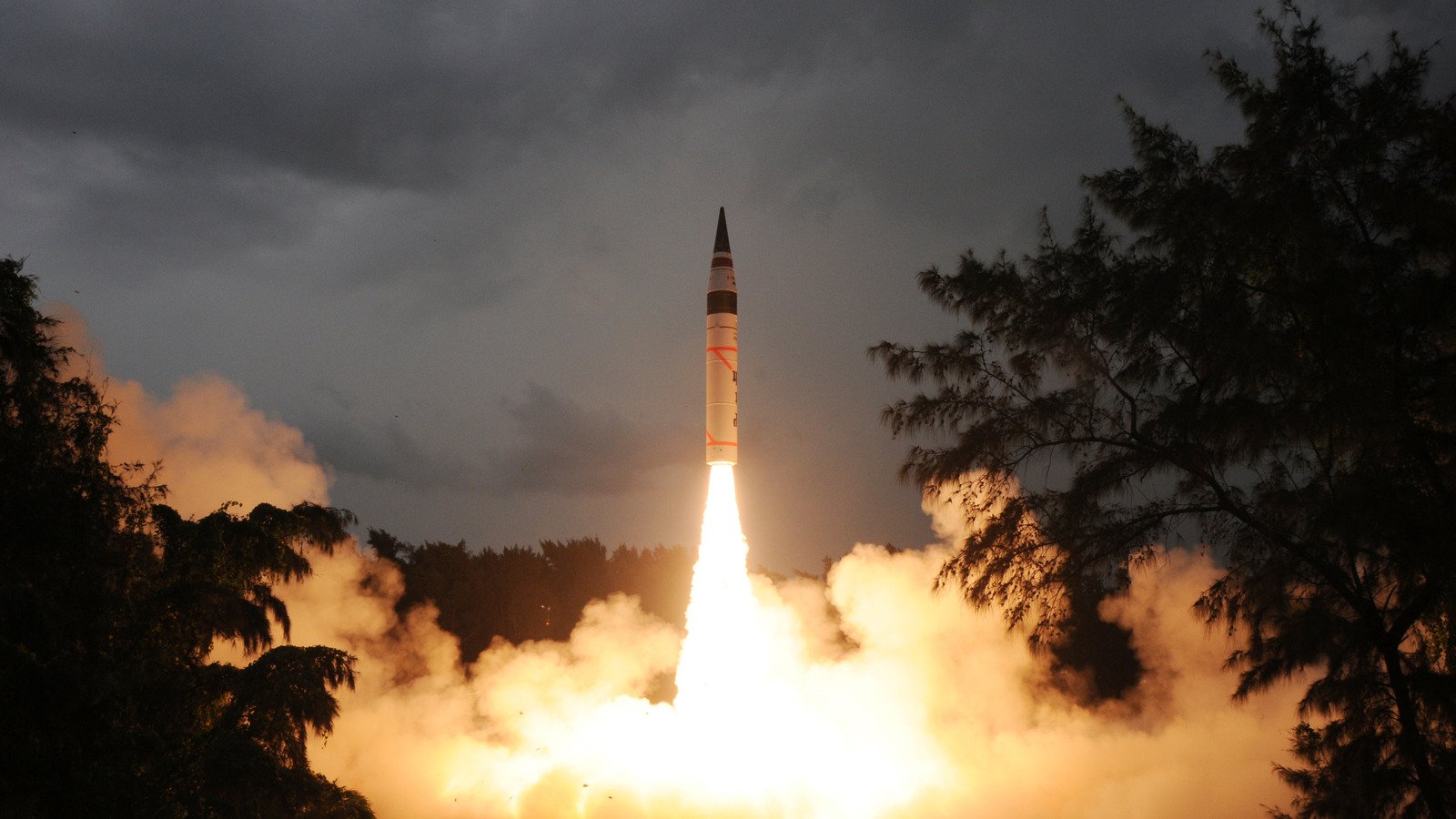
Approximately 48 of these warheads are likely aircraft-deployable, utilizing jets such as the Jaguar IS/IB, Mirage 2000, and Rafale as platforms. The most numerous candidate is the Jaguar IS, with 79 aircraft reported in India’s current inventory. India also holds a substantial number of land-based weapons, with an estimated 64 as of 2022; including the short-range 350-kilometer Prithvi-II, and 750-kilometer Agni-I launchers designed for road or rail transport.
India also fields various intermediate-range ballistic missiles such as the K-4 submarine-launched ballistic missile (SLBM), reportedly designed with a 3,500-kilometer range. The most recent land-based Agni-III IRBM boasts a similar range, reaching to an estimated 3,000-3,500 kilometers. This ties in with India’s recent push seemingly directed towards nuclear deterrence against China.
Advertisement
That said, India ramped up its various nuclear programs in general, such as power generation. For example, the nation is also building six plutonium fast-breeder facilities in the configuration of the Fast Breeder Test Reactor power plant, which first achieved criticality in October 1985. India certainly possesses the materials to produce additional weapons to replenish and bolster stocks, a crucial element of maintaining a nuclear weapons arsenal. Coupled with arsenals including the latest Arjun main battle tank, India boasts a thoroughly modernized integrated warfare doctrine with a likely well-maintained substantial nuclear stockpile.
Pakistan’s nuclear arsenal
Getty Images/Getty Images
The Pakistani nuclear arsenal stands roughly equal in both size and capability to its Indian counterpart, though estimates according to the Stockholm International Peace Research Institute (SIPRI) place the figure at 170 in January 2024 — the same as the previous year’s survey. Much like India, however, Pakistan similarly refuses to disclose the complete details of its armament, and much of the program is fraught with misinformation and public deception.
Advertisement
That said, it’s estimated that the majority of its nuclear-capable platforms are land-based, with an estimated 126 launchers including four types of short-range missiles. These include the Shaheen I/IA (700 and 900 kilometers), Abdali (200 kilometers), Ghaznavi (300 kilometers), and Nasr “quick-response” (70 kilometers) weapons. Additionally, Pakistan also deploys IRBMs such as the Shaheen III with a range of 2,750 kilometers, and fields an ongoing program developing launch-capable submarines. Lastly, Pakistan fields a number of F-16B aircraft it modified to be compatible with nuclear payloads, providing them a full range of launch options. Pakistan also fields a number of its own JF-17 fighters, an aircraft co-developed with China as a Generation 4.5 F-16 replacement.
Advertisement
Pakistan first demonstrated its nuclear weapon capability in 1998, though its uranium-enrichment program actually dates to the mid-1970s. Since then, China offered foreign aid to Pakistani weapons research and procurement, becoming instrumental in Pakistan’s modernization of its nuclear capability. Various nuclear tests took place between the two nations in a tit-for-tat exchange — a practice which was condemned by the United Nations at the time.
Indian nuclear policy and rules of engagement
Sondeep Shankar/Getty Images
India’s nuclear weapon policy centers around its adherence to the “No First Use” (NFU) policy. However, India’s actual adherence to the policy fluctuated since its initial announcement in 2003: For instance, Indian Defence Minister Rajnath Singh announced in 2019 that the government’s latest national security policy calls their NFU pledge into question. Today, India retains its observance of the NFU, though it retains certain additional stipulations — namely that India reserves the right to nuclear retaliation against biological and chemical warfare. Likewise, India has not signed or boycotted various treaties such as the Comprehensive Nuclear-Test Ban Treaty and Non-Proliferation of Nuclear Weapons Treaty.
Advertisement
India’s policies retain a “big stick” diplomacy approach, in that the country officially opposes nuclear warfare, but maintains a modest nuclear program. This includes the capacity to develop and regularly maintain a plutonium-based stockpile. While India and Pakistan have remained locked in a nuclear arms-race for the better part of three decades, both countries have consistently demonstrated a strive towards mutually-agreed nuclear peace.
For example, following the rapid escalation of nuclear tests in 1998, Pakistan and India jointly signed the 1999 Lahore Declaration, which stipulated that both nations commit to curbing any accidental or unauthorized weapon detonations. Furthermore, India and the United States maintain cooperative relations with nuclear programs, such as power generation. However, official American policy stipulates the usage of nuclear arms solely as deterrents, also abiding by the NFU.
Advertisement
Pakistani nuclear policy and rules of engagement
Syed Zargham/Getty Images
India and Pakistan’s rules of engagement differ in one key area: Pakistan maintains a first-use capability, whereas India officially recognizes the NFU pledge. India reserves the right to retaliate if a nuclear weapon is launched against it, but the Indian government pledged to not fire first. Pakistan, on the other hand, made no such pledge. This gives Pakistan a distinct edge if it perceives its conventional military forces to be asymmetrical to India’s, though Pakistan officially maintains that it will not deploy nuclear weapons on the battlefield.
Advertisement
As for Pakistan’s relation with China, the shared nuclear research agreement between the two countries stipulated nuclear energy across the board, including providing Pakistan with nuclear reactors for use in power generation. Despite their close relationship, however, China refuses to provide a nuclear second-strike capability to Pakistan — meaning if Pakistan deploys its weapons in anger, China will likely not deploy its own in Pakistan’s support.
The majority of Pakistani nuclear arms tests appears to be the result of their local arms-race with India, with the program first developing as a result of the 1971 war with New Delhi before rapidly escalating, as mentioned above. Therefore, despite being a far smaller nation than India, Pakistan actually retains a sizable, modern, and clandestine nuclear arsenal, backed by a policy of more aggressive deterrence than the likes of the United States.
Advertisement
Both countries’ nuclear defensive capabilities and deterrences
Anton Petrus/Getty Images
Analyzing Pakistan’s nuclear doctrine in general is fraught with uncertainty and disinformation, with the country largely keeping its cards close to its chest. Defensively, Pakistan appears to largely rely upon a combination of Mutually-Assured Destruction and a Cold-Start — or proactive — doctrine. Its development continues into the realm of tactical-yield nuclear devices, a program dating back approximately one decade, intended as a dramatic force-multiplier on local battlefields. As such, it fields a number of extreme short-range tactical weapons, reaching as short as 60 kilometers (37 miles). Pakistan, in other words, adopts a more offensive than defensive policy in its method of deterrence and national defense, at least officially.
Advertisement
India’s various declassified systems appear more defensive in nature, focusing on interception. Its main tool is the Indian Ballistic Missile Defense (BMD) program, which launched in 2000 during the height of the nuclear proliferation with Pakistan. This system includes various capabilities such as modern command-and-control centers with weapons detection and tracking, plus various countermeasures. These include interceptor payloads fitted with anti-projectile missiles, designed to shoot down the weapons mid-flight. And India likely improved these systems substantially following its initial release.
For example, the country demonstrated its capability to shoot down its own satellites in March 2019, meaning its tracking software is advanced enough to detect and intercept an object at orbital velocities. Lastly, India still retains its own nuclear weapons as a deterrent against both Pakistan, and perhaps even China, as SIPRI speculated in its 2024 report. This enhanced capability is the result of India’s development into IRBMs, whereas before it almost exclusively relied on shorter-range warheads.
Advertisement
