

Who Makes Ryobi’s Socket Sets? Here’s What You Need To Know
We may receive a commission on purchases made from links.
Ryobi is one of the most prominent tool makers on the planet. Perhaps best known for being one of the best cheap power tool brands, it also manufactures a wide range of hand tools and accessories. Among these are a range of socket sets that are aimed mainly at the DIY and home mechanic niche. However, as with many modern tool brands, the name on the box doesn’t always tell the full story about the company behind the brand and where the tools are manufactured. To understand this, we need to take a quick look at the history of Ryobi.
The company was formed in Japan in December 1943, initially producing die-cast parts mainly for the aviation industry. It wasn’t until the sixties that the first Ryobi power tool came on the market; unfortunately, there is no clear indication of when they first produced a socket set. What we do know is that Ryobi’s consumer tools are no longer produced by Ryobi Ltd. in Japan. Instead, Ryobi Limited licences the Ryobi Trademark to Techtronic Industries Consumer Power Tools, Inc. (TTI), a Hong Kong-based manufacturer that also owns brands including Milwaukee, Hoover, Hart, among various others.
TTI has a network of manufacturing plants that includes facilities in the US, China, Mexico, and Vietnam. Most Ryobi tools are manufactured in these factories, with China being the primary source. However, the Ryobi brand has its headquarters in the US, more specifically, it’s based out of Greenville, South Carolina. Let’s take a closer look at TTI, and how socket sets fit into its wider manufacturing structure.
How Ryobi socket sets fit into TTI’s supply chain
Trong Nguyen/Shutterstock
Because of TTI’s complex global structure, pinpointing where a particular brand’s tools are manufactured is challenging. However, what we can say is that most of Ryobi’s tools are manufactured in Asia. More specifically, TTI’s manufacturing plants in China and Vietnam are the main manufacturing centers. TTI does maintain manufacturing facilities in the USA, but these are focused on the assembly of larger power tools like lawnmowers, and pressure washers.
Although the firm doesn’t publish exact factory sites for its hand tool lines, a more likely “closer to home” manufacturing site for Ryobi tools is from TTI’s Mexico facility (at least for US-based readers). In essence, what this means is that a socket set labelled “Designed by Ryobi” might have been manufactured in any of these jurisdictions — although China remains the largest single source. It’s estimated that about 75% of the company’s products are manufactured in China, even though 60% of TTI’s sales are in America.
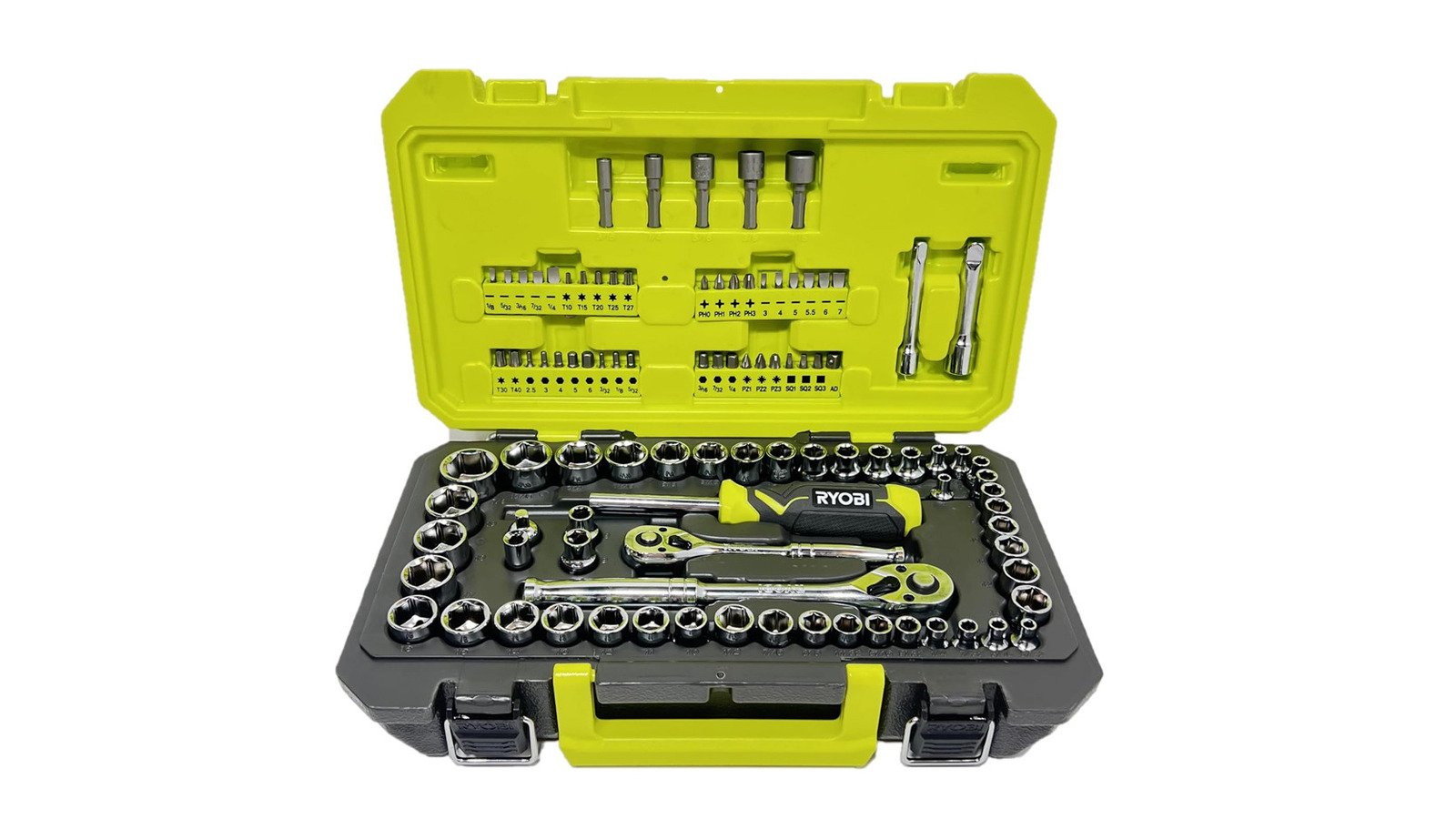
It’s this reliance on industrialized markets like the US that underlies why the remaining share of TTI’s manufacturing is distributed across the US and Mexico, and also why these plants focus more on manufacturing larger tools, with their proximity to Ryobi’s primary market reducing the shipping costs on these products. So, the next time you’re shopping for a new set of sockets — like the Ryobi 156-piece mechanics socket set — it’s worth remembering that it comes out of TTI’s wider multi-region manufacturing network — and that it never hurts to know the key things to consider before buying Ryobi tools in general.
