

Your cheap Chevrolet EV might not be cheap for Long
Digital Trends may earn a commission when you buy through links on our site. Why trust us?
GM confirms limited Chevy Bolt EV run as Kansas plant repurposes for gas vehicles and Buick production.
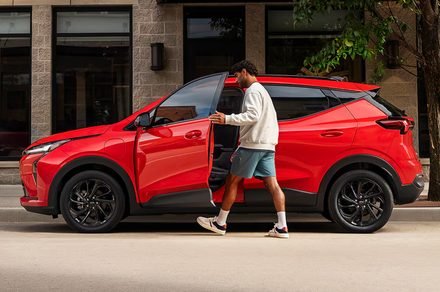
General Motors’ effort to bring back the Chevrolet Bolt EV as an affordable electric vehicle is already facing a roadblock. Although the refreshed 2027 Chevy Bolt EV has just started arriving at U.S. dealerships with a sub-$30,000 price tag, Bloomberg reports that GM officials now say the new model will be in production for only about 18 months before the line winds down around mid-2027.
This shift comes as GM continues reshuffling its manufacturing footprint, with its Fairfax Assembly plant in Kansas City, Kansas, set to switch from Bolt EV output to other vehicles, including gas-powered models and a relocated Buick crossover. The decision marks a significant pivot away from making one of the U.S. market’s most affordable electric cars, at least for now.
Why This Matters for EV Buyers and GM’s Strategy
Under current plans, the updated Bolt, which has been marketed as a budget-friendly EV with around 255-262 miles of range and a starting price around $28,995, won’t stick around for long. GM confirmed that once the limited-run Bolt EV completes its production cycle, the Fairfax plant will transition to building gas-powered Chevrolet Equinox SUVs beginning in mid-2027, freeing up capacity previously aimed at electric vehicles.
What’s more is that officials also plan to assemble the next-generation Buick compact SUV on the same line starting in 2028, a model currently built in China and imported into the U.S. That reshoring effort aligns with tariff pressures and changing trade policies, but it comes at the expense of a vehicle that was meant to help fill the EV pricing gap left by Bolt’s earlier discontinuation.
For EV shoppers, the Bolt’s short production run highlights just how uncertain the market still is. Policy changes such as the loss of the federal EV tax credit, higher tariffs on imported cars, and shifting consumer demand are forcing automakers to rethink their strategies in the U.S., even as GM continues to push models like the Equinox EV. While the 2027 Chevy Bolt EV is still one of the most affordable electric cars in America, its limited run suggests that truly budget-friendly EV options may stay rare unless new models step in to fill the gap.
Varun is an experienced technology journalist and editor with over eight years in consumer tech media. His work spans…
Tesla kills Autopilot for good and Musk warns of FSD price hikes
Autopilot is dead; Musk says “subscribe or drive yourself”
It feels like the end of an era for Tesla buyers in North America. The company has officially pulled the plug on “Autopilot” as a standard inclusion, signaling a massive shift toward a pay-to-play future. If you order a new Model 3 or Model Y today, it won’t come with the lane-keeping tech that used to be a hallmark of the brand. Instead, you are left with basic cruise control – pretty much the same “dumb” system you’d find on an economy car from a decade ago – unless you are willing to sign up for a monthly subscription.
This pivot is clearly about money and control. Elon Musk has been hinting at this for a while, but the timeline is now set in stone: the option to buy Full Self-Driving (FSD) for a one-time fee of around $8,000 is disappearing on February 14, 2026. After that date, it is subscriptions all the way down, currently priced at about $99 a month. Musk has already warned that this price will likely climb as the software gets smarter, effectively turning driver assistance into a recurring utility bill rather than a feature you own. It is essentially the “Netflix-ification” of your daily commute.
Buying a new Tesla? You might want to double-check if Autosteer is included
Tesla has reportedly dropped the lane centering feature from all Model 3 and Model Y trims.
Just weeks after confirming plans to move Full Self-Driving (FSD) to a monthly subscription for new cars, Tesla now appears to have removed another key feature from all Model 3 and Model Y variants. The company’s lane-centering feature, dubbed Autosteer, is reportedly no longer available in the Model 3 and Model Y configurator on its website.
Autosteer is one of the core features of Tesla’s Autopilot suite and helps vehicles maintain their position in the center of a lane. The feature, along with Traffic Aware Cruise Control (TACC), was previously included as standard on all trims, except for the affordable Model 3 and Model Y variants launched last October, which only included TACC.
Waze expands speed bump, toll, and emergency vehicle alerts worldwide
Waze is now warning you about everything except bad drivers
It looks like Waze is finally ready to make good on some old promises. After a long stretch of silence, the Google-owned navigation app has started sending out teaser emails confirming that a whole raft of “new” driving features is about to hit our screens. I say “new” with a bit of hesitation because, if you have been following the news, you might remember these exact features being announced way back in early 2024. They were supposed to be the next big thing, but aside from a few lucky testers, most of us never saw them. Now, nearly two years later, Waze says they are rolling out “over the coming weeks.” Better late than never, right?
The core of this update is about giving drivers a “heads up” on the physical stuff that actually disrupts a drive. We are finally getting specific warnings for things like speed bumps, sharp curves, and approaching toll booths. It sounds simple, but anyone who has hit a hidden speed bump at 30 mph knows how valuable that little icon can be. The goal is to give you enough context to react smoothly rather than slamming on the brakes at the last second.
