

10 Best Drones (2025): Flight-Tested and Reviewed
Featured in this article
It’s no exaggeration to say that the best drones have changed the way we view the world. They’ve taken once-difficult and expensive moviemaking techniques and made them accessible to anyone. Videos that previously required a camera crew, expensive cranes, and hours of filming can now be done in minutes with the tap of a single Auto Takeoff button.
Drones aren’t just flying cameras, though; they’re also the modern version of remote-controlled vehicles. Again, they’ve made flying easier and more accessible, thanks to intelligent collision sensors that protect your investment from mishaps. Cheaper drones, while fun, will never fly as well or deliver the kind of video and photo results possible with more expensive models. You get what you pay for. That said, if you’re not worried about wowing YouTube with your sweeping panoramic masterpiece, you don’t have to spend a fortune to get a good, fun drone. Here are the best drones I’ve tested for every budget.
The elephant in the room is the fact that the biggest drone maker was just barred from selling its products in the US. We’re still recommending DJI drones for anyone outside the US, and we have more information about the ban below, along with alternative options.
Be sure to check out our many other buying guides, including the Best Action Cameras, Best Compact Cameras, and Best Mirrorless Cameras.
Updated December 2025: We’ve added the DJI Mini 5 Pro, DJI Neo 2, DJI Mini 4K, Antigravity A1, and Potensic Atom, and added information about the DJI ban.
On December 23, 2025, DJI was added to the Federal Communications Commission’s “Covered List”—a move that effectively prohibits the Chinese drone giant from launching new products in the US. The ban stems from a national security audit mandated by Congress that was never completed, largely because no government agency was ever assigned to conduct it.
The good news for existing DJI owners in the US is that their drones will continue to function. However, the long-term implications remain unclear: future software updates could be restricted, and even products currently sitting on store shelves may become unavailable for purchase. The ban encompasses DJI’s entire product lineup—not just drones, but also gimbals, action cameras, and microphones.
DJI has consistently rejected the US government’s security concerns over its relationship with the Chinese military, framing the situation as a byproduct of wider US-China trade tensions. The company continues to push for a proper audit, but for now, if you’ve been eyeing a DJI product, your window to buy may have already closed.
That’s bad news for US consumers, because DJI’s drones offer the best value for money and the company’s competitors rarely come close in terms of performance. That’s not to say there aren’t other viable options—I’ve included a couple of non-DJI models below for this reason.
Above a certain size and weight, drones are subject to some fairly strict laws regarding how and where they can be flown. You may need to register your drone, apply for a permit, pass an exam, or label your drone with personal details before getting it airborne. These laws differ depending on which country you’re in. Ensure you check local regulations carefully before flying. For the US, UK, and EU, more details can be found here: US FAA, UK CAA, and EU EASA.
In general, laws become more restrictive the heavier the drone, and sub-250-gram (8.8-ounce) drones tend to fall into a largely unrestricted category with relatively few legal hoops for pilots to negotiate. That’s why so many manufacturers offer lightweight drones.
To get the most out of a drone, it may be worthwhile to invest in a few optional accessories.
Batteries: The first thing I’d probably buy is spare batteries, as drone battery life tends to be fairly short, and having extras in your pocket greatly extends flying time. For a less immediate solution, you could buy a high-capacity power bank to recharge your drone’s battery while you’re out and about.
ND filters: If you’re filming in bright sunlight and want greater control over shutter speed (which can help achieve pleasing effects like motion blur), neutral density filters are an essential camera add-on. These are generally made to fit specific models of drones.
Carrying case: While drones are often hardier than they look, a dedicated carrying bag or case keeps your expensive investment well protected, while often leaving space for extras like controllers, cables, batteries, memory cards, and spare propellers. The bags that DJI bundles with its drones in its Fly More Combo packages are excellent quality, but any camera bag with customizable interior pockets would work well, too.
-
Best Drone for Most People
If you’ve been waiting for a pocket-sized drone that doesn’t compromise on image quality, the DJI Mini 5 Pro (9/10, WIRED Recommends) is a genuine game-changer. By squeezing a full 1-inch sensor into its compact frame, DJI has effectively delivered Air-class camera performance into a folding drone small enough to slip into a jacket pocket. The results speak for themselves: 4K video at up to 120 frames per second, 50-megapixel stills, and an impressive 14 stops of dynamic range for video and photos that hold onto shadow and highlight detail even in tricky lighting.
Beyond the camera upgrades, the Mini 5 Pro brings professional-grade safety features once exclusive to larger, pricier models. Forward-facing LiDAR works alongside omnidirectional vision sensors to detect obstacles even in total darkness—a godsend for those golden hour flights that stretch into twilight. I put it through its paces in brutal coastal winds gusting past 30 mph, and while it was clearly working hard, it maintained its position with impressive composure.
Sadly, like all of DJI’s drones right now, it’s nearly impossible to acquire in the US. That’s a great shame, because it’s pound for pound the best camera drone on the market.
-
Best DJI Alternative
With DJI effectively banned from launching new products in the US and longtime rival Autel Robotics having withdrawn from the consumer drone market, the drone playing field has shifted dramatically. Enter the Potensic Atom 2, a sub-250-gram drone that has suddenly become the most credible alternative to DJI’s Mini series.
The Atom 2’s credentials are solid rather than cutting-edge. A 1/2-inch Sony sensor captures 48-megapixel photos and 4K HDR video at 30 fps, stabilized by a three-axis gimbal that delivers impressively smooth footage in normal weather conditions. Its AI-powered tracking modes work well enough for recording social media content, and the range of autonomous QuickShots adds creative flair without requiring expert piloting skills.
Flight performance is dependable and beginner-friendly, with up to 32 minutes of battery life and stable hovering even in moderate winds. The well-made controller works with most smartphones securely, while the Potensic Eve app hits a good balance between simplicity and functionality. There’s no obstacle avoidance, though, so you’ll need to fly with more caution than you would with most DJI drones.
At $360, the Atom 2 costs roughly the same as DJI’s entry-level Mini 4K while offering comparable—and in some ways superior—specs. In a market abruptly starved of affordable Chinese-made alternatives, Potensic has delivered exactly what US consumers might need: a dependable, well-priced drone that doesn’t compromise too heavily on performance.
-
Best 360 Camera Drone
The Antigravity A1 (7/10, WIRED Recommends) is the world’s first 360-degree drone, and it’s exactly as wild as that sounds. Borrowing “shoot first, frame later” technology from Insta360’s action cameras, the A1 uses two ultra-wide lenses to capture a complete spherical view of everything around it, then cleverly erases itself and its propellers from the footage. The result is an immersive 8K video (up to 30 fps) that you can reframe however you like during editing, whether that’s creating sweeping pans, dramatic zooms, or unconventional perspectives that’d be impossible with a traditional camera drone.
The desktop and mobile editing apps are slick and intuitive, making it easy to refine your footage into shareable clips. Video quality impresses in good light, though you’ll notice some softening and motion blur creeping in as conditions get trickier. At under 250 grams, the A1 also dodges most registration requirements, which is a welcome bonus.
It’s not all good news, though. Antigravity has gone all-in on a goggles-and-motion-controller setup that feels clunky compared to standard drone controllers. The motion grip steers like you’re wading through treacle, and having to wear goggles (which require their own separate battery) means you’ll need to bring a spotter every time you fly.
At $1,599, the A1 costs DJI Air 3S money but delivers a much more niche, finicky experience. It’s an innovative proof of concept that hints at exciting possibilities for 360 aerial footage, but the execution needs refinement before it can truly challenge the mainstream.
-
Best Beginner Drone
At just £209, this pocket-sized quadcopter is the perfect entry point into aerial photography, complete with one feature that elevates it far beyond its predecessor: omnidirectional obstacle avoidance. The original Neo had a habit of flying into trees; the Neo 2 intelligently drops altitude or adjusts its path to avoid collisions, making autonomous flight stress-free rather than a dice roll.
And autonomous flight is where the Neo 2 truly shines for beginners. Select a preset flight mode (Follow, Dronie, Helix, and others), launch it from your palm, and let it handle the cinematography while you concentrate on looking photogenic. When you want more control, the Neo 2 works with smartphones for basic instructions, or standard DJI controllers for proper manual piloting; you can even turn it into an FPV drone with compatible goggles.
Image quality won’t threaten a Mini or Air series drone—it’s a 12-megapixel sensor shooting 4K video at up to 60 fps (100 fps with a controller)—but for social media clips and vacation memories, it’s more than adequate. The main limitation is battery life: expect around 10 minutes of actual flight time before you’re swapping cells. The Fly More Combo, which includes three batteries, feels like a near-essential purchase for this reason.
At 160 grams, the Neo 2 stays comfortably under regulatory thresholds, and its integrated propeller guards make it safe to fly around people. It’s a superb choice for beginners wanting to experiment with drones without the financial commitment.
-
Best Upgrade
Despite sitting slap bang in the middle of DJI’s drone lineup, wedged between the premium Mavic and ultralight Mini ranges, the DJI Air 3S (9/10, WIRED Recommends) is anything but average. With a smaller and more lightweight build than its Mavic cousins, the Air 3S offers fantastic portability. Crucially, though, it still manages to deliver heavyweight battery life (up to 45 minutes of flight on a full charge) and camera performance.
The gimbal-mounted dual camera setup features a wide-angle camera with a 50-MP 1-inch sensor and a medium telephoto camera with a 48-MP 1/1.3-inch sensor. Both can shoot 10-bit 4K video at 60 frames per second (fps) (or 120 fps for slow-motion playback), with the larger wide-angle sensor also offering an impressive 14 stops of dynamic range and highly impressive low-light capabilities.
It’s reassuringly simple and safe to fly, too, with a full suite of omnidirectional obstacle sensors helping to prevent collisions and forward-facing lidar to prevent aerial mishaps, even when flying in the dark. The only note of caution I would sound when it comes to the Air 3S is that its weight (724 grams) puts it into an aircraft category that requires more paperwork and flight restrictions than an ultralight drone like the DJI Mini 4 Pro.
-
Best FPV Drone
By beaming an ultra-low-latency live feed from its camera directly into a pair of goggles, a first-person view (FPV) drone puts you right in the cockpit of a small and agile aircraft able to squeak through the smallest of gaps and pull off breathtaking moves like flips, barrel rolls, loops, and vertical plunges. These aren’t drones you buy to get pristine photos of wide-open vistas so much as to experience (and document) an adrenaline-inducing roller-coaster ride through a tight, obstacle-populated environment.
As such, piloting an FPV drone is a completely different, entirely more challenging kettle of fish than piloting a standard camera drone. Not only do you lose the anti-crash guard rails used by many drones, but you’re flying at a greater speed, with less time to react. The DJI Avata 2 (8/10, WIRED Recommends) brings the skill requirements down to a more beginner-friendly level, all while capturing video at 4K/60 fps or 2.7K/120 fps. While it doesn’t have automatic obstacle avoidance, the Avata 2’s motion-sensitive controller and ability to quickly brake and hover in midair make it a lot more forgiving than the full manual twin-stick controls used by most FPV drones.
The Avata 2’s goggles are also fantastic, pairing with the drone and delivering a crystal-clear image through its pair of micro OLED screens. They’re even comfortable for those with poor eyesight, like myself, thanks to eyepieces that can be adjusted for inter-pupillary distance and a diopter for correcting vision.
I’d liken flying the Avata 2 to riding a bike with the training wheels on, because there are certain moves you can’t pull off with the motion controller, such as steep dives, where the motors cut out completely, and the drone drops like a stone. If you want to perform these riskier stunts, the gamepad-style DJI Remote Controller 3 is available as an optional add-on.
-
Best Small Selfie Drone
Need something to make your vacation Instagram posts stand out from the ground-based crowd? The HoverAir X1 ProMax (7/10, WIRED Recommends) might be just the ticket. This pocket-sized drone with automated flight is perfect for capturing quick aerial selfies or dutifully following along as you walk, cycle, or skate through a picturesque landscape, producing video (up to 8K resolution) and photos (up to 48 MP) that can be shared to social media right away.
Despite the camera’s minuscule size, image quality holds up. The 8K is mostly a gimmick, especially from a sensor this small, but the 4K footage looks cleaner and punchier than that of market leader DJI’s Neo drone (which is admittedly quite a bit cheaper). It’s a pity, though, that HoverAir doesn’t allow the camera to rotate 90 degrees to shoot native 9:16 portrait content. Given its focus on creating social-media-ready footage, that would have been a valuable addition.
Designed first and foremost for short automated flights, the X1 ProMax can still be controlled via optional joystick and beacon accessories, which allow it to be flown for longer and further away—if, for example, you wanted to capture a photo or video showcasing a wider landscape or a large building. I found it a responsive and zippy flyer, but the 16-minute battery limits its capabilities.
-
Best Luxury Drone
The Mavic 4 Pro (9/10, WIRED Recommends) is expensive, but it’s the best drone on the market if money is no concern, largely thanks to the cameras, of which there are three: a wide-angle paired with two telephoto zoom cameras (28, 70, and 168 mm, respectively).
You can snap 100-MP photos and shoot 6K video at 60 fps (or 4K at 120 fps), and the 16 stops of dynamic range give you greater control over exposure. The aperture is adjustable too, allowing you to swing from f/2 to f/11. The gimbal lets you freely rotate and tilt, meaning it can capture true portrait-oriented content, perfect for the likes of TikTok and Instagram Reels. I also highly recommend upgrading to the RC 2 Pro Controller, with a larger and brighter screen, vertical orientation, and the ability to install third-party apps (it runs Android).
-
Best Ultralight Drone
It might be an incremental upgrade, but the Mini 4 Pro (8/10, WIRED Recommends) cements DJI’s position as undisputed champion of the sub-250-gram flyers that can fit in your palm. It employs the same 1/1.3-inch 48-MP sensor as its predecessor but gives its image-processing software a notable bump. It matches the Mini 3 Pro’s 4K/60 fps performance, but can capture slow motion 4K at 100 fps and record in 10-bit D-Log M for greater post-production color grading freedom. Both its photos and video look fine straight from the camera, and the Night Mode vastly improves the low-light video quality.
It’s not just the camera performance that’s been boosted. The obstacle-avoidance system also points sensors in every direction to prevent the drone from careening into trees, walls, power poles, and other potential hazards. Add that to the generous 34 minutes of battery life, plus DJI’s always-simple flight controls and software, and you’ve got a refreshingly chilled-out flight experience, making the Mini 4 Pro ideal for beginners and experienced pilots alike.
-
Best Star Wars Drone
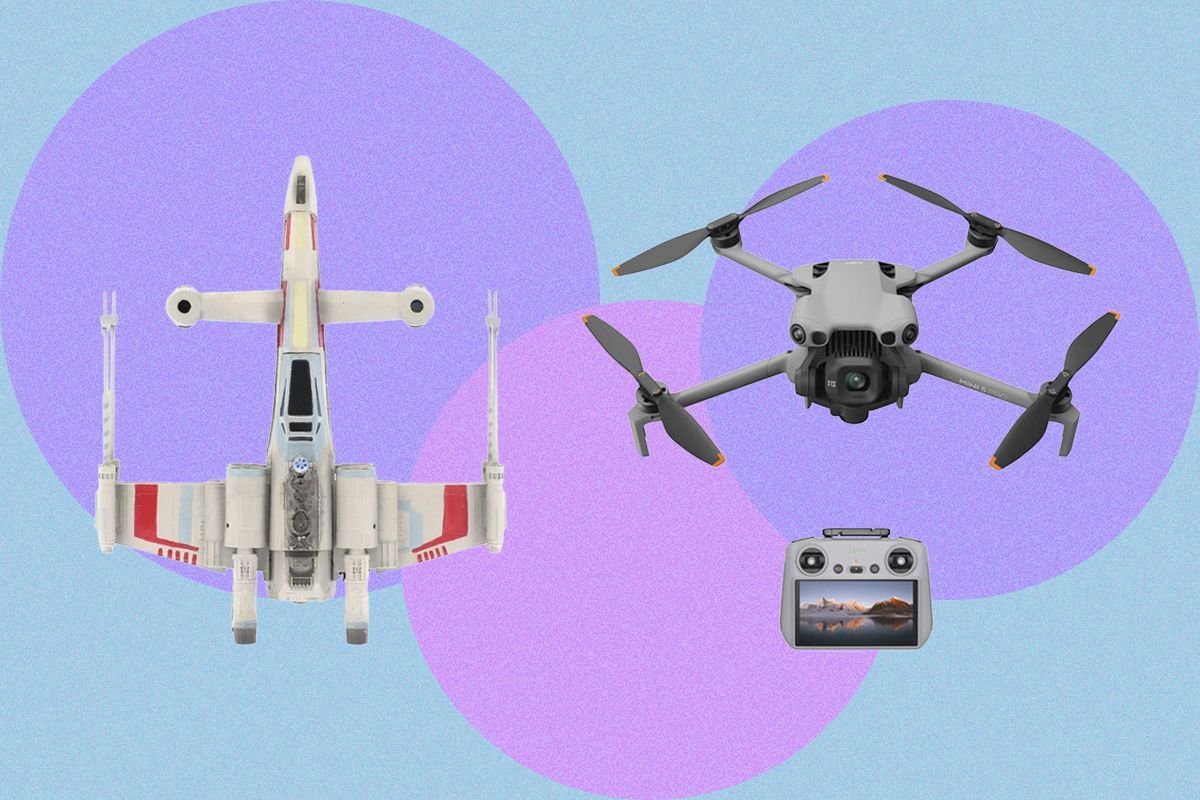
Propel’s X-Wing fighter drone is great for Star Wars fans. There are actually a few drones in this line: the X-Wing, and the Tie X1 ($130). The best part is that all of them have a “battle mode,” so you can fly against friends and try to shoot them down. Get hit three times with the IR beam and your drone will auto-land. Unfortunately, these have a learning curve when it comes to flying—a little tap of the control stick goes a long way—and mine had a habit of flying off at an angle immediately on takeoff. Holding a position is also a lost cause, but once you master the sensitive controls, these are fun to fly (and fight). The prices of these fluctuate a lot, particularly on Amazon where the price swings around by $100 or more; don’t pay more than $60 for the X-Wing.
Avoid No-Name Brands
The internet is awash with “toy drones” in the $50 to $150 price range. There are two reasons for this. First, well-made drones are still expensive. Drones also share many components with smartphones, which means chips, camera sensors, and tiny lenses are cheap at the wholesale level. That results in a million knockoffs.
Unfortunately, you tend to get what you pay for. While two of the under-$100 models I’ve tested were fun to fly, the photos and video they produced were hot garbage. I also have my doubts about their long-term durability. I think most people would be better off buying one of the tiny toy drones mentioned above while saving up for a DJI Mini 4 Pro.
That said, if you don’t care about creating content, just want to have fun flying, and don’t mind taking a risk, these “toys” might be worth a look.
Power up with unlimited access to WIRED. Get best-in-class reporting and exclusive subscriber content that’s too important to ignore. Subscribe Today.
