Close Menu

    Subscribe to Updates

    Get the latest creative news from FooBar about art, design and business.

    What's Hot

    Bungie’s Marathon set for March 2026 launch | News-in-brief

    Former Call of Duty dev Schofield laments the state of Activision and EA

    Pandora is betting on AI agents to scale service and emotional selling during the peak holiday season

    Facebook X (Twitter) Instagram
    • Artificial Intelligence
    • Business Technology
    • Cryptocurrency
    • Gadgets
    • Gaming
    • Health
    • Software and Apps
    • Technology
    Facebook X (Twitter) Instagram Pinterest Vimeo
    Tech AI Verse
    • Home
    • Artificial Intelligence

      AI has become the norm for students. Teachers are playing catch-up.

      December 23, 2025

      Trump signs executive order seeking to ban states from regulating AI companies

      December 13, 2025

      Apple’s AI chief abruptly steps down

      December 3, 2025

      The issue that’s scrambling both parties: From the Politics Desk

      December 3, 2025

      More of Silicon Valley is building on free Chinese AI

      December 1, 2025
    • Business

      Top 10 cloud computing stories of 2025

      December 22, 2025

      Saudia Arabia’s STC commits to five-year network upgrade programme with Ericsson

      December 18, 2025

      Zeroday Cloud hacking event awards $320,0000 for 11 zero days

      December 18, 2025

      Amazon: Ongoing cryptomining campaign uses hacked AWS accounts

      December 18, 2025

      Want to back up your iPhone securely without paying the Apple tax? There’s a hack for that, but it isn’t for everyone… yet

      December 16, 2025
    • Crypto

      Crypto Twitter Turns Bearish on 2026—but These 3 Sectors Could Still Win

      December 25, 2025

      Bitcoin’s Trading Pair Flashes Down to $24,000 on Binance: Why You Need to be Careful

      December 25, 2025

      Cardano’s 18% Breakdown Setup Is Clear — But So Is Its Only Escape Route

      December 25, 2025

      How a Major Source of Market Stress in 2025 May Be Diminishing

      December 25, 2025

      USDC Is Being Used for More Than Trading, and Bybit Is Expanding Support on XDC

      December 25, 2025
    • Technology

      Pandora is betting on AI agents to scale service and emotional selling during the peak holiday season

      December 25, 2025

      How to transfer your games to the Nintendo Switch 2

      December 25, 2025

      2025 Christmas Day NFL games: How to watch today, full streaming schedule and more

      December 25, 2025

      Steam and Valve’s online games are partially down

      December 25, 2025

      Research shows ‘more agents’ isn’t a reliable path to better enterprise AI systems

      December 25, 2025
    • Others
      • Gadgets
      • Gaming
      • Health
      • Software and Apps
    Check BMI
    Tech AI Verse
    You are at:Home»Technology»Quantum Error Correction Goes FOOM
    Technology

    Quantum Error Correction Goes FOOM

    TechAiVerseBy TechAiVerseDecember 25, 2025No Comments6 Mins Read0 Views
    Facebook Twitter Pinterest Telegram LinkedIn Tumblr Email Reddit
    Quantum Error Correction Goes FOOM
    Share
    Facebook Twitter LinkedIn Pinterest WhatsApp Email

    Quantum Error Correction Goes FOOM

    In this post: why I expect the maximum achievable qubit quality to increase drastically in the next few years.

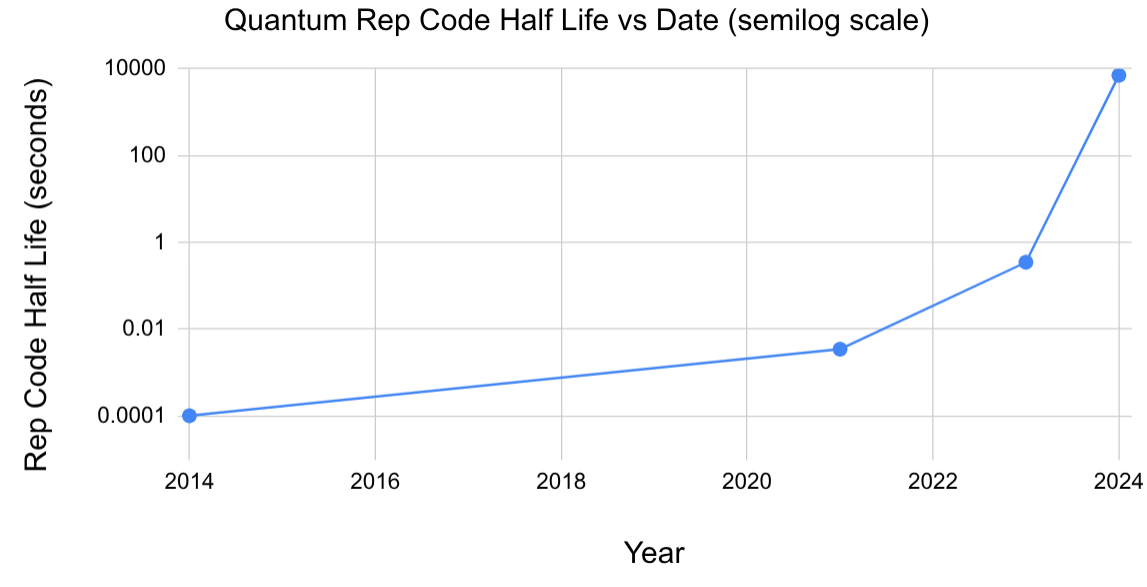
    In 2014, the John Martinis group at UCSB performed an experiment where they stored a classical bit using their quantum computer.
    They protected the bit with a 9 qubit quantum repetition code.
    The protected bit had a half life of roughly 100 microseconds.
    Clearly that’s not competitive with classical storage… but the goal of the experiment wasn’t to hit a high number.
    The goal was to perform a demonstration of the fledgling power of quantum error correction.
    In particular, the 9 qubit rep code had a longer lifetime than the individual physical qubits, and also a longer lifetime than the 5 qubit rep code that they also tried.
    It hinted that qubit quality could be solved using qubit quantity.

    Later experiments by the same group (now at Google) improved on this starting point.
    In 2021, it was a 21 qubit rep code with a half life of 3 milliseconds.
    Then, in 2023, it was a 51 qubit rep code with a half life of 300 milliseconds.
    Most recently, in 2024, it was a 59 qubit rep code with a half life of 2 hours.

    Let’s plot this data:

    (view with semilog scale instead)

    That’s quite the plot, right?
    There’s a huge lull and then… FOOM!
    It took nearly a decade for the half life to approach one second, and then one year later it’s suddenly measured in hours?!
    I know why it happens, but I still find it surprising.

    Here’s a simple model that explains the FOOM.
    The lifetime $L$ of a repetition code grows like $L = C lambda^q$ (see equation 11 of “Surface codes: Towards practical large-scale quantum computation”).
    Here $q$ is the number of physical qubits, $lambda$ is a measure of qubit quality, and $C$ is a starting constant.
    Suppose quality is held fixed at $lambda = 2$ and qubit count doubles each year (meaning $q = 2^t$).
    Then $L$ grows superexponentially:

    [L = C lambda^q = C lambda^{2^t}]

    The first stacked exponential is qubit count vs years, due to the assumed Moore’s-law-like growth.
    The second stacked exponential is error rate vs qubit count, due to technical details of how quantum error correction works that I’m not going to go into.

    What do you get when you stack two exponentials?
    A lull followed by a FOOM.

    In practice, things are a bit more complex than a superexponential.
    There are “hurdles” that place ceilings on the lifetime of error corrected objects.
    You discover these QEC hurdles due to the superexponential not holding, and you get mini FOOMs as you fix them.
    A mundane example of a QEC hurdle is, if you don’t have backup generators, your qubits can’t live longer than the time between power outages.
    Installing backup generators would allow the lifetime to increase, until it becomes limited by whatever the next QEC hurdle is (such as asteroid strikes).

    An important QEC hurdle is leakage.
    During operation, superconducting transmons can get overexcited and “leak” out of the qubit subspace.
    The proportion of leaked qubits will grow until they suffocate the computation.
    Fixing this requires some kind of leakage removal.
    Another important QEC hurdle is high energy events like cosmic rays.
    The 2023 lifetime of 300 milliseconds noticeably deviated from the $L = C lambda^q$ idealization, due to high energy impacts intermittently disabling the entire chip.
    In 2024 this problem was mitigated using gap engineering, resulting in the sudden 10000x jump in lifetime.
    Without cosmic rays (or other QEC hurdles), the lifetime would have already been unmeasurably long in 2023.

    QEC hurdles are extremely important to identify and fix.
    In fact, this is one of the major reasons the google team does rep code experiments.
    To clear the way for full quantum error correction.

    Full Quantum Error Correction

    So far I’ve only talked about protecting a classical bit on a quantum chip.
    That only requires correcting one type of error (bit flip errors).
    The real goal is, of course, to protect quantum bits.
    Protecting a qubit requires correcting a second type of error (phase flip errors, such as caused by unwanted measurements).
    Repetition codes protect against bit flips, but actually make phase flip errors worse.
    Correcting both simultaneously requires more complex codes, such as the surface code.

    Although the process of protecting a qubit is more complex than protecting a bit, the same basic dynamics are present.
    There’s a quality bar you must cross in order for it to work, and then you get exponential returns on error suppression by increasing qubit count.
    If your qubit count is also increasing exponentially, then you will achieve superexponential error suppression vs time (with ceilings as you encounter QEC hurdles).

    In a surface code, quadrupling the number of physical qubits will square the logical error rate of the protected qubit.
    In 2024, the best surface code experiment had a logical error rate of 0.1% per round (corresponding to a half life of a ~300 microseconds).
    Holding quality constant, one qubit quadrupling would turn that 0.1% into 0.0001% (~300 milliseconds).
    The next quadrupling would reach 0.0000000001% (~3 days).
    And the one after that would reach 0.0000000000000000000001% (~30 billion years).

    Quadrupling the number of physical qubits has technical challenges, like wiring complexity, which must be overcome in a way that doesn’t degrade qubit quality.
    And, of course, there will be some QEC hurdle that places a ceiling stricter than 30 billion years (e.g. nuclear war).
    But ultimately the picture looks qualitatively similar to the rep code case.
    Lull… then FOOM.

    Because error corrected qubits recently begun to surpass physical qubits, I think the FOOM for logical qubits is near.
    I realize how ridiculous the hypotheticals look in this plot, but I legitimately think this is what will happen:

    Summary

    In my view, there are three long standing barriers to full scale quantum computation: qubit quality, qubit quantity, and qubit speed.
    I think the quality barrier will fall within the next five years.
    This is perhaps surprising, because the quality barrier has held strong over the three decades that we’ve known about quantum error correction.
    But logical qubits have recently begun surpassing physical qubits, and QEC goes FOOM.

    Share. Facebook Twitter Pinterest LinkedIn Reddit WhatsApp Telegram Email
    Previous ArticleSelf-referencing Page Tables for the x86-Architecture
    Next Article We invited a man into our home at Christmas and he stayed with us for 45 years
    TechAiVerse
    • Website

    Jonathan is a tech enthusiast and the mind behind Tech AI Verse. With a passion for artificial intelligence, consumer tech, and emerging innovations, he deliver clear, insightful content to keep readers informed. From cutting-edge gadgets to AI advancements and cryptocurrency trends, Jonathan breaks down complex topics to make technology accessible to all.

    Related Posts

    Pandora is betting on AI agents to scale service and emotional selling during the peak holiday season

    December 25, 2025

    How to transfer your games to the Nintendo Switch 2

    December 25, 2025

    2025 Christmas Day NFL games: How to watch today, full streaming schedule and more

    December 25, 2025
    Leave A Reply Cancel Reply

    Top Posts

    Ping, You’ve Got Whale: AI detection system alerts ships of whales in their path

    April 22, 2025538 Views

    Lumo vs. Duck AI: Which AI is Better for Your Privacy?

    July 31, 2025191 Views

    6.7 Cummins Lifter Failure: What Years Are Affected (And Possible Fixes)

    April 14, 202594 Views

    6 Best MagSafe Phone Grips (2025), Tested and Reviewed

    April 6, 202586 Views
    Don't Miss
    Gaming December 25, 2025

    Bungie’s Marathon set for March 2026 launch | News-in-brief

    Bungie’s Marathon set for March 2026 launch | News-in-brief Home News Marathon (2025) Developer aiming…

    Former Call of Duty dev Schofield laments the state of Activision and EA

    Pandora is betting on AI agents to scale service and emotional selling during the peak holiday season

    How to transfer your games to the Nintendo Switch 2

    Stay In Touch
    • Facebook
    • Twitter
    • Pinterest
    • Instagram
    • YouTube
    • Vimeo

    Subscribe to Updates

    Get the latest creative news from SmartMag about art & design.

    About Us
    About Us

    Welcome to Tech AI Verse, your go-to destination for everything technology! We bring you the latest news, trends, and insights from the ever-evolving world of tech. Our coverage spans across global technology industry updates, artificial intelligence advancements, machine learning ethics, and automation innovations. Stay connected with us as we explore the limitless possibilities of technology!

    Facebook X (Twitter) Pinterest YouTube WhatsApp
    Our Picks

    Bungie’s Marathon set for March 2026 launch | News-in-brief

    December 25, 20250 Views

    Former Call of Duty dev Schofield laments the state of Activision and EA

    December 25, 20250 Views

    Pandora is betting on AI agents to scale service and emotional selling during the peak holiday season

    December 25, 20250 Views
    Most Popular

    What to Know and Where to Find Apple Intelligence Summaries on iPhone

    March 12, 20250 Views

    A Team of Female Founders Is Launching Cloud Security Tech That Could Overhaul AI Protection

    March 12, 20250 Views

    Senua’s Saga: Hellblade 2 leads BAFTA Game Awards 2025 nominations

    March 12, 20250 Views
    © 2025 TechAiVerse. Designed by Divya Tech.
    • Home
    • About Us
    • Contact Us
    • Privacy Policy
    • Terms & Conditions

    Type above and press Enter to search. Press Esc to cancel.