

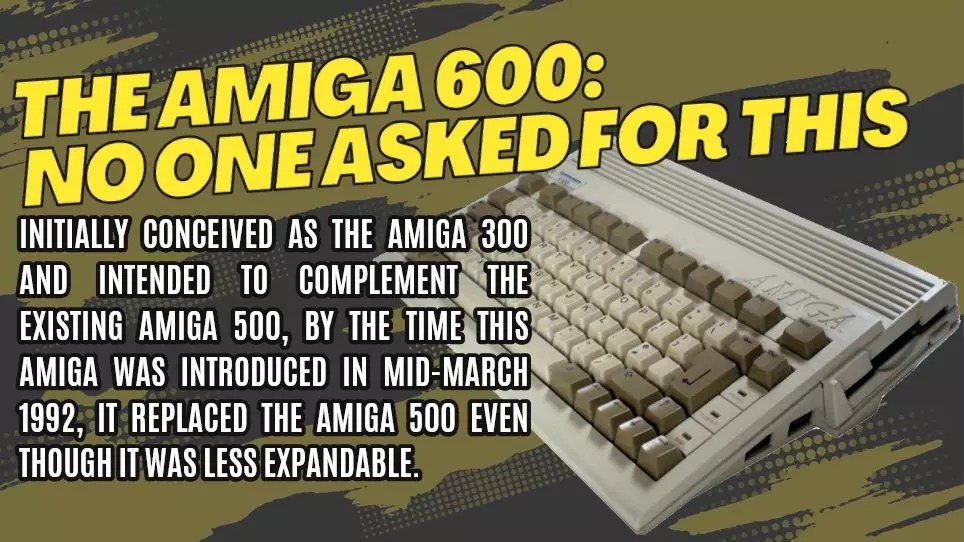
Amiga 600: From the Amiga No One Wanted to Retro Favorite
The Amiga 600 was one of the last Amigas, and it became a symbol of everything wrong with Commodore and the product line. Retro enthusiasts like it today because of its small size, so it’s the perfect retro Amiga for today. But it couldn’t have been much more wrong for the time it was introduced, March 11-18, 1992 at the CeBit show.
The Amiga 600 was a cost-reduced Amiga for home use, similar in size and appearance to a Commodore 64. But internally it wasn’t much more than a repackaged Amiga 1000 from 1985, trying to compete with VGA graphics and 386 CPUs.
Commodore didn’t understand its own success
The Amiga 600 shows how Commodore didn’t understand its previous successes and failures. When Commodore was at its best, the process looked something like this. It decided on a price point to hit. Then its engineers built the computer they would want while staying within that budget. Most of Commodore’s engineers were computer enthusiasts themselves, so it was like a car company selling cars designed by car enthusiasts.
The machines built momentum fairly quickly. Other enthusiasts took to the machines, built peripherals and software to go with it, and created an ecosystem that sold the computer. Commodore’s marketing rarely said much more than their computer was better and cheaper than the others. For a while, that was all it took.
What was wrong with the Amiga 600
The Amiga 600 was the opposite of all that. It was 1985 technology repackaged to look as much like 1982 technology as possible, priced at $500 and released in 1992. But that didn’t include a monitor and hard drive. You wanted those. By the time you added a monitor and a hard drive to get the system you really wanted, it cost closer to $1,000. At that price, you could get an off-brand PC with a VGA monitor. It wouldn’t be great. But it also didn’t feel like someone ripping you off with expensive add-ons. Or you could pay $200 more and get a pretty nice PC with lots of expansion capability. Either way you went, the PC seemed like a better value. And as 1992 wore on, that PC came down in price while Amiga prices held mostly steady.
The Amiga 600 failed, and Commodore discontinued it in 1993. No one noticed though. Commodore still had inventory when it folded in 1994 so you could still get one if you wanted one. They had refurbished Amiga 500s too, so you could get one of those instead. And that’s what the people in the know went for, if they bought an Amiga instead of a PC.
Amiga 600 vs Amiga 500
In most ways, the Amiga 600 was just a cut-down version of the Amiga 500. Launched in 1987, the Amiga 500 had been pretty successful. It initially cost $695 when released, and was also a cut-down version of the Amiga 1000, repackaged in a single piece with a full keyboard that resembled the now-ubiquitous PC keyboard layout of today.
An ecosystem sprung up around the Amiga 500 because it was really expandable. It featured a port on the side where you could plug in a hard drive or CD-ROM drive, and a trapdoor expansion that could take additional memory. If you were willing to tinker, you could expand it inside, because all of the major chips were in sockets. Lots of Amiga 500 add-0ns were circuit boards that plugged into chip sockets.
The Amiga 600 dispensed with most of that. All of the chips except the system ROM were soldered to the motherboard, so all the wonderful internal A500 expansions didn’t work anymore. The expansion port on the side disappeared, with a PCMCIA port in its place. That’s nice today, but in 1992, PCMCIA peripherals were fairly scarce. The keyboard shrunk down to something resembling today’s 40% keyboards. The only improvement it featured over the A500 was having a 44-pin IDE port on the motherboard.
It was fully software-compatible with the A500, but most of the peripherals that had sprung up around it over the previous five years had to be redesigned. It was a dated machine, with no hardware ecosystem around it, and offered no significant price savings over the machine it replaced.
The Amiga 300
At one point, the Amiga 600 was going to be called the Amiga 300 and sold as a cut-down Amiga. That sounds like a solution in charge of a problem but at least wouldn’t have meant discontinuing a machine that still sold well. Discontinuing a machine that was still selling and replacing it with one with a name that made it sound like an upgrade when it wasn’t created new problems for a company that didn’t need any more new problems.
Dated technology
Both the Amiga 500 and 600 featured a Motorola 68000 CPU running at 7 MHz. In 1987 this was fine. By 1992, that 68000 was competing with 16 MHz 386SX CPUs, which at least sounded much better. The perceived value of a 386SX at 16 MHz was much higher than that of a 7 MHz 68000. Apple discontinued its last computer based on the 68000 CPU in October 1992, which shows Commodore didn’t need to be trotting out a new machine based on that chip in March.
They also had 4-voice, stereo sound. In 1987, the Amiga’s sound was as good as it got. In 1992, a cheap PC couldn’t keep up. It either came with the standard PC speaker, or 3-voice Tandy sound, if you bought a Tandy 1000. But you could get an add-on card. By 1992, you could get a Sound Blaster with 22-voice sound. It cost more, but the perceived value was much higher too.
The graphics problem
But the biggest problem was the graphics. In 1985, the Amiga’s 640×200 resolution and ability to display up to 4,096 colors was revolutionary. But 1987 saw the introduction of VGA, with the ability to display 256 colors from a palette of 262,144 colors, and a maximum resolution of 640×480. It was shockingly expensive in 1987, but prices came down rapidly. The Amiga’s graphics lended themselves well to 2D platform-style games and allowed the Amiga to punch above its weight. A stock Amiga 600 can play a Commander Keen-style game just as smoothly as a faster PC.
But in May 1992, id Software dropped Wolfenstein 3D, the first 3D first-person shooting game. It ran reasonably well on a 386sx-based PC with VGA graphics, while nothing comparable existed on the Amiga. While a brand-name 386SX with a VGA monitor cost slightly more than an Amiga 600 with a monitor and comparable hard drive, it could do something fun that an Amiga couldn’t do. People will pay more money if it seems like it’s worth it. And with every succeeding month in 1992 and 1993, the value proposition favored the PC more and more.
How the Amiga 600 could have been better
Commodore’s bad decisions have led to a ton of armchair quarterbacking over the years, especially around the C-128 and C-65, and many of those ideas weren’t technologically possible at the time. One thing Commodore could have done fairly easily would have been to replace the CPU. ICD had an accelerator board for the Amiga 500 containing a 68000 CPU running at 14 MHz. Supra had an even better one, the Supra Turbo 28, with a 68HC000 running at 28 MHz. These made the Amiga noticeably faster, without costing a lot of money and while maintaining very high compatibility with the original. Commodore’s engineers could have redesigned the A600 motherboard to accommodate a faster 68000. They had the ability.
A faster CPU would have made the A600 look better on paper, and made Amiga owners more willing to forgive its other shortcomings. Commodore might have even been able to raise the price a little to eek out a little more much-needed profit margin.
Putting the AGA chipset in the A600 would have also helped. The CPU still would have hurt, but the graphics would have been more competitive. But there’s a problem with that idea: the AGA chipset wasn’t ready to ship in March.
The logic behind the Amiga 600
The blame for the Amiga 600 primarily lies on Commodore product manager Bill Sydnes. Sydnes had been the product manager for IBM’s doomed PCjr. His influence showed. He took a successful product, made a cut-down version of it, and made it look like the machine that beat his PCjr in the marketplace. Amiga engineers called it the Amiga Junior and got in trouble for doing so.
Had Commodore been able to cut the price significantly, consumers might have accepted it. The problem was the redesign didn’t have a lot to work with. Reducing the board size and changing to newer, cheaper capacitors saved a few dollars, but the big money was elsewhere. The Amiga’s custom chipset was still being manufactured using a dated manufacturing process. Commodore’s MOS subsidiary used a 3.5 µm manufacturing process, while Intel and other chip manufacturers were using a 1 or 1.5 µm process in 1985. By 1992, the rest of the industry had moved on to a .8 or .6 µm process. This meant Commodore’s competitors went from getting twice as many chips per wafer in 1985 to getting 3-5 times as many chips per wafer in 1992, so they could lower their prices much more quickly.
That’s why Commodore couldn’t price a bare A600 at $199 or $299. At that price, it might have had a chance because it could be the computer you bought if you couldn’t afford anything else. At $499, you had enough money to have other options, whether that meant a dated PC/XT clone, a used or refurbished Amiga 500, or saving up a few more months to get a more current PC.
Commodore’s ability to make its own chips had been a big advantage in 1982. Its process was out of date even then, but was competitive enough that it saved money by making them itself. Ten years later, it didn’t.
Commodore’s other option
Commodore had an ace in the hole in 1992: The Amiga 1200. Unlike the Amiga 600, it was a real improvement over the Amiga 500, with a faster 32-bit 68EC020 CPU running at 14 MHz, and VGA-like AGA graphics. In some ways it was too little, too late and it probably was. But the Amiga had a cult following, and it was enough to keep that niche interested, especially in Europe where the Amiga had a bigger following.
The problem was MOS technology couldn’t make the new chips. They were too complex. Commodore farmed out the graphics chip to HP and the memory/bus controller to VLSI. But since it wasn’t used to working with outside suppliers, it didn’t get the order in soon enough to get the chips in large quantities. So when Christmas 1992 came around, Commodore didn’t have enough chips to keep up with Amiga 1200 demand.
Osborneing itself
The Amiga 600 came out in March 1992 and the A1200 came out in October. Commodore couldn’t make up its mind which machine to build, and stepped right into the Osborne effect. In a perfect world, Commodore would have decided much earlier in the year to go with the Amiga 1200 so it could at least flood the market at Christmas. Better yet, it would have introduced it earlier in the year.
With too few A1200s to meet demand, they tried to make up the difference with Amiga 600s, and that went about as well as you’d imagine. Commodore ended up with piles of unsellable inventory, and the inability to keep up with early demand for the Amiga 1200 meant it lost momentum. Given the choice between going on a waiting list for an Amiga 1200, buying a 386SX immediately, or buying an Amiga 600, many more chose that 386sx. The 386sx looked like a comparable machine and it had Wolfenstein 3D.
This meant Commodore had a problem. It had a pile of machines no one wanted. It had money tied up in those machines. That meant Commodore had less money to pay HP and VLSI for chips to make the machines people did want. After a disastrous Christmas 1992 season, Commodore bled cash for five more quarters and went out of business in April 1994.
The Amiga 600 today
It’s no help to Commodore now, but it seems like more people want an Amiga 600 today than in 1992. It’s small and self-contained, so it takes up less space than other retro systems. You can plug it into a Dell 2001fp or similar monitor and it takes up less space than a PC keyboard. When you’re done with it, you can swap it in for another system and stash the A600 on a shelf or wall bracket. Internally, the A600 takes a 44-pin hard drive or compact flash-to-IDE adapter for storage, and there’s a lot more PCMCIA hardware available now than there was in 1992. And if you want to really hotrod it, the Vampire board featuring a faster CPU and AGA-compatible chipset came out for the A600 before other Amiga models. So today it’s possible to turn the A600 into something compatible with the A1200, only smaller, faster, and better.
Even without modification, it’s a smaller and lighter Amiga 500. The A500’s keyboard is better, but if you’re playing games, you probably won’t notice the difference. And that’s the main reason people want a classic Amiga today. If you have multiple classic computers, it’s nice for them to be as small as possible. An Amiga 600 gives the classic Amiga experience in the smallest possible form factor. It was the worst Amiga possible in 1992 but in some ways it’s the ideal Amiga now.
Amiga 600 caveats
The major problem with the A600 is that it uses surface-mount capacitors, a cost-reducing measure from 1992. These capacitors tend to fail and leak, so many A600s don’t work today until you replace the caps. Be sure to ask if the caps have been replaced, and be prepared to replace them if they are original. The electrolyte leaks out and damages the motherboard over time, so be sure to replace the caps if they are still original. Original caps don’t improve the system value, and turn the system into a time bomb. Older Amigas used through-hole caps that weren’t as prone to leak, so there’s nothing wrong with leaving those original.
Similarly, many memory expansion boards contain a battery for a real-time clock. Ensure the battery is new, since a leaky battery can damage both the expansion board and the motherboard.
The A600 is also very prone to discoloration. While the machine still works, it doesn’t look as nice. Fortunately it responds well to the chemical-free retrobright method to restore its original color.
So while the Amiga 600 was the Amiga no one wanted and it neatly summed up everything wrong at Commodore in a neat little package, it’s a very nice retro computer now. It cures Amiga sprawl by packing all the essentials into less space than you need for a C-64. In some ways it’s the original Amiga Mini.
David Farquhar is a computer security professional, entrepreneur, and author. He has written professionally about computers since 1991, so he was writing about retro computers when they were still new. He has been working in IT professionally since 1994 and has specialized in vulnerability management since 2013. He holds Security+ and CISSP certifications. Today he blogs five times a week, mostly about retro computers and retro gaming covering the time period from 1975 to 2000.
