

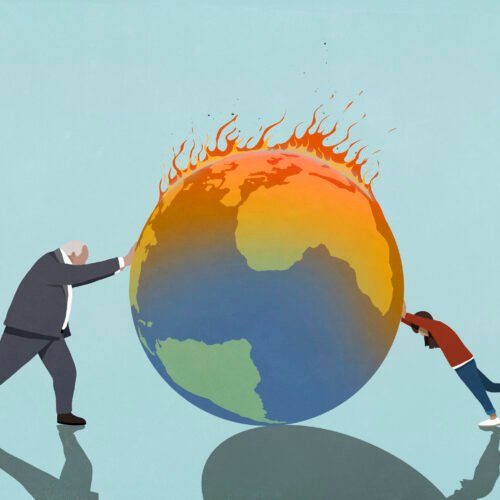
Despite congressional threat, National Academies releases new climate report
Things have changed since 2009: We’re more certain about the problems.
Earlier this year, the Environmental Protection Agency announced that it was going to reject the work it had done back in 2009, when it first determined that greenhouse gas emissions posed a threat to the US public. While it laid out a number of reasons for revisiting its earlier work, one of those focused on the science: The EPA’s original decision was over 15 years old, and it claimed our understanding of climate change had itself changed since then.
The National Academies of Science (NAS) decided that at least one aspect of that was probably right: Our understanding of the climate has changed in the last 15 years. So, it asked a group of scientists to do a quick update of our understanding of greenhouse gases, completed before public comment was closed on the EPA’s plan. That report is now out, and the NAS’s conclusion is clear: The EPA was right in 2009, and everything we’ve learned since has only made it more right.
The politics of emissions
The EPA’s endangerment finding already had a long history by the time it was completed during the Obama administration. In it, the EPA concluded that greenhouse gases pose a risk to the US and its citizens, both directly through health impacts and indirectly through economic damages. Under the Clean Air Act, that finding enabled regulation of greenhouse gas emissions and formed the foundation of plans to reduce those originating from transportation and electrical generation. All of those plans have been held up in court or abandoned before coming into effect.
The first Trump administration, rather than try to overturn a solid scientific analysis, attempted to implement toothless regulations. The second one, however, is far more ambitious and is attempting to reduce the threat of any future regulations by overturning the endangerment findings. It relied on a number of reasons to justify doing so.
The first was legal. It correctly noted that the current Supreme Court has shown a hostility to environmental regulations that appears to border on the pathological, and has been more than happy to overturn precedent. So, the EPA suggested that these past rulings now raise doubts about the EPA’s ability to pursue greenhouse gas regulations at all. Strategically, it’s likely that the administration hopes its actions will end up before the Supreme Court, providing it with the opportunity to overturn the decision (Massachusetts v. EPA) that compelled the EPA to consider greenhouse gas regulations in the first place.
Second, the EPA raised the issue of whether regulations in the US are meaningful given the global scope of carbon emissions. Even if the US were to completely eliminate its carbon emissions, we’d remain on track for dangerous warming by the century’s end.
Finally, the EPA questioned whether the science underlying the original endangerment finding remained relevant. After all, it suggested, we’d gotten lots of additional data since then (apparently choosing to ignore the fact that said data includes record-setting warmth). To strengthen this part of its case, the EPA relied on the Department of Energy, which released the draft of a report prepared by a hand-picked set of scientists with far-out-of-the-mainstream ideas. The report, as expected based on its authors, raised a large series of spurious doubts about climate science, which led to a massive critique of the report by other climate scientists.
It also led to the DOE being sued over its secrecy regarding the choice of authors and the preparation of the report. Rather than amending or defending the report, the DOE chose to dissolve the group that prepared it in the hope that this would end the lawsuit. This leaves the scientific portion of the EPA’s argument on shaky ground.
The National Academies responded to the EPA’s actions by saying it would prepare a report of its own, which it did despite the threat of a congressional investigation into its work. And the result undercuts the EPA’s claims even further.
Blunt and to the point
The NAS report does not mess around with subtleties, going straight to the main point: Everything we’ve learned since the endangerment finding confirms that it was on target. “EPA’s 2009 finding that the human-caused emissions of greenhouse gases threaten human health and welfare was accurate, has stood the test of time, and is now reinforced by even stronger evidence,” its authors conclude.
That evidence includes a better understanding of the climate itself, with the report citing “Longer records, improved and more robust observational networks, and analytical and methodological advances” that have both allowed us to better detect the changes in the climate, and more reliably assign them to the effects of greenhouse gases. The events attributed to climate change are also clearly harming the welfare of the US public through things like limiting agricultural productivity gains, damage from wildfires, losses due to water scarcity, and general stresses on our infrastructure.
But it’s not just the indirect effects we have to worry about. The changing climate is harming us more directly as well:
Climate change intensifies risks to humans from exposures to extreme heat, ground-level ozone, airborne particulate matter, extreme weather events, and airborne allergens, affecting incidence of cardiovascular, respiratory, and other diseases. Climate change has increased exposure to pollutants from wildfire smoke and dust, which has been linked to adverse health effects. The increasing severity of some extreme events has contributed to injury, illness, and death in affected communities. Health impacts related to climate-sensitive infectious diseases—such as those carried by insects and contaminated water—have increased.
Moreover, it notes that one of the government’s arguments—that US emissions are too small to be meaningful—doesn’t hold water. Even small increments of change will increase the risk of damaging events for decades to come, and push the world closer to hitting potential tipping points in the climate system. Therefore, cutting US emissions will directly reduce those risks.
None of these should come as a surprise to anyone who has followed the coverage of climate change here over the last decade or so. But the report backs it all up with dozens of pages of discussions of evidence, followed by 35 pages of references to the academic literature, all focused on the last 15 years of results.
It’s going to be worth seeing how the EPA deals with the fact that the DOE has given up on defending the analysis it likes, and it has received two major scientific works: one that showed the DOE report is badly flawed, and a second that shows the original endangerment finding was robust. Part of producing a final document that terminates the endangerment finding will involve discussing how it responded to public comment on its original proposal, and both of these critiques were done with the intention of being part of the public comment.
In the end, however, the EPA is likely to be relying on the Supreme Court letting it do what it prefers, regardless of where the science points. And that will remain a viable strategy even if it drops arguing against the science entirely.
John is Ars Technica’s science editor. He has a Bachelor of Arts in Biochemistry from Columbia University, and a Ph.D. in Molecular and Cell Biology from the University of California, Berkeley. When physically separated from his keyboard, he tends to seek out a bicycle, or a scenic location for communing with his hiking boots.
