

How a 1980s toy robot arm inspired modern robotics
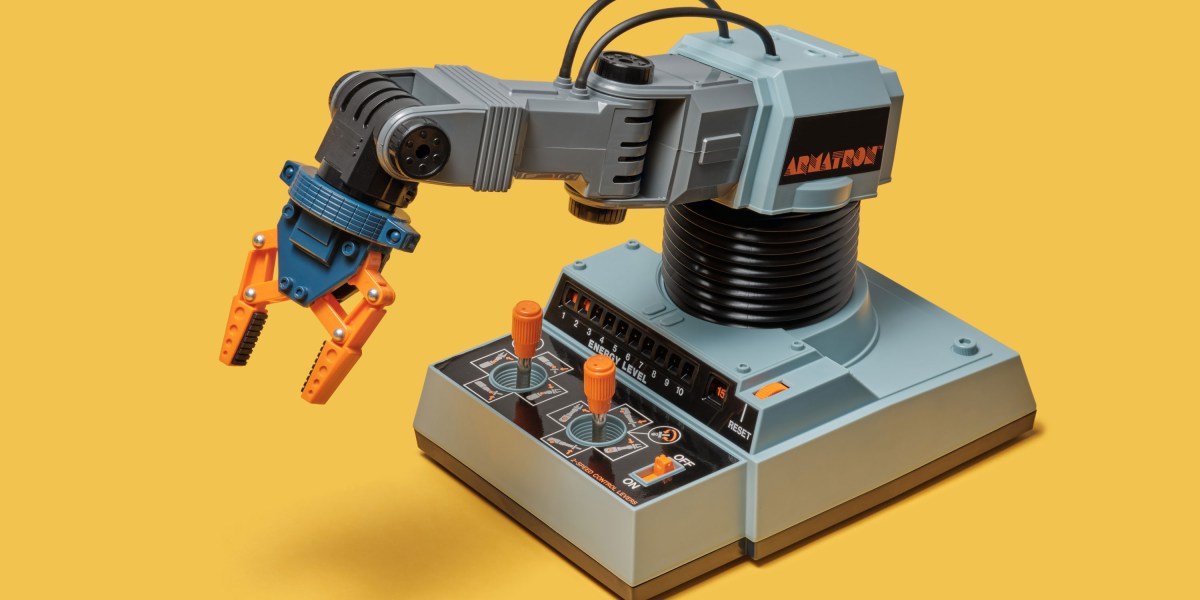
As a child of an electronic engineer, I spent a lot of time in our local Radio Shack as a kid. While my dad was locating capacitors and resistors, I was in the toy section. It was there, in 1984, that I discovered the best toy of my childhood: the Armatron robotic arm.
COURTESY OF TAKARA TOMY
Described as a “robot-like arm to aid young masterminds in scientific and laboratory experiments,” it was the rare toy that lived up to the hype printed on the front of the box. This was a legit robotic arm. You could rotate the arm to spin around its base, tilt it up and down, bend it at the “elbow” joint, rotate the “wrist,” and open and close the bright-orange articulated hand in elegant chords of movement, all using only the twistable twin joysticks.
Anyone who played with this toy will also remember the sound it made. Once you slid the power button to the On position, you heard a constant whirring sound of plastic gears turning and twisting. And if you tried to push it past its boundaries, it twitched and protested with a jarring “CLICK … CLICK … CLICK.”
It wasn’t just kids who found the Armatron so special. It was featured on the cover of the November/December 1982 issue of Robotics Age magazine, which noted that the $31.95 toy (about $96 today) had “capabilities usually found only in much more expensive experimental arms.”
JIM GOLDEN
A few years ago I found my Armatron, and when I opened the case to get it working again, I was startled to find that other than the compartment for the pair of D-cell batteries, a switch, and a tiny three-volt DC motor, this thing was totally devoid of any electronic components. It was purely mechanical. Later, I found the patent drawings for the Armatron online and saw how incredibly complex the schematics of the gearbox were. This design was the work of a genius—or a madman.
The man behind the arm
I needed to know the story of this toy. I reached out to the manufacturer, Tomy (now known as Takara Tomy), which has been in business in Japan for over 100 years. It put me in touch with Hiroyuki Watanabe, a 69-year-old engineer and toy designer living in Tokyo. He’s retired now, but he worked at Tomy for 49 years, building many classic handheld electronic toys of the ’80s, including Blip, Digital Diamond, Digital Derby, and Missile Strike. Watanabe’s name can be found on 44 patents, and he was involved in bringing between 50 and 60 products to market. Watanabe answered emailed questions via video, and his responses were translated from Japanese.
“I didn’t have a period where I studied engineering professionally. Instead, I enrolled in what Japan would call a technical high school that trains technical engineers, and I actually [entered] the electrical department there,” he told me.
Afterward, he worked at Komatsu Manufacturing—because, he said, he liked bulldozers. But in 1974, he saw that Tomy was hiring, and he wanted to make toys. “I was told that it was the No. 1 toy company in Japan, so I decided [it was worth a look],” he said. “I took a night train from Tohoku to Tokyo to take a job exam, and that’s how I ended up joining the company.”
The inspiration for the Armatron came from a newspaper clipping that Watanabe’s boss brought to him one day. “It showed an image of a [mechanical arm] holding an egg with three fingers. I think we started out thinking, ‘This is where things are heading these days, so let’s make this,’” he recalled.
As the lead of a small team, Watanabe briefly turned his attention to another project, and by the time he returned to the robotic arm, the team had a prototype. But it was quite different from the Armatron’s final form. “The hand stuck out from the main body to the side and could only move about 90 degrees. The control panel also had six movement positions, and they were switched using six switches. I personally didn’t like that,” said Watanabe. So he went back to work.
COURTESY OF TAKARA TOMY
Watanabe’s breakthrough was inspired by the radio-controlled helicopters he operated as a hobby. Holding up a radio remote controller with dual joystick controls, he told me, “This stick operation allows you to perform four movements with two arms, but I thought that if you twist this part, you can use six movements.”
COURTESY OF HIROYUKI WATANABE
“I had always wanted to create a system that could rotate 360 degrees, so I thought about how to make that system work,” he added.
Watanabe stressed that while he is listed as the Armatron’s primary inventor, it was a team effort. A designer created the case, colors, and logo, adding touches to mimic features seen on industrial robots of the time, such as the rubber tubes (which are just for looks).
When the Armatron first came out, in 1981, robotics engineers started contacting Watanabe. “I wasn’t so much hearing from people at toy stores, but rather from researchers at university laboratories, factories, and companies that were making industrial robots,” he said. “They were quite encouraging, and we often talked together.”
The long reach of the robot at Radio Shack
The bold look and function of Armatron made quite an impression on many young kids who would one day have a career in robotics.
One of them was Adam Burrell, a mechanical design engineer who has been building robots for 15 years at Boston Dynamics, including Petman, the YouTube-famous Atlas, and the dog-size quadruped called Spot.
Burrell grew up a few blocks away from a Radio Shack in New York City. “If I was going to the subway station, we would walk right by Radio Shack. I would stop in and play with it and set the timer, do the challenges,” he says. “I know it was a toy, but that was a real robot.” The Armatron was the hook that lured him into Radio Shack and then sparked his lifelong interest in engineering: “I would roll pennies and use them to buy soldering irons and solder at Radio Shack.”
“There’s research to this day using AI to try to figure out optimal ways to grab objects that [a robot] sees in a bin or out in the world.”
Burrell had a fateful reunion with the toy while in grad school for engineering. “One of my office mates had an Armatron at his desk,” he recalls, “and it was broken. We took it apart together, and that was the first time I had seen the guts of it.
“It had this fantastic mechanical gear train to just engage and disengage this one motor in a bunch of different ways. And it was really fascinating that it had done so much—the one little motor. And that sort of got me back thinking about industrial robot arms again.”
Eric Paulos, a professor of electrical engineering and computer science at the University of California, Berkeley, recalls nagging his parents about what an educational gift Armatron would make. Ultimately, he succeeded in his lobbying.
“It was just endless exploration of picking stuff up and moving it around and even just watching it move. It was mesmerizing to me. I felt like I really owned my own little robot,” he recalls. “I cherish this thing. I still have it to this day, and it’s still working.”
PUBLIC DOMAIN
Today, Paulos builds robots and teaches his students how to build their own. He challenges them to solve problems within constraints, such as building with cardboard or Play-Doh; he believes the restrictions facing Watanabe and his team ultimately forced them to be more creative in their engineering.
It’s not very hard to draw connections between the Armatron—an impossibly analog robot—and highly advanced machines that are today learning to move in incredible new ways, powered by AI advancements like computer vision and reinforcement learning.
Paulos sees parallels between the problems he tackled as a kid with his Armatron and those that researchers are still trying to deal with today: “What happens when you pick things up and they’re too heavy, but you can sort of pick it up if you approach it from different angles? Or how do you grip things? There’s research to this day using AI to try to figure out optimal ways to grab objects that [a robot] sees in a bin or out in the world.”
While AI may be taking over the world of robotics, the field still requires engineers—builders and tinkerers who can problem-solve in the physical world.
COURTESY OF RADIOSHACKCATALOGS.COM
The Armatron encouraged kids to explore these analog mechanics, a reminder that not all breakthroughs happen on a computer screen. And that hands-on curiosity hasn’t faded. Today, a new generation of fans are rediscovering the Armatron through online communities and DIY modifications. Dozens of Armatron videos are on YouTube, including one where the arm has been modified to run on steam power.
“I’m very happy to see people who love mechanisms are amazed,” Watanabe told me. “I’m really happy that there are still people out there who love our products in this way.”
Jon Keegan writes about technology and AI and publishes Beautiful Public Data, a curated collection of government data sets (beautifulpublicdata.com).
