

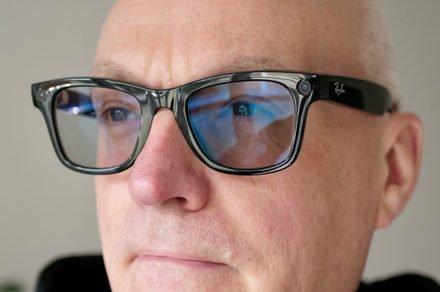
Meta’s smart glasses can now filter human voice in chaotic spaces
Meta’s new trick for smart glasses essentially filters noise and amplifies the human voices for clearer communication in chaotic places.
Andy Boxall / Digital Trends
Smart glasses, such as those sold by Meta Ray-Ban, aren’t particularly well-suited for conversations in public places. A key part of the problem is that their mic and speaker assembly is not up to the same standard as a pair of dedicated earbuds like the AirPods. Thankfully, a software-driven trick is fixing the challenge of talking in chaotic places for Meta smart glasses users.
What can it do?
The solution is called Conversation focus, and it’s not rolling out for all users who registered for the Early Access program to test experimental features. The new feature essentially focuses on a target audio signal and filters out the rest of the environmental noise.
“Conversation focus amplifies the voices of people you are facing for better communication in noisy places,” explains the company on a support page. All you have to do is say a voice command, like “Hey Meta, start conversation focus,” and the feature will kick into action.
Broadly, Meta claims that once the feature is activated, you will hear the voice of he person in front of you get amplified. The company notes that the system works best when the distance between two people is less than 1.8 metres.
Temper your expectations
Conversation focus works across two levels — standard and boosted. In boosted mode, voice amplification is sharper, and it is suited for particularly noisy spaces. Users can adjust the voice amplification by sliding their fingers on the touchpad integrated in the side arms.
But the feature has its own set of limits. Meta says it is not designed for “extremely loud environments.” Additionally, if you trigger another feature that requires mic access, such as talking to the onboard assistant, conversation focus will be paused.
It is available for the Ray-Ban Meta and Oakley Meta HSTN smart glasses in the US and Canada, and as mentioned above, it’s limited to early access users. The feature’s rollout was first spotted by UploadVR. If the idea of conversation focus sounds familiar, it’s because AirPods also offer a similar convenience called Conversation Awareness.
Nadeem is a technology and science reporter at Digital Trends.
Xreal’s latest entry-level AR glasses give you sharper visuals for less
Better resolution, brighter displays, and a $50 price cut make the Xreal 1S hard to ignore.
Xreal is back at CES 2026 with an updated take on its entry-level AR glasses. The new Xreal 1S builds on last year’s Xreal One with a handful of notable upgrades and a $50 price cut.
Although the Xreal 1S looks largely unchanged on the outside, Xreal has bumped the resolution from 1080p to 1200p and increased the brightness from 600 to 700 nits. The field of view (FoV) and aspect ratio have also been upgraded, going from 50-degrees and 16:9 on last year’s model to 52-degrees and 16:10.
Finally, a health band that doesn’t make you do math
Luna Band debuts with real-time AI health coaching and no subscription fees
Luna, a rising name in the health-tech world, has just pulled the curtain back on the Luna Band. This isn’t your typical fitness tracker designed to bury you under a mountain of charts and spreadsheets. Instead, it’s a wearable built for the moment, offering real-time, voice-led coaching that tells you what to do now rather than just showing you what you did yesterday. The device made its first appearance just before CES 2026 and is currently being demoed for the crowds in Las Vegas following its debut at Pepcom.
Most wearables on the market today are great at collecting stats but not so great at explaining what they mean for your day
The stylish Vocci smart ring wants to archive your life, one audio clip at a time
An AI-driven voice recorder that takes a single click for highlights and a double-tap for full voice recording.
Smart rings are evolving rapidly beyond the domain of health and wellness tracking. The likes of Samsung and Oura have focused on biosensing, while upstarts such as 7Ring are turning them into contactless payment devices. At CES 2026, a new wearable brand named Gyges Labs is showcasing another side of smart rings that essentially turns them into an AI-powered note-taking device.
What sets this one apart?
