As part of this, it gathered three customers to talk about their experiences of moving from VMware to Nutanix.
Of these, only one was directly attributable to Broadcom’s licensing changes, but Broadcom-Amazon Web Services (AWS) relations were key to another.
We asked them about their journey to Nutanix and away from VMware, as well as the precise pain points that prompted their decisions.
Here, we talk to:
Dom Johnston, IT manager for Golding in Brisbane, Australia, which is a heavy civil and mining contracting company that has operated on the east coast of Australia for about 75 years.
Kee Yew Wei, associate vice-president for infrastructure and operations at MSIG, which is a Japan-headquartered insurance company that operates internationally.
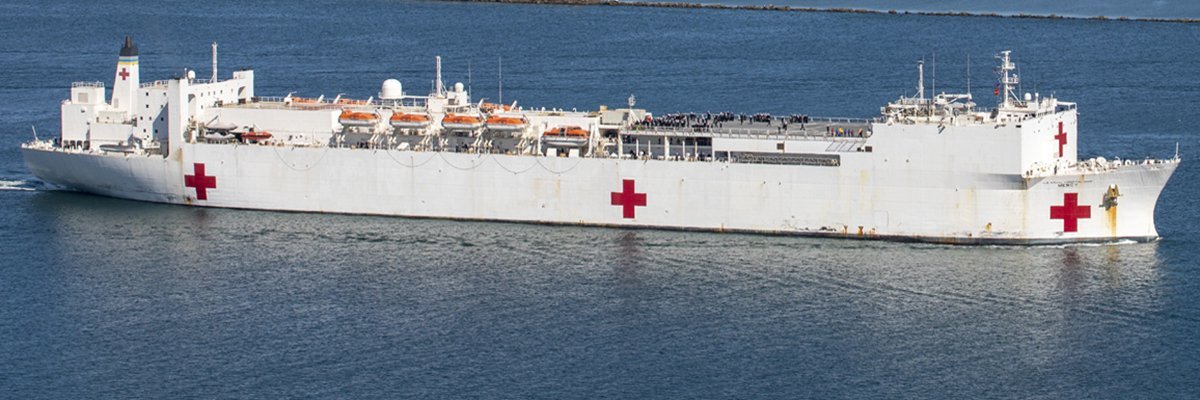
Mike Taylor, hospital ship joint task director for Military Sealift Command and the US Navy, which operates two hospital ships, Mercy (pictured above) and Comfort.
What’s the story of your journey from VMware to Nutanix?
Dom Johnston: Golding had its infrastructure sitting in VMware on AWS. We had a three-year contract with VMware for that platform, which ended in February this year. About March of last year, there was a fairly public divorce between VMware and AWS. We weren’t sure where that left us.
To cut a long story short, with what we saw over the next two to three months from there, we considered the risk of leaving our infrastructure there beyond the end of that three-year contract was too great for us.
Golding had its infrastructure sitting in VMware on AWS. [After the] fairly public divorce between VMware and AWS, we weren’t sure where that left us. With what we saw over the next two to three months, we considered the risk of leaving our infrastructure there beyond the end of that three-year contract was too great. Nutanix has kind of swung in to replace that Dom Johnston, Golding
So we went out to market to look at alternatives. And Nutanix has kind of swung in to essentially replace that. We use NC2 [Nutanix Cloud Clusters] to run our production workloads in AWS, for our DR [disaster recovery] capability, and that’s essentially to directly replace the functionality that existed within AWS and VMware Cloud Disaster Recovery, which was the DR product that sat alongside that.
So essentially, our DR strategy is that if an event occurs, we immediately spin up the DR environment ready to accept a workload. In the event that is not required, it’s spun back down again, and we’ve lost, you know, a couple 100 bucks worth of compute usage.
Kee Yew Wei: Our journey with Nutanix is from 2017. We were looking for a hyper-converged system to simplify our environment, to do away with the traditional three-tier legacy system, to simplify our environment, and to reduce our datacentre footprint.
Nutanix is the system, but we didn’t have full confidence in Acropolis at that time, because it was quite new compared to VMware.
After a couple of years using Nutanix, we built confidence, so we have recently migrated all our VMware to Nutanix AHV. We completed the full migration last month.
All this came about after the acquisition by Broadcom, and we received a quotation with a 300% to 400% increase on our renewal pricing. So, then we made the decision to go for Nutanix.
We started planning somewhere around Q3 last year and were quite conservative, with completion planned for maybe somewhere in Q2 this year. My team migrated 1,000 to 2,000 VMs [virtual machines] from Q4 and completed that at the beginning of April. So today, we are a full Nutanix house.
Mike Taylor: Our story with Nutanix started way back in 2017. We’d been Nutanix lookers for a long time.
On my ships, we had 1,000 blade servers and EMC tiered storage taking up multiple racks. But on the ships, there’s only a finite amount of power they generate, so I needed to find a way to bring everything down into a smaller footprint – but a smarter, smaller footprint, something that would allow me to very elegantly manage and have ease of use that my teams aboard the ships could deal with.
After a couple of years using Nutanix, we built confidence, so we have recently migrated all our VMware to Nutanix AHV Kee Yew Wei, MSIG
So, we did a bake-off with Dell, Cisco and Nutanix, and we implemented Nutanix on Mercy in 2019 and Comfort in 2020.
Now, we’re looking at generational refreshes of all of our equipment and probably expanding from there and getting some new features, with redundancy and disaster recovery. We do have an onboard continuity-of-operations rack, so we have mirrored failover clusters of Nutanix aboard the ships.
Now we’re all Nutanix. Everything moved over. That’s like, out of 80-something servers, we only had two or three servers that had hiccups.
Can you identify the precise pain point at which you decided to move to Nutanix from VMware?
Taylor: I remember standing in my main datacentre on the hospital ships. It’s very anticlimactic if you ever get to go; I just have five racks, but two of those five were purely just to run my server infrastructure. I remember standing there with one of my peers, and we were looking at it and we said, “Oh, hey, we’re still using SAN directors.” And SAN was going away, they were on their way out.
Dell had come out with stuff like FX, and other people were dabbling with hyper-converged, whereas Nutanix had already done it, and they had their own software, which was easy to understand for my engineers. So, I’m looking at these racks full of equipment, especially the VNX, which was power hungry. So, we said, “There has to be a better way to do this.” Energy was the problem. Energy was the driver to finding a solution.
We weren’t impacted by the Broadcom event. We got in before it. I do still run some VMware, so I am impacted by it there. The challenge we have incurred in continuing to operate that small part isn’t financial. It’s purely that I can’t get to updates. I can’t get to download them. It’s support aspects of the change that impact us the most, not the financial part of it.
If we hadn’t moved to Nutanix, if we were still purely ESXi, the financial part would certainly be a burden, like it is for other military commands.
Johnston: After AWS and VMware had their thing, we were notified by VMware that we were no longer able to spin up our on-demand DR cluster. They told us that, essentially, we could still use our DR plan if we powered down our production cluster before spinning up a DR cluster. We were testing quarterly, but we were no longer able to do that. In fact, we shifted to testing monthly because there was so much uncertainty in that space. We were left in a situation where, because we couldn’t test, we had zero confidence.
Kee Yew Wei: It was all about cost. We got a bill with a 300% to 400% increase on our last renewal. So, this is one of the key factors that drove us to migrate all our workloads to Nutanix.
When you migrated to Nutanix, were there some trade-offs, or do you have the same functionality you had with VMware?
Taylor: The trade-offs are very, very light, if any. My people were very seasoned with ESXi VMware Tools and the orchestration that VMware had.
But the learning curve for Nutanix is very short. It’s very easy to pick up, but you have to learn it. There’s a different way to import an OVA, as opposed to the way you do it within the VMware ecosystem, for example. So, the trade-off is really just time to become a master at using the system with regard to functionality.
The learning curve for Nutanix is very short. It’s very easy to pick up Mike Taylor, US Navy
In fact, I think I have enhanced capability using AHV as my hypervisor. When it comes to security, using VMware with the military, we have to submit vulnerability scans constantly. That’s just part of our regular drumbeat. I still run VMware on classified parts of my network, and it is very challenging to keep it secure and up to date. I don’t have that issue with Nutanix.
Johnson: I second that. As far as trade-offs are concerned, or the functionality, it’s really just a question of semantics in relation to the differences between the two platforms. The way that Nutanix handles snapshots is different to the way that VMware handles snapshots. That was a learning curve for us.
It’s like going from Windows 10 to Windows 11. Things are in a different spot, but it’s the same functionality.
You need to prepare your team, get them training, show them what to do. I don’t think there’s any loss of functionality. In fact, I think there are faster workflows, better availability of tools.
Jonathan is a tech enthusiast and the mind behind Tech AI Verse. With a passion for artificial intelligence, consumer tech, and emerging innovations, he deliver clear, insightful content to keep readers informed. From cutting-edge gadgets to AI advancements and cryptocurrency trends, Jonathan breaks down complex topics to make technology accessible to all.