

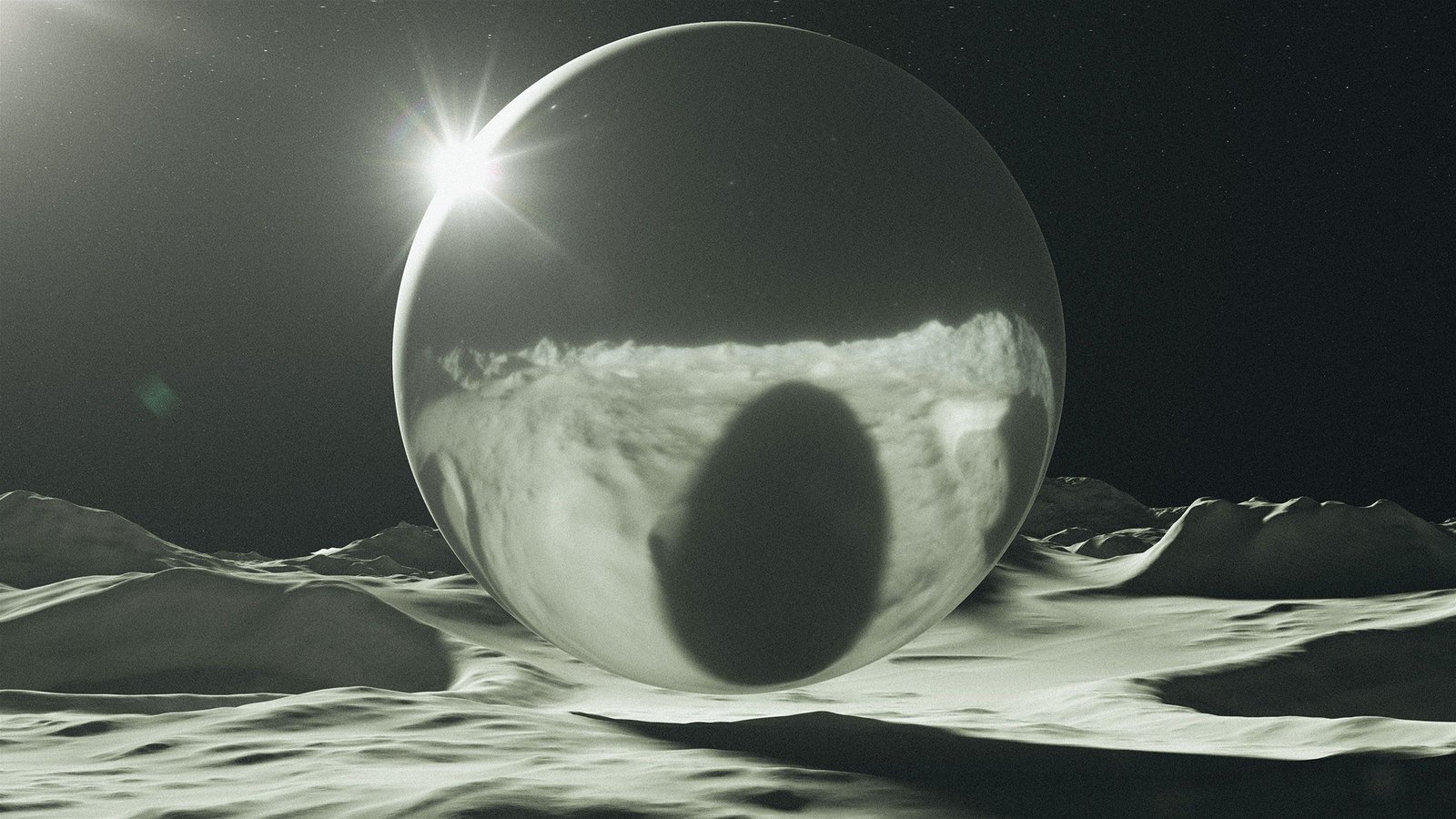
The Search for Alien Artifacts Is Coming Into Focus
There’s no denying the allure of alien artifacts. Science fiction is awash in the material remnants of extraterrestrial civilizations, which surface in everything from the classic books of Arthur C. Clarke to game franchises like Mass Effect and Outer Wilds.
The discovery of the first interstellar objects in the solar system within the past decade has sparked speculation that they could be alien artifacts or spaceships, though the scientific consensus remains that all three of these visitors have natural explanations.
That said, scientists have been anticipating the possibility of encountering alien artifacts since the dawn of the space age.
“In the history of technosignatures, the possibility that there could be artifacts in the solar system has been around for a long time,” says Adam Frank, a professor of astrophysics at the University of Rochester.
“We’ve been thinking about this for decades. We’ve been waiting for this to happen,” he continues. “But being responsible scientists means holding to the highest standards of evidence and also not crying wolf.”
That raises some tantalizing questions: What is the best way to search for alien artifacts? And what should we do if we actually identify one? Given that these technosignatures could run the gamut from tiny alloy flecks to hulking spaceships—or perhaps, some material that is unimaginable to Earthlings—it is difficult to know what to expect.
To meet this challenge, researchers are currently working on an array of techniques to search for signs of alien remnants across our solar system—including in orbit around Earth.
For example, Beatriz Villarroel, an assistant professor of astronomy at the Nordic Institute for Theoretical Physics, has focused on a largely untapped observational resource: historical images of the sky taken before the human space age.
By studying archival photographic observations captured by telescopes prior to the launch of Sputnik in 1957, Villarroel has produced a portrait of the sky before it was speckled with our satellites. As the lead of the Vanishing & Appearing Sources during a Century of Observations project (VASCO), she had initially been looking for any evidence that stars, or other natural objects, might vanish on these archival plates.
Instead Villarroel found inexplicable “transients” that look like artificial satellites in orbit around Earth, long before the launch of Sputnik, which she and her colleagues reported in 2021.
“That’s when I realized this is actually a fantastic archive, not for searching for vanishing stars, but for looking for artifacts,” she says.
Last year, Villarroel and her colleagues published three more studies about the search for near-Earth alien artifacts in The Publications of the Astronomy Society of the Pacific, Monthly Notices of the Royal Astronomical Society, and Scientific Reports that have generated spirited debate among scientists. Researchers have suggested a range of alternate explanations for the transients, which could involve instrumental errors, meteors, or debris from nuclear tests.
The mystery could potentially be resolved with a dedicated mission to search for artifacts in geosynchronous orbit, an environment about 22,000 miles above Earth. However, Villarroel doubts that such a mission would be green-lit by any federal space agency in the near term, due to the controversial nature of the topic.
“There’s so much taboo that nobody’s ever going to take such results seriously until you bring down such a probe,” she adds.
Frank says he agrees that the stigmatization of the search for otherworldly artifacts—and the search for alien life, more broadly—is counterproductive. But he sees the pushback over research into alien artifacts as a healthy and natural part of scientific inquiry.
“This is how science actually works,” he says. “You publish a paper in a reputable journal, and now we can have the scientific back and forth.”
To that end, we can expect plenty more of this back-and-forth in the coming years. The discovery of the first interstellar object, 1I/‘Oumuamua, in 2017—followed by 2I/Borisov in 2019 and 3I/ATLAS in 2025—has now brought ground truth to the long-standing dream of studying real, tangible material from other solar systems.
Beyond searching for artifacts close to Earth, scientists are also exploring new ways to search for artificial probes or other material detritus made by aliens that might pass through the solar system.
As Frank notes, the search for physical technosignatures has been the topic of scientific inquiry for more than half a century. In 1960, the physicist Ronald N. Bracewell speculated in Nature that aliens might send autonomous robotic scouts across vast interstellar expanses, which came to be known as Bracewell probes.
In a seminal 1985 paper in Acta Astronautica, researchers Robert A. Freitas Jr. and Francisco Valdes dubbed this effort “the search for extraterrestrial artifacts (SETA),” a subset of the search for extraterrestrial intelligence (SETI), and laid out several reasons why an intelligent species might prefer to make contact via a probe rather than, for instance, an interstellar radio signal.
“An intelligent artifact orbiting a garrulous inhabited world may engage in a true conversation with the indigenous civilization, an almost instantaneous, complex interaction between cultures,” the team said. “Contact via probes provides a potentially richer, deeper interaction than via interstellar radio links.”
The dawn of this new era of interstellar objects has inspired a range of anticipatory research about the best practices for identifying technosignature candidates. Avi Loeb, a Harvard astronomer, founded the Galileo Project to search for these artifacts in part due to his interpretations of ‘Oumuamua and ATLAS as possible technosignatures—a stance that has put him at odds with the majority of scientists in this field, who broadly consider all known interstellar objects to be natural in origin.
Researchers in the field are also developing criteria for identifying technosignatures and testing these methods on newly discovered interstellar objects. For example, Sofia Shiekh, a technosignature researcher at the SETI Institute, has published a guide for assessing possible artifacts, and led an effort to search for signs of artificial radio activity on 3I/ATLAS, the interstellar comet discovered in 2025, which did not find evidence of technosignatures.
In another study published last year, scientists led by James Davenport, an astronomer at the University of Washington, synthesized decades of SETA research into a comprehensive strategy to screen interstellar objects for hints that they might be alien artifacts..
In addition to the trio of interstellar objects discovered so far, we can expect many more farflung entities to come into the sights of next-generation telescopes in the coming years, especially the Vera C. Rubin Observatory, which began operating from its Chilean desert perch in 2025.
Scientists are eager to spot hints of alien technologies in these observations, such as shiny reflective materials, unusual motions and trajectories, or even active communication signals.
“Since these things are coming from other solar systems, we also expect there’s going to be some anomalies and there’s going to be some ways it’s going to look different from what we’ve seen,” says Frank, who is a co-author on the study led by Davenport. “You’ve got to set limits on that and say, this is what we mean when it’s more than anomalous or weird—I would say the technical term is, that’s freaky.”
Of course, that raises the thorniest question of all: What do we do if we find something really freaky? Is it safe or wise to approach or intercept an artifact from an alien civilization?
Villarroel notes that an active probe might not cooperate with an attempt to study it or retrieve it. Even in the case of alien space trash or other inert artifacts, it would be important to establish some degree of risk mitigation in any attempt to rendezvous with an object.
Even so, if scientists were presented with the opportunity to take a closer look at an alien artifact, they would be hard-pressed to resist, Frank says. “Unless it immediately starts showing activity—like it sends us a message, or it starts dropping drones that are heading at us—if it’s passing through the solar system, and it looks like an artifact, of course, we’re going to send probes,” he predicts.
Michael Bohlander, chair in global law and SETI policy at Durham University, suggests that, in addition to anticipating possible safety or contamination risks, people need to be prepared for the potential social, cultural, and geopolitical dimensions of discovering an alien artifact or spacecraft.
“Depending on how close things get—from an artifact somewhere out in space to a spaceship found on Earth or maybe in orbit—lots of people would be excited about it, but scared at the same time,” he says. “Mass panics and hysterical reactions could be expected on a large scale. So there are multiple dimensions to the whole thing, and not just a technological one.”
Despite the roiling tensions and fragile alliances that alien arrivals often inspire in science fiction, Frank anticipates that this momentous discovery, if it ever occurs, will unite global scientists rather than dividing them.
“The worldwide scientific community would be totally collaborative on this, and we would be thrilled,” Frank concludes. “This would be the greatest thing that had ever happened in the history of humanity for scientists, if we had this kind of evidence.”
