

Lenovo Talix Zeta: Expandable power station offers 20-year lifespan, 240W USB-C and solar charging – NotebookCheck.net News
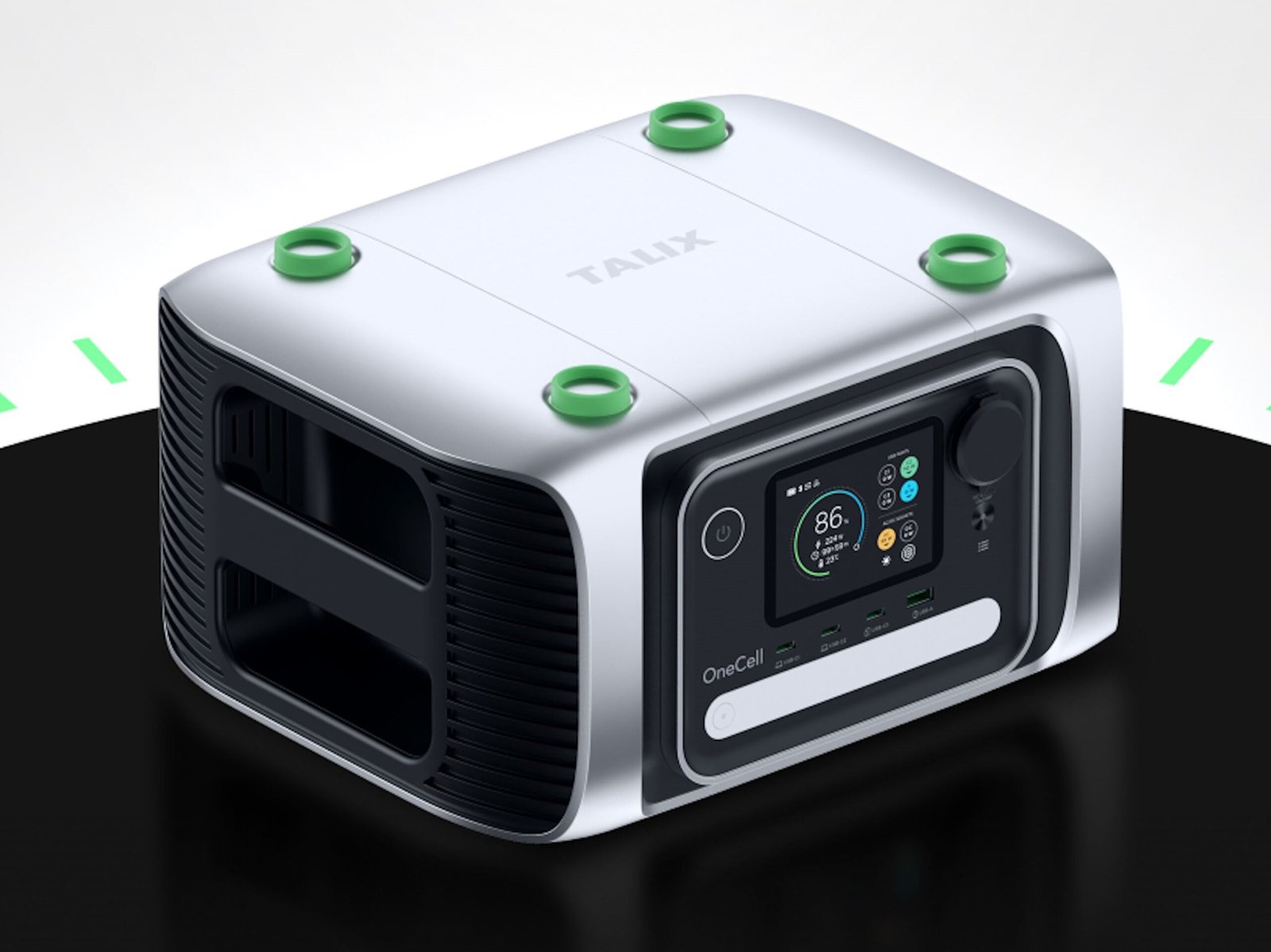
The Lenovo Talix Zeta promises extremely high durability and is designed to store a significant amount of energy. The capacity can be expanded considerably, while the new power station can also be connected to an accompanying smartphone app.
The Talix Zeta is a new power station that was apparently developed in cooperation with Lenovo. The Talix Zeta comes with a capacity of 1kWh and can be expanded with three additional batteries to up to 4kWh. Lithium iron phosphate battery cells are supposed to offer a lifespan of more than 20 years. According to the manufacturer, 70% of capacity remain after 8,000 charging cycles.
The maximum output power via the AC outlet is specified as up to 300 watts, which can increase to 1,200 watts when four units are combined. Therefore, very power-hungry devices cannot be operated with just a single power station. Either way, up to 240 watts can be provided via USB Type-C and USB PD 3.2, which should be high enough for many regular laptops that support charging via USB-C. There are also USB Type-A ports with a maximum output of 12 watts.
The Talix Zeta itself can also be charged via USB Type-C via a suitable power adapter. Charging via solar panels is also supported, which can be very useful when camping. Charging from the power grid via USB Type-C takes place at up to 240 watts or up to 300 watts via an AC outlet. However, the maximum solar charging speed is relatively low at just 110 watts.
Talix has not provided pricing details thus far. The power station will be financed as part of a crowdfunding campaign, and a version for the European market is also planned. Deliveries will kick off in May 2026.
Related Articles
Editor of the original article: Silvio Werner – Senior Tech Writer – 16106 articles published on Notebookcheck since 2017
I have been active as a journalist for over 10 years, most of it in the field of technology. I worked for Tom’s Hardware and ComputerBase, among others, and have been working for Notebookcheck since 2017. My current focus is particularly on mini PCs and single-board computers such as the Raspberry Pi – so in other words, compact systems with a lot of potential. In addition, I have a soft spot for all kinds of wearables, especially smartwatches. My main profession is as a laboratory engineer, which is why neither scientific contexts nor the interpretation of complex measurements are foreign to me.
Translator: Enrico Frahn – Managing Editor Accessory Reviews, Tech Writer – 5951 articles published on Notebookcheck since 2021
My fascination for technology goes back a long way to the Pentium II era. Modding, overclocking and treasuring computer hardware has since become an integral part of my life. As a student, I further developed a keen interest in mobile technologies that can make the stressful college life so much easier. After I fell in love with the creation of digital content while working in a marketing position, I now scour the web to bring you the most exciting topics in the world of tech. Outside the office, I’m particularly passionate about motorsports and mountain biking.
Silvio Werner, 2025-12-22 (Update: 2025-12-22)


