

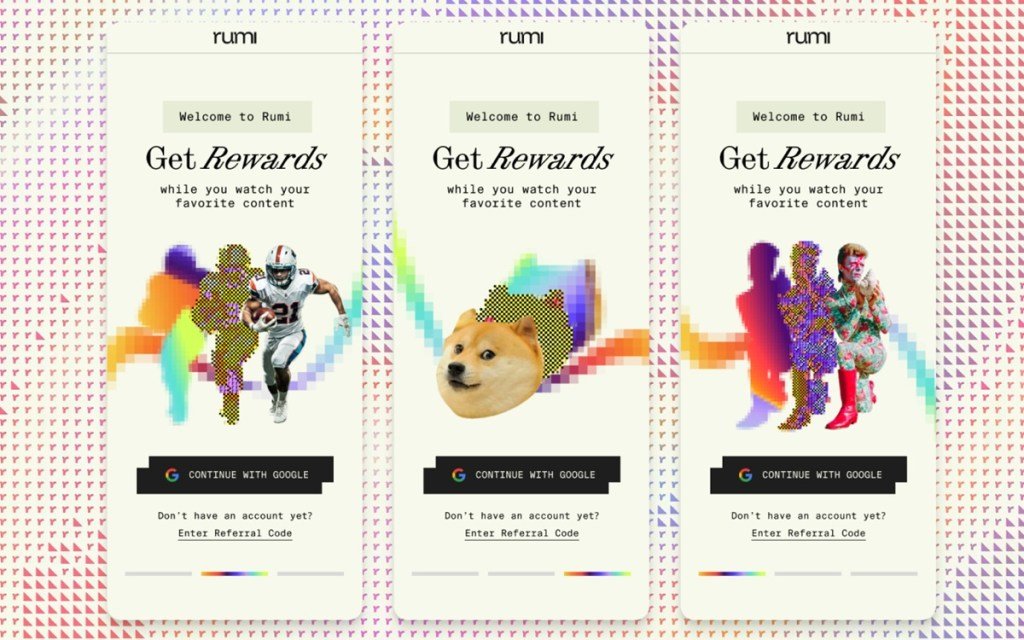
Rumi raises $4.7M to change passive media into interactive AI experiences
Rumi is making passive media into interactive media with rewards and AI.
Image Credit: Rumi
How would you like to earn money while watching TV? Rumi, an AI media company, has raised $4.7 million in a pre-seed funding round to transform passive media with rewards.
Rumi is launching its invite-only beta app today and it aims to allows users to engage with media content in real time.
The round, co-led by A16z crypto CSX and EV3, will support Rumi’s mission to build the first decentralized AI infrastructure for media, combining cutting-edge artificial intelligence with user-powered indexing to transform streaming into an intelligent, interactive experience.
Viewers can chat with characters or pro sports athletes about what they’re doing on the screen, identify actors and outfits on screen, or receive real-time fact checks during heated political debates — all powered by AI.
“Rumi sits at the cutting edge of AI agents, consumer media and decentralized infrastructure,” said Salvador Gala, cofounder of EV3, in a statement. “Their approach to indexing audio and video content through a distributed network of AI-powered nodes empowers users to directly benefit from existing behaviors.”
Streaming meets earning
With users spending more than five hours a day watching content — often while multitasking — Rumi allows them to earn passive income by contributing spare compute to build the world’s richest knowledge base on video content that in turn allows AI agents to deeply understand and augment media in ways we can’t even imagine yet, the company said.
“AI can make storytelling truly immersive — but it first needs to understand the world’s content and culture to do so,” said Niko Cunningham, CEO of Rumi, in a statement. “Rumi is building that infrastructure and giving users a way to be part of it from day one.”
This decentralized indexing system helps AI agents deliver smarter insights and personalized features such as contextual overlays, real-time cultural context and interactive recommendations, while protecting user privacy and respecting content IP.
Business model and partnerships
Rumi is licensing infrastructure to third party AI agents, developers, and creators, providing agents brand new functionality and monetization opportunities. Those opportunities include contextual ads which, from the viewer’s perspective, can be seamlessly integrated in the conversation with AI agents, and much more value-adding. Agents can organically surface recipe cards during cooking shows or fashion links tied to what characters are wearing on the screen.
Rumi is also building a “decentralized Nielsen,” offering real-time analytics and audience insights. Early partnerships include Virtuals.io, who will integrate Rumi’s APIs to provide agents using their platform media contextual-awareness and interactivity capabilities, in addition to TVision and Story Protocol who will rely on Rumi to provide unique viewership data and content analytics.
Rumi is now welcoming early users to its watch-to-earn beta, allowing participants to help build what it calls the first intelligent, user-powered media ecosystem. Sign up at https://www.rumilabs.io.
How Rumi works
Infrastructure allowing AI to understand human stories and culture locked in billions of hours of video.
Imagine having an entire cast and crew, commentators, shopping assistants, fact-checkers, researchers, and writers in your living room — sitting on your couch with you as you watch your favorite movies, shows, sports, news. That’s media contextually-aware AI. To enable that future, the company built a decentralized network of indexers analyzing content as they watch, and getting compensated for their work and compute.
Over time, the company plans to use the money to bring to market the world’s best AI architecture for distilling the story from video: relations between actions, characters, objects; story / character arcs — mapping, understanding and AI participating in the world’s stories — not just documents and facts like today’s current LLMs.
The company is building infrastructure to support Live TV / sports (vs historical content that are covering now) and to build a brand-new gateway to media, D2C app — first ever AI remote and media companion.
How the “watch-to-earn” model works
Users get paid for their compute and data contributions. They are providing value by analyzing video content and interacting with it on their machines.
That data is valuable because it empowers the next generation of AI agents that can identify and deeply understand content, providing them the ability to augment and personalize content for you, and turn passive media into interactive experience.
The viewership analytics data that we’re collecting on how people interact with content at the depth never reached before, is also used to improve content and advertising quality.
The company said it will help individual creators and Hollywood studios improve quality of storytelling, as Rumi is collecting the richest and most granular trove of data on what resonates with people — stories, characters, objects.
Rumi said it will boost advertisers’ return-on-investment by enabling contextual, agentic ads, that are more personalized and valuable to consumer, and feel seamless, organic — embedded in the natural conversation flow… ads that don’t feel like ads. Of course, people have to agree to the privacy policies of the company.
As far as the target audience goes, Rumi said anyone with a computer and access to streaming platforms can join our network today and get rewarded for their contributions to enabling the AI-powered Media future. The company is primarily focused on Web3 users, as they’re used to the model of sharing their spare resources, such as compute power or bandwidth, in exchange for points or tokens.
Rival companies
There are a few decentralized networks paying people for their compute resources to train AI models or run inference, such as Bittensor, Akash, or Render.
However, Rumi said it is focused on video understanding and have built its proprietary deep learning models and architectures that allow it to distill the essence of the story from the video, which Rumi believes will be critical for AI to truly understand the stories humans care about and how they connect to our culture, building up towards more human AI.
Rumi makes money by providing media contextual awareness to AI Agents, allowing them to become way more than simple bots on social media. Rumi charges them for accessing its APIs and serve their end users contextual Ads.
It’s also selling viewership data and analytics to media companies, advertisers, AI Labs, and other parties interested in understanding how consumers interact with content (on which they spend perhaps five hours a day).
Content licensing and rights management policies for AI
Rumi said it is never storing, rebroadcasting nor exposing any actual IP-protected content. Its decentralized network is indexing it in similar fashion that Google indexed web pages.
The company said it will never train any AI models on that IP-protected content. It is building infrastructure that benefits IP owners: Rumi gives them a brand new direct channel of communication with their audiences, via which they can deepen the consumer engagement in ways unimaginable before, and access new monetization opportunities.
Courts have repeatedly upheld that publishing granular transcriptions or summaries of video content qualify as fair use—as seen in Google Books (Authors Guild v. Google), where digitizing and displaying searchable snippets of entire books was ruled transformative. And the same held in TVEyes v. Fox, where indexing and repurposing broadcast content for search and review was partially upheld as fair use.
Rumi’s network of indexers transcribes content, but it doesn’t publish it to the public. Rumi’s protocol only exposes APIs to allow AI Agents to interact with that transcript and content fingerprint, prompt by prompt.
Rumi said this opens endless opportunities for creators to make their content more personalized and interactive, so it ultimately benefits the IP owners, as they direct channels of communication with their audiences, which they can monetize.
Why now? What macro trends are converging that make Rumi viable today?
Consumers want more interactive, connected, personalized and immersive entertainment. It’s clear looking at the growth of gaming, social media, and the massive second screening trend: 80% of Gen Zs report constantly scrolling through their phones while watching TV.
Consumer AI agents are about to boom, but they will not start with high stakes use cases like planning and paying for your vacation. They will start in your living room, making your entertainment more immersive, connected and educational. Tech is finally ready, and anyone can analyze content on their device, contribute to more immersive and personalized future of media, and earn while doing that, Rumi said.
GB Daily
Stay in the know! Get the latest news in your inbox daily
Read our Privacy Policy
Thanks for subscribing. Check out more VB newsletters here.
An error occured.
